

Cisco 8300 Series is a high-performance secure routing family designed for large enterprise branches that need routing, SD-WAN, encrypted WAN connectivity, segmentation, and integrated security on the same platform. Cisco currently markets the family as Cisco 8300 Series Secure Routers, with both fixed and modular models for different branch architectures.
Compared with smaller branch platforms, Cisco 8300 Routers are aimed at sites with more users, heavier application traffic, higher VPN demand, and stronger expansion requirements. Choosing the correct part number therefore depends on interface density, modularity, security performance, operating mode, and software entitlement rather than bandwidth alone.
Series Highlights
- Secure routing and SD-WAN for large branches
- Hardware-accelerated networking and security
- Integrated NGFW and threat-protection capabilities
- 10G and multigigabit connectivity
- Fixed and modular hardware options
- 5G cellular support through compatible modules
- Platform-based software licensing
- Routing Advantage and WAN Essentials/Advantage options
- Cloud, controller-based, or on-premises management
Review Cisco 8300 Series Price List and request a quote tailored to your licensing needs.
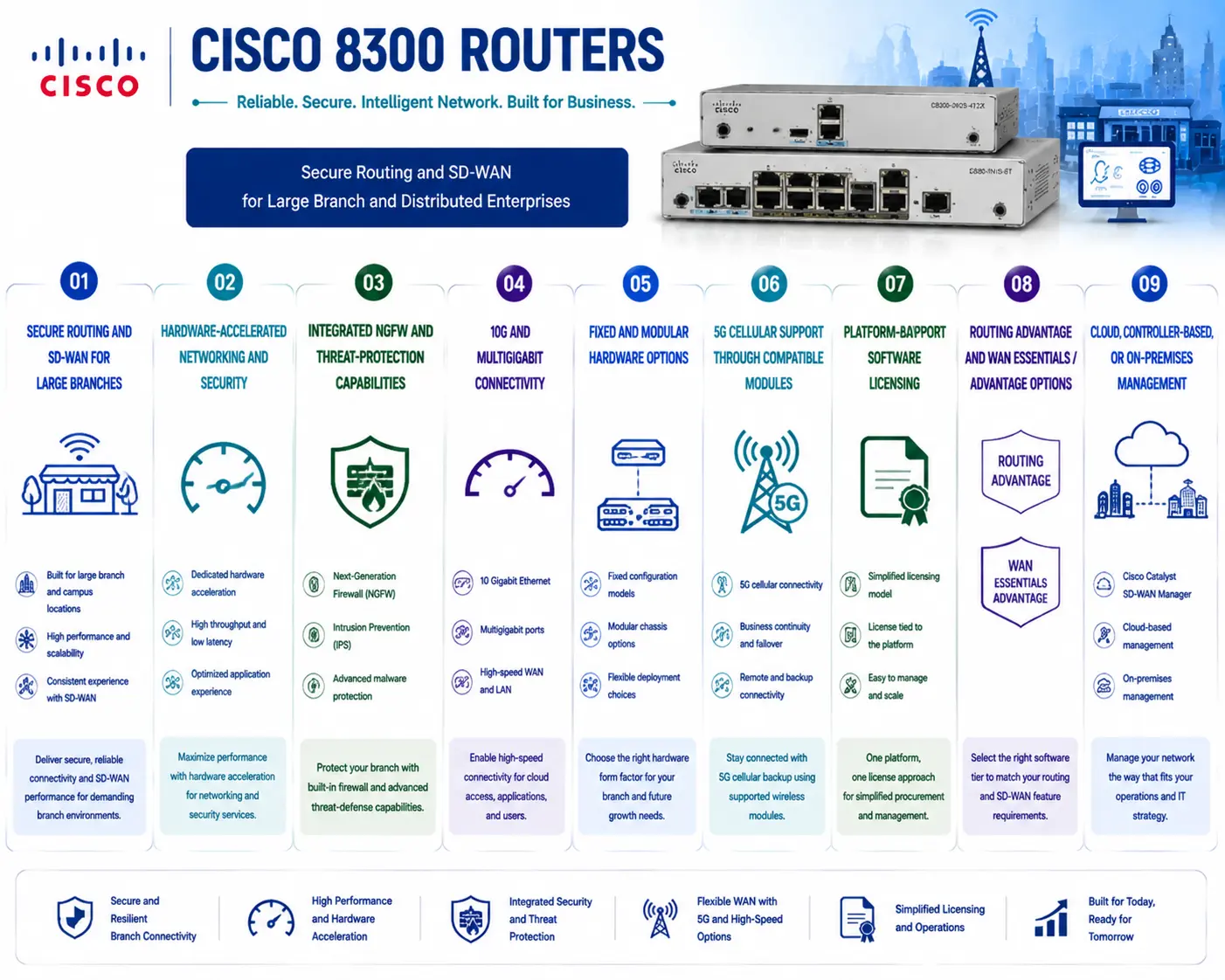
Cisco 8300 Series At a glance
What it is: Large-branch secure WAN edge router family
Product family: Cisco 8000 Series Secure Routers
Typical use: Large branches, SD-WAN, VPN, direct internet access, segmentation, and secure application connectivity
Software: Cisco IOS XE
Operating modes: Autonomous routing, SD-Routing, and Catalyst SD-WAN
Current platform class: Large
License model: Platform-based routing and WAN subscriptions
Ordering scope: Router model, interfaces, expansion modules, cellular, license tier, power, optics, and accessories
Series Overview
The current Cisco 8300 Secure Routers include C8375-E-G2, C8355-G2, and C8355-G2-MX. The C8375-E-G2 is modular, with one Service Module slot, one Network Interface Module slot, a PIM slot, two 10G SFP/SFP+ interfaces, and four 2.5G multigigabit ports. The C8355-G2 uses a fixed design with 10G SFP/SFP+, 5G multigigabit, and 1G interfaces.
Both main platforms reach up to 38 Gbps forwarding and 20 Gbps IPsec in Cisco’s published tests, although SD-WAN and threat-protection performance differ by model and enabled services. Real sizing should therefore consider actual traffic rather than headline forwarding numbers alone.
Licensing and Part Number Guidance
Cisco 8300 Series uses Cisco’s current platform-based licensing model within the broader Cisco Router License category. The C8355-G2 and C8375-E-G2 belong to the Large platform class, so compatible subscriptions are assigned according to that class rather than bandwidth tier. Licenses can also be portable between eligible devices within the same platform class.
Cisco Routing OS Essentials is included with the hardware for fundamental autonomous-routing functions. For more advanced traditional routing, organizations can select Cisco Routing Advantage. SD-Routing and Catalyst SD-WAN environments use Cisco WAN Essentials or Cisco WAN Advantage subscriptions. Cisco does not require a separate HSEC/HSECK9 license for the 8000 Series Secure Router generation.
Part-number selection must still include the hardware architecture. A modular C8375-E-G2 may suit a site that needs NIM, SM, or cellular expansion, while the fixed C8355-G2 may be better where integrated high-speed interfaces are sufficient.
Common Use Cases
| Use case | Typical requirement |
|---|---|
| Large branch | High-throughput secure WAN connectivity |
| Catalyst SD-WAN | Central policy and intelligent path selection |
| Direct internet access | NGFW, IPS, URL filtering, and secure connectivity |
| Segmented branch | Multiple VRFs and policy-controlled network zones |
| Modular deployment | Voice, WAN, cellular, or service-module expansion |
| High VPN demand | Hardware-accelerated IPsec connectivity |
Models, Licenses, and Ordering Scope
| Area | What to confirm |
|---|---|
| Model | C8355-G2, C8355-G2-MX, or C8375-E-G2 |
| Architecture | Fixed or modular |
| Interfaces | 1G, 2.5G/5G mGig, or 10G |
| Expansion | NIM, SM, or PIM requirements |
| Cellular | LTE or 5G requirement |
| Mode | Autonomous, SD-Routing, or Catalyst SD-WAN |
| License | Routing OS Essentials, Routing Advantage, WAN Essentials, or WAN Advantage |
| Accessories | Modules, power, optics, storage, cables, and mounting |
What to Check Before Requesting a Quote
Start with the branch role, expected throughput, number of users, WAN circuits, VPN demand, security services, and interface requirements. Then determine whether fixed interfaces are sufficient or whether NIM, SM, cellular, or other expansion is required.
For an existing Cisco environment, also provide the current router, software release, management platform, and Smart Account details. This helps avoid choosing unnecessary hardware or the wrong Large-class subscription.
Activation and Delivery Notes
Cisco 8300 Secure Routers use Cisco Smart Account and Virtual Account infrastructure for subscription management. SD-WAN and SD-Routing entitlements are assigned through Cisco Catalyst SD-WAN Manager, while autonomous deployments use the corresponding routing-license workflow. Cisco also applies Day-0 license enforcement to 8000 Series Secure Routers beginning with IOS XE 17.18.1a, so the required subscription should be available before deployment or applicable software upgrades.
Cisco Router pricing depends on your router series, license type, deployment model and support requirements.