

Cisco Catalyst 8000V is a virtualized edge-routing platform based on Cisco IOS XE, designed to provide enterprise routing, SD-WAN, VPN, security, and cloud-connectivity capabilities as software rather than as a dedicated physical router. It can run on supported virtual infrastructure and cloud environments, making it suitable for organizations that need a software-defined WAN or routing edge without deploying a physical Catalyst 8000 appliance.
Cisco Catalyst 8000V can operate in autonomous routing or controller-managed environments, depending on the deployment architecture. Licensing and throughput must be considered together because the available functionality and configured bandwidth depend on the selected license level and software release. Cisco currently documents Network Essentials, Network Advantage, and Network Premier network-stack licenses with corresponding DNA add-on licenses for Catalyst 8000V.
Series Highlights
- Virtual edge-routing platform based on Cisco IOS XE
- Designed for enterprise WAN, SD-WAN, cloud, and branch connectivity
- Can run on supported virtual infrastructure and cloud environments
- Supports autonomous routing and controller-managed deployment models
- Network Essentials, Network Advantage, and Network Premier license levels
- Cisco DNA Essentials, Advantage, and Premier add-on subscriptions
- Throughput can be configured using numeric or tier-based licensing
- HSECK9 provides additional cryptographic capability where required
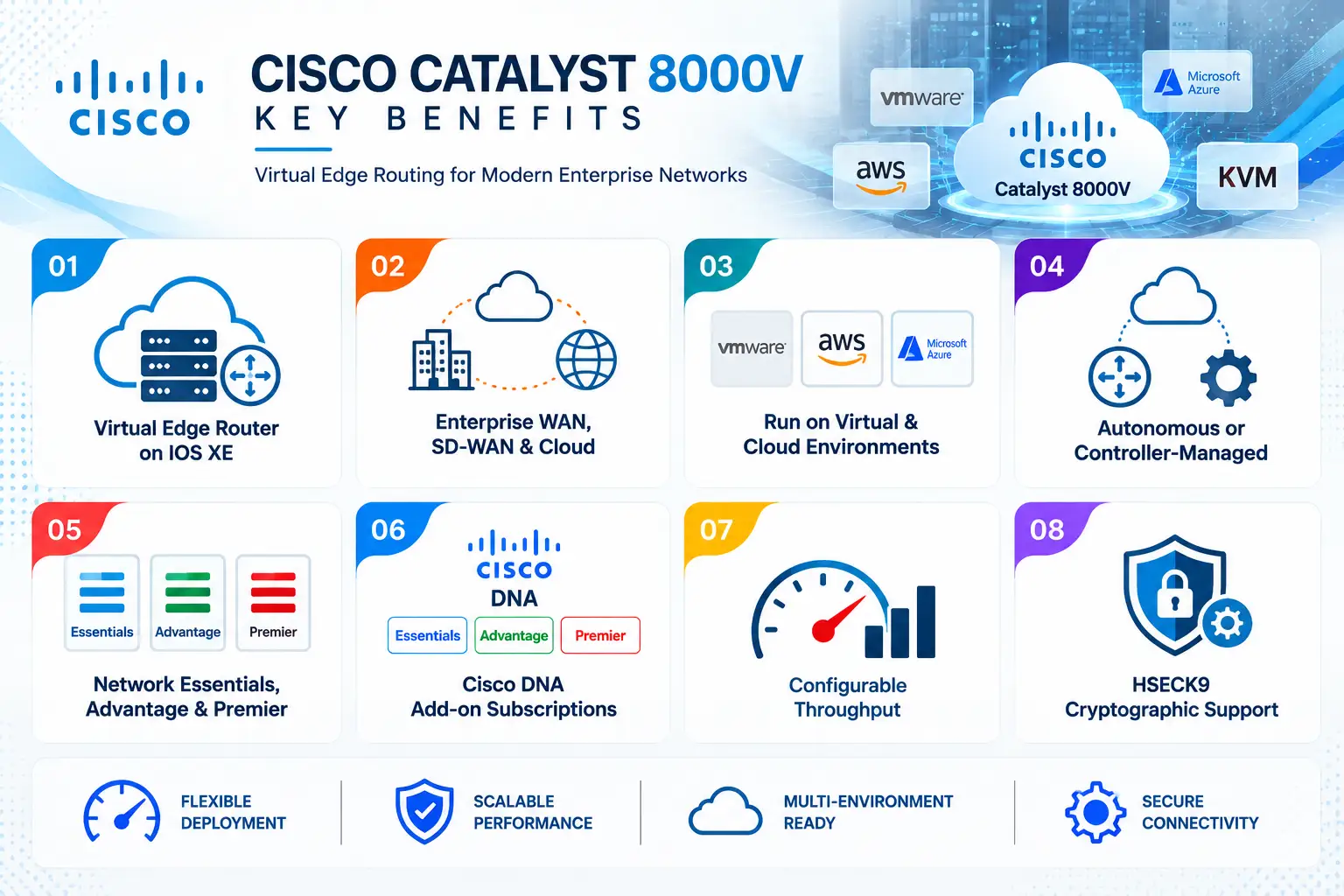
Cisco Catalyst 8000V At a glance
What it is: Virtualized Cisco Catalyst 8000 Edge platform running Cisco IOS XE.
Product family: Cisco Catalyst 8000 Edge Platforms
Typical use: SD-WAN edge, virtual branch routing, cloud connectivity, enterprise WAN, VPN, and virtual network edge deployments.
Deployment: Virtual machine or supported cloud environment.
Software: Cisco IOS XE.
License scope: Network-stack license, DNA-stack add-on, throughput entitlement, HSECK9 where required, and applicable feature licenses.
License levels: Network Essentials, Network Advantage, and Network Premier.
Throughput: Numeric or tier-based depending on the supported software release and license configuration.
Management: Cisco Catalyst SD-WAN Manager or traditional IOS XE management, depending on deployment mode.
Who needs it: Organizations requiring a virtual enterprise edge router for cloud, SD-WAN, branch, or hybrid network deployments.

Series Overview
Cisco Catalyst 8000V provides the routing and WAN capabilities of the Catalyst 8000 Edge platform in a virtualized form. Instead of purchasing a dedicated hardware appliance, organizations can deploy the software on supported virtual infrastructure or cloud platforms and allocate resources according to their architecture.
This makes the platform particularly relevant for environments where routing needs to be positioned close to cloud workloads, virtualized data centers, branch applications, or distributed enterprise services.
In a typical deployment, Catalyst 8000V can establish routing relationships between enterprise networks, cloud resources, branch locations, data centers, and internet connections. It can also participate in Cisco SD-WAN architectures when deployed in the appropriate controller-managed mode.
The virtual architecture also changes how capacity should be planned. CPU, memory, virtual interfaces, network connectivity, throughput, software tier, and licensing must be considered together rather than selecting a physical chassis and fixed interface configuration.
Licensing and Throughput Guidance
Choosing the correct Cisco Catalyst 8000V license depends on the required software functionality, deployment mode, throughput, and subscription requirements.
Cisco documents three network-stack license levels for Catalyst 8000V:
- Network Essentials
- Network Advantage
- Network Premier
Each network-stack level has a corresponding Cisco DNA add-on:
- DNA Essentials
- DNA Advantage
- DNA Premier
Cisco describes the network-stack license as perpetual, while the corresponding DNA-stack add-on is subscription or term based. Cisco currently documents 3-year and 5-year options for all DNA add-ons and 7-year options for certain add-ons.
Throughput is another major ordering consideration. Catalyst 8000V supports both numeric and tier-based throughput configurations in supported releases. The tier model includes Tier 0, Tier 1, Tier 2, and Tier 3.
Organizations requiring higher encrypted throughput may also need the HSECK9 license. Cisco documents HSECK9 as an export-controlled license required for full cryptographic functionality, including throughput above 250 Mbps and higher tunnel-count requirements.
Common Use Cases
| Use Case | Why It Matters |
|---|---|
| Virtual SD-WAN Edge | Provides a software-based edge for Cisco SD-WAN deployments without requiring a dedicated physical router |
| Cloud Connectivity | Provides routing between enterprise networks and cloud workloads |
| Virtual Branch Router | Extends routing and WAN capabilities to virtualized branch environments |
| Hybrid WAN | Connects physical, virtual, cloud, and internet-based network segments |
| VPN Gateway | Supports encrypted connectivity between sites and network environments |
| Data Center Edge | Provides virtual routing at the boundary of virtualized infrastructure |
| Cloud-Native Networking | Places routing capabilities close to applications and workloads |
| Network Migration | Provides a software-based routing platform during transitions between physical and virtual architectures |
Models, Licenses, and Ordering Scope
| Area to Check | What to Confirm |
|---|---|
| Deployment Model | Virtual infrastructure, cloud environment, autonomous mode, or controller-managed SD-WAN |
| Network-Stack License | Network Essentials, Network Advantage, or Network Premier |
| DNA Add-On | DNA Essentials, DNA Advantage, or DNA Premier corresponding to the network stack |
| Throughput | Required numeric bandwidth or applicable Tier 0–Tier 3 entitlement |
| HSECK9 | Whether higher encrypted throughput or additional tunnel capacity requires HSECK9 |
| Software Version | Cisco IOS XE release and compatibility with required licensing features |
| Virtual Resources | CPU, memory, virtual interfaces, and hypervisor or cloud requirements |
| Management | Cisco Catalyst SD-WAN Manager or traditional IOS XE management |
| Term | Required subscription duration for DNA-stack licensing |
| Smart Account | Smart Account and Virtual Account readiness for applicable licensing |
| Additional Services | UBE, CME, SRST, or other supported feature-specific licensing requirements |
Cisco’s current documentation states that Cisco DNA licensing combines multiple feature-specific licenses, while HSECK9, UBE, CME, and SRST remain separate from the DNA license.
What to Check Before Requesting a Quote
Before requesting a quote for Cisco Catalyst 8000V, first define the deployment architecture.
Confirm whether the instance will operate as a traditional virtual IOS XE router, as part of a Cisco Catalyst SD-WAN deployment, or within a hybrid design.
The next step is to determine the required throughput. This should include normal traffic, peak traffic, encrypted traffic, and expected growth. Throughput should not be selected independently from the license tier because Cisco associates the available throughput configuration with the applicable licensing model.
Also confirm:
- Network Essentials, Advantage, or Premier requirement
- Corresponding DNA subscription
- Numeric or tier-based throughput
- HSECK9 requirement
- VPN and tunnel requirements
- Cloud or hypervisor platform
- CPU and memory allocation
- SD-WAN controller requirements
- Smart Account and Virtual Account status
- Subscription duration
- Additional feature licenses
For environments using more than 250 Mbps of throughput or requiring higher cryptographic capacity, the HSECK9 requirement should be checked carefully before ordering. Cisco also documents specific throughput and tunnel restrictions when HSECK9 is not available.
Activation and Delivery Notes
After the correct Cisco Catalyst 8000V licensing configuration is selected, the software must be deployed on the supported virtual or cloud infrastructure and the applicable license level must be configured.
Cisco’s documented workflow includes configuring the boot-level network-stack license together with its corresponding DNA add-on. After the license configuration is saved, a reload is required for the configured boot-level changes to become effective. The show version and show license summary commands can then be used to verify the configured license and usage status.
For example, a Network Advantage deployment uses the corresponding DNA Advantage add-on. The same relationship applies to Network Essentials/DNA Essentials and Network Premier/DNA Premier.
After activation, administrators should validate:
- License level
- DNA subscription
- Throughput configuration
- HSECK9 status
- Smart Account assignment
- Virtual Account assignment
- Software version
- SD-WAN controller connectivity where applicable
- Virtual interface configuration
- VPN and routing functionality
Cisco Catalyst 8000V Pricing and Quote
Cisco Catalyst 8000V pricing depends on the selected network-stack level, DNA subscription, throughput, deployment model, HSECK9 requirement, additional feature licenses, and subscription term.
For an accurate quotation, provide:
- Required Catalyst 8000V deployment count
- Deployment platform
- Autonomous or SD-WAN mode
- Required throughput
- Encrypted traffic requirements
- Network Essentials, Advantage, or Premier
- Corresponding DNA subscription
- HSECK9 requirement
- Required UBE, CME, or SRST features
- Subscription duration
- Support requirements
The licensing configuration should be calculated from the actual virtual-router workload rather than simply counting the number of branch locations.
Cisco Catalyst 8000 pricing depends on your router series, license type, deployment model and support requirements.