

VMware NSX provides software-defined networking for virtualized infrastructure, with centrally managed connectivity and policy. A VMware NSX license assessment should separate networking requirements from separately entitled security services. Compare the target release, existing VMware licensing, and required capabilities before selecting a subscription or planning an upgrade.
Quick Benefits
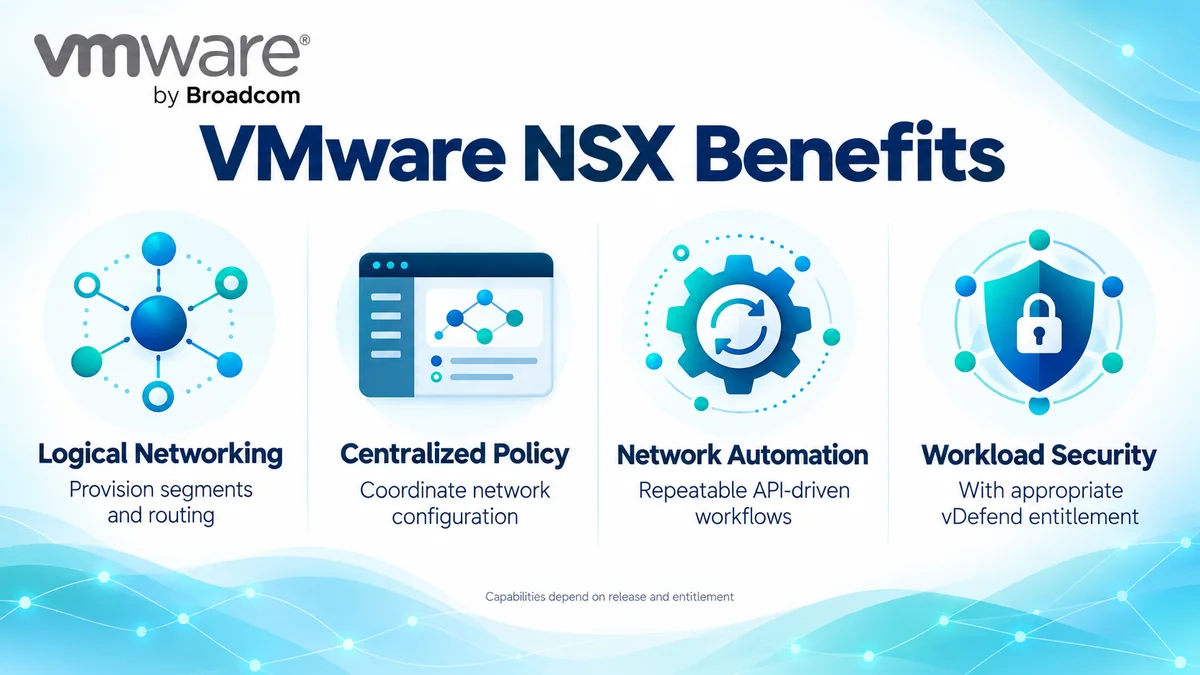
- Provision logical networks across supported infrastructure
- Coordinate switching and routing policies centrally
- Automate repeatable network configuration
- Connect virtual workloads to external networks
- Plan security capabilities against explicit entitlements
At a Glance
- Vendor: VMware by Broadcom
- Product family: VMware License
- Deployment: Software-defined networking on supported infrastructure
- Core elements: NSX Manager, transport nodes, and Edge services
- Commercial scope: Platform networking and applicable security add-ons
- Quote inputs: Release, host/core inventory, topology, and required services

Features & Benefits
Logical Switching and Routing
NSX creates logical segments and routing services over a supported physical underlay. Tier-0 and Tier-1 gateway designs organize connectivity between workloads and external networks. This helps teams provision network services consistently while retaining responsibility for underlay reachability, capacity, and resilience.
Centralized Policy and Automation
NSX Manager provides a common control point for network configuration and operational visibility. APIs support integration with provisioning workflows, reducing repeated manual configuration. Standardized policies help infrastructure teams coordinate changes across hosts and application environments without treating every network request as a separate physical-device task.
Workload Security with Appropriate Entitlements
Where purchased and supported, VMware vDefend services provide firewalling and microsegmentation capabilities managed within the NSX environment. Review distributed and gateway security requirements separately from base networking. A networking entitlement alone does not establish access to every firewall, threat-prevention, or inspection capability.
License Overview
NSX networking is included within VMware Cloud Foundation, while the exact security scope depends on the purchased entitlements. Current VCF subscriptions use physical-core capacity with a documented minimum of 16 licensed cores per physical processor. Confirm host coverage and current order terms; do not size the proposal from virtual machine count alone.
Legacy NSX editions and existing keys require release-specific review. Older edition names do not establish current availability, support eligibility, or rights to additional security services.
Product Overview
NSX separates logical networking from much of its physical configuration. Transport nodes implement the data plane, while Edge nodes provide services required by the selected routing architecture. For the underlying virtualization requirement, review VMware vSphere. NSX also sits within the wider Network License portfolio.
Core Technical Flow
Administrators define segments, gateways, and policies through NSX Manager or APIs. Transport nodes realize the configuration. Overlay traffic crosses the physical underlay between tunnel endpoints; routed traffic uses the configured gateway path. External connectivity and centralized services depend on the Edge design, with security enforced only where configured and entitled.
Options & Licensing Models
Build the proposal around the required service scope. Confirm release-specific dependencies before ordering.
| Scope | Buyer Assessment |
|---|---|
| NSX networking within VCF | Base platform entitlement, physical cores, supported release, and topology |
| vDefend Distributed Firewall | Workload firewall and microsegmentation requirements; separate entitlement review |
| vDefend Gateway Firewall | Gateway security needs, deployment architecture, and applicable licensing |
| Existing NSX environment | Installed release, existing rights, support, and migration path |
Compatibility & Requirements
Validate NSX, vCenter, hypervisor, and VCF interoperability for the intended release. Check supported adapters, drivers, firmware, and Edge deployment requirements. Review underlay MTU, tunnel-endpoint connectivity, routing, DNS, NTP, certificates, and management access. Legacy NSX-V designs need a migration assessment rather than assumptions of direct compatibility.
Activation & Deployment
Prepare Broadcom account access, Site ID, entitlement visibility, and management connectivity. Use the workflow for the purchased release: supported earlier deployments use applicable keys, while VCF 9 base licensing integrates through VCF Operations and vCenter. vDefend activation is separate; NSX 9.1 requires License Hub for its security features.
After registration, inspect licensing status in NSX Manager, confirm transport-node and Edge health, and test segment connectivity and routing. If security was purchased, validate a representative permitted and denied flow before expanding enforcement.
Pricing & Quote Process
Provide host, processor, and physical-core inventories, current NSX/VCF versions, and existing contract dates. Describe sites, clusters, Edge architecture, expected traffic, and growth. Capacity for traffic handling is a design input; it should not be confused with the license metric.
List networking, distributed firewall, gateway firewall, and advanced security requirements separately. Request a VMware NSX quote to review the appropriate base platform, add-ons, subscription term, support scope, and activation responsibilities.