

The family includes BIG-IP i11600 and BIG-IP i11800, representing the upper performance range of the iSeries appliance portfolio. These platforms were commonly deployed in large data centers, carrier environments, and organizations running multiple BIG-IP services where smaller appliances could not provide sufficient throughput or processing capacity.
Series Highlights
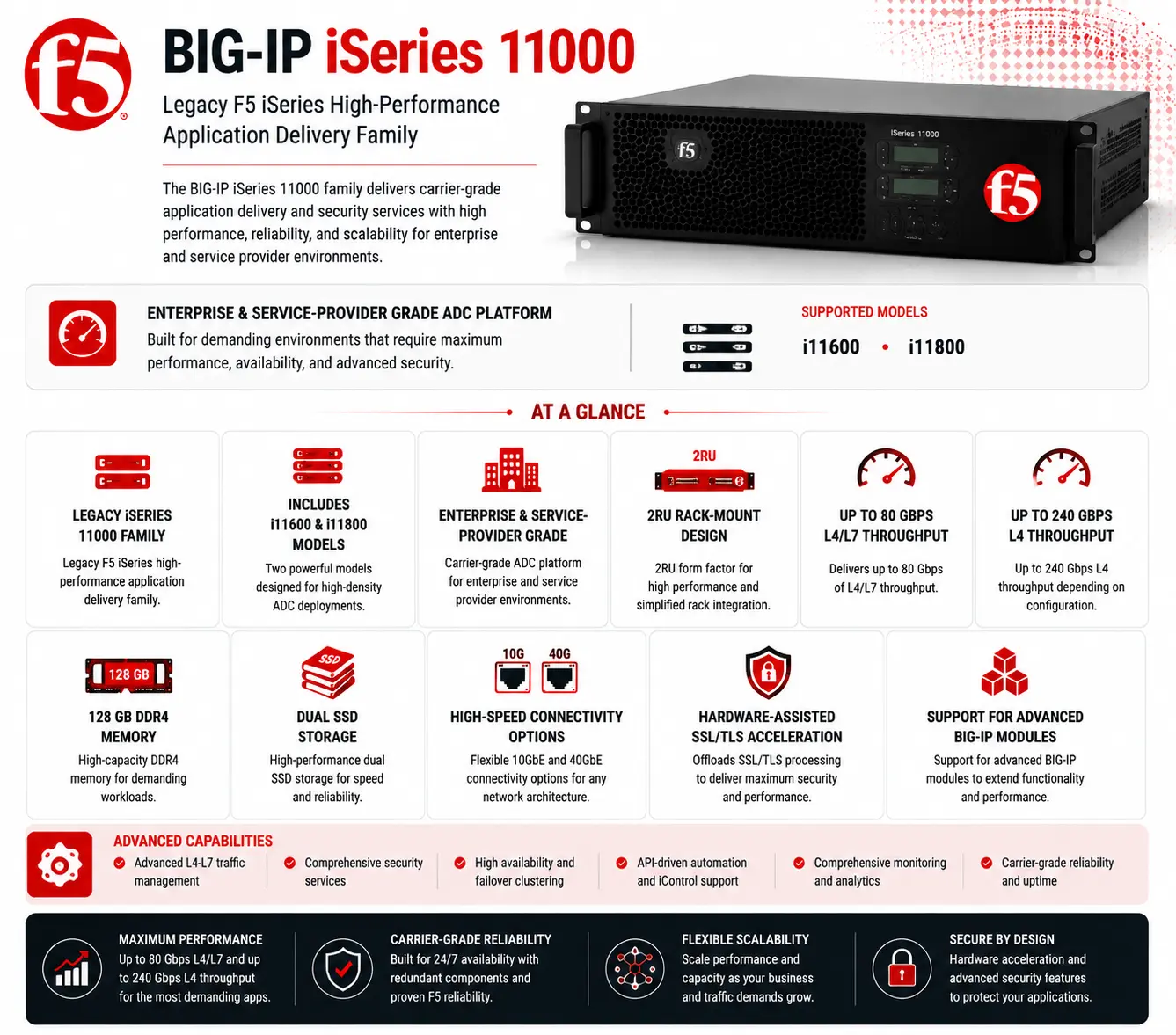
- Legacy F5 iSeries high-performance application delivery family
- Includes BIG-IP i11600 and BIG-IP i11800 models
- Enterprise and service-provider grade ADC platform
- 2RU rack-mount appliance design
- Up to 80 Gbps L4/L7 throughput
- Up to 240 Gbps L4 throughput depending on configuration
- 128 GB DDR4 memory
- Dual SSD storage
- High-speed 10GbE and 40GbE connectivity options
- Hardware-assisted SSL/TLS acceleration
- Support for advanced BIG-IP modules
Review BIG-IP i11000 Price List and request a quote tailored to your licensing needs.
BIG-IP i11000 At a glance
What it is: High-end F5 iSeries physical application delivery platform
Product family: BIG-IP iSeries
Models: i11600 and i11800
Software architecture: BIG-IP TMOS
Deployment type: Physical ADC appliance
Form factor: 2RU rack-mount
Memory: 128 GB DDR4
Storage: Dual SSD storage
Interfaces: High-speed 10GbE and 40GbE connectivity
Typical role: Enterprise ADC, SSL/TLS offload, application security, DNS, secure access, and large-scale traffic management
Series Overview
The BIG-IP i11000 family was created for environments where application traffic volumes and security requirements exceeded the capabilities of lower iSeries platforms.
Unlike smaller appliance families, i11000 systems were commonly used as core ADC platforms handling critical production applications. Their larger resource capacity allowed organizations to combine multiple BIG-IP services on one appliance while maintaining predictable performance.
The family consists of two main models:
| Model | Position |
|---|---|
| BIG-IP i11600 | High-performance enterprise model |
| BIG-IP i11800 | Highest capacity model in the family |
Both models share the same general appliance architecture, including a 2RU chassis, large memory capacity, SSD storage, and high-speed network connectivity. The primary difference between them is the licensed performance level and available processing capacity.
Typical i11000 deployments included:
- Enterprise application load balancing
- SSL/TLS termination
- Web application security
- Secure remote access
- Global traffic management
- Large-scale data-center application delivery
Because these appliances were often placed at critical network points, accurate identification of the installed model is important during support, renewal, and migration projects.
Licensing and Part Number Guidance
BIG-IP i11000 part numbers represent more than the physical appliance model. A complete configuration may include the BIG-IP License entitlement, enabled modules, support coverage, and accessories.
- Hardware platform
- BIG-IP software entitlement
- Enabled modules
- Support coverage
- Accessories and connectivity options
When reviewing an existing i11000 deployment, confirm the exact model first:
- i11600
- i11800
The model affects available throughput, SSL processing capability, and workload capacity.
Before requesting pricing, review:
- Current BIG-IP modules
- License registration details
- TMOS version
- Support contract status
- Application traffic profile
- SSL/TLS workload
- High availability configuration
The same hardware family can support different use cases depending on the enabled BIG-IP services. A platform running only LTM load balancing has different requirements compared with a system combining Advanced WAF, APM, DNS, and encrypted traffic inspection.
For organizations planning replacement, the decision should include both licensing requirements and future platform strategy.
Common Use Cases
| Use case | Typical i11000 role |
|---|---|
| Large enterprise ADC | High-volume application traffic management |
| Service provider infrastructure | Customer-facing application delivery |
| SSL/TLS acceleration | Dedicated encryption processing |
| Web application security | Advanced BIG-IP security services |
| Data-center core ADC | Central application traffic control |
| Secure access services | Identity-aware application connectivity |
| High availability platforms | Mission-critical application environments |
| Hardware refresh projects | Migration toward newer F5 systems |
Models, Licenses, and Ordering Scope
| Area | What to confirm |
|---|---|
| Model | i11600 or i11800 |
| BIG-IP services | LTM, DNS, APM, AFM, Advanced WAF |
| Traffic requirements | Throughput, connections, SSL demand |
| Software | TMOS compatibility |
| Network connectivity | 10GbE/40GbE requirements |
| Deployment | Standalone or HA configuration |
| Storage | SSD configuration |
| Support | Renewal or replacement requirements |
| Migration | Existing platform transition plan |
| Part numbers | Hardware, licenses, support, and accessories |
What to Check Before Requesting a Quote
For BIG-IP i11000 environments, the first step should be understanding the current production workload.
Before requesting a quote, verify:
- Installed model
- Current BIG-IP modules
- Application inventory
- Peak traffic volume
- SSL/TLS processing requirements
- Network interface usage
- HA configuration
- Future growth expectations
One of the common mistakes in ADC replacement projects is selecting a new platform only by comparing hardware numbers. Modern F5 platforms use different architectures, and resource allocation is handled differently compared with traditional iSeries appliances. For example, an i11800 running Advanced WAF, high SSL traffic, and multiple applications may require a different replacement design compared with an i11800 used mainly for LTM services.
Migration planning should include:
- Configuration migration
- License compatibility
- Software validation
- Application testing
- Maintenance window planning
- Rollback preparation
Activation and Delivery Notes
BIG-IP i11000 appliances use the traditional F5 TMOS architecture.
Deployment normally includes:
- Hardware installation
- License activation
- Module provisioning
- Network configuration
- Application policy migration
- HA validation
For redundant environments, both appliances should maintain compatible:
- Software versions
- Licenses
- Provisioning settings
- Network configuration
Unlike newer rSeries platforms, i11000 does not separate the hardware layer from BIG-IP workloads through F5OS and tenants. Therefore, migration to rSeries requires additional architecture planning.
Before delivery or replacement, confirm:
- Exact appliance model
- Required BIG-IP modules
- Support requirements
- Network interfaces
- Migration approach
F5 pricing depends on your product edition, license type, deployment model, traffic needs, term, and support requirements.