

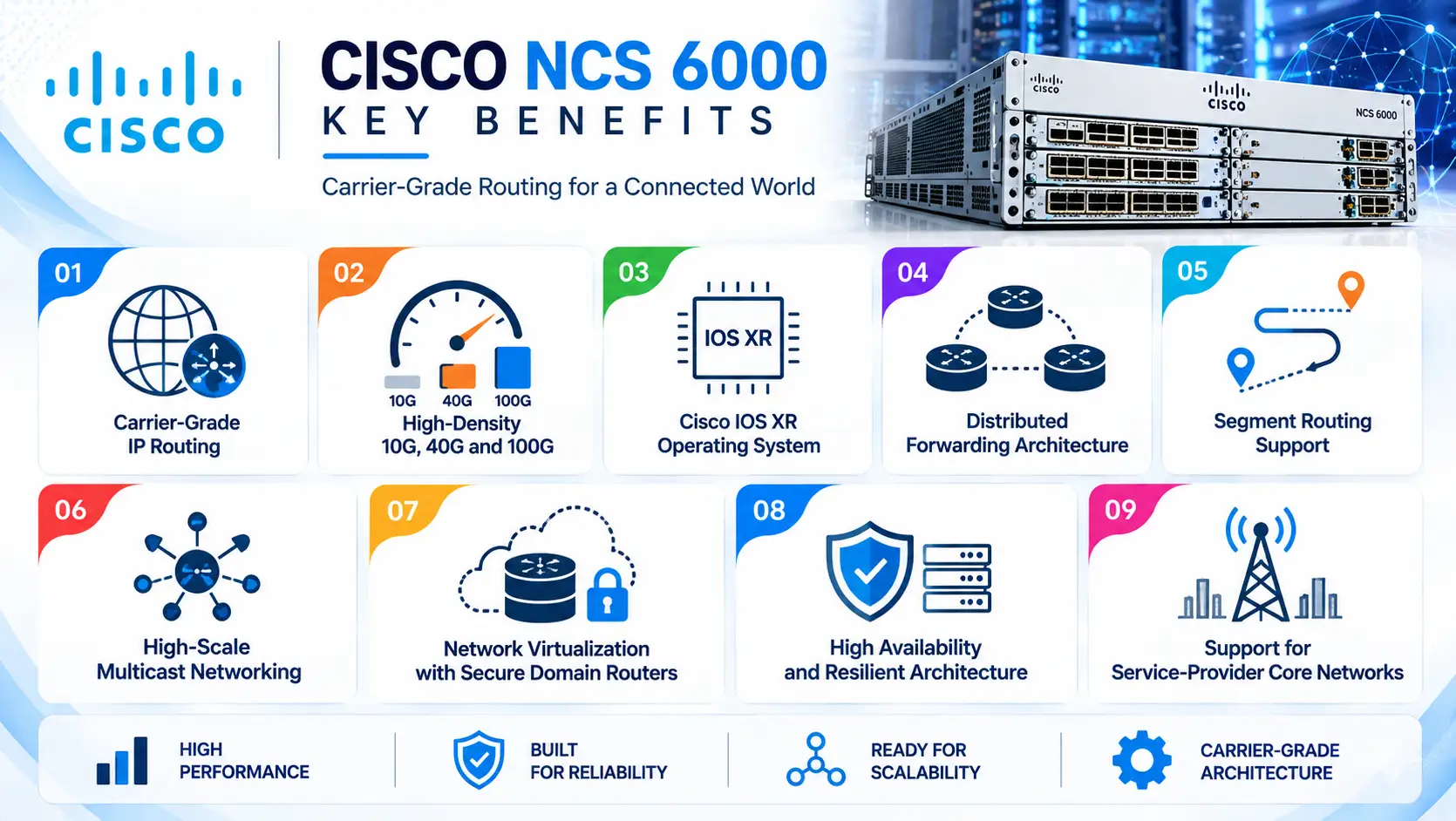
Cisco NCS 6000 is a carrier-grade routing platform designed for service-provider and large-scale network environments where high forwarding capacity, distributed architecture, MPLS, IP routing, and operational resiliency are required. The platform runs Cisco IOS XR and uses a distributed architecture in which forwarding decisions are performed on individual line cards while route processors manage the control plane.
Quick Benefits
- Carrier-grade IP routing
- High-density 10G, 40G and 100G connectivity
- Cisco IOS XR operating system
- Distributed forwarding architecture
- Segment Routing support on supported releases and configurations
- High-scale multicast networking
- Network virtualization through Secure Domain Routers
- High availability and resilient architecture
- Support for service-provider core networks
Cisco NCS 6000 At a Glance
What it is: Carrier-grade modular routing platform
Parent category: Cisco NCS License
Operating system: Cisco IOS XR
Primary role: Service-provider core, aggregation, and high-capacity IP/MPLS routing
Architecture: Distributed chassis-based routing platform
Forwarding technology: Cisco nPower Network Processor Units
Network technologies: IP, IPv6, MPLS, Segment Routing, multicast, QoS, and traffic engineering
Typical environments: Service-provider core, mobile backhaul, cloud transport, data-center interconnect, and large-scale WAN
Management: IOS XR CLI, NETCONF/YANG, XML, SNMP, model-driven telemetry, and supported management systems
License Overview
A Cisco NCS 6000 License defines the software capabilities and specific platform functions available on an NCS 6000 deployment. Because the NCS 6000 is a modular carrier-class system, licensing should be evaluated together with the selected chassis, line cards, IOS XR release, and required network functions.
The licensing model is different from the licensing structure used by newer Cisco platforms such as Catalyst 8000 or Cisco 8000 Series routers. NCS 6000 deployments can contain licenses associated with specific capabilities, line-card functions, multicast resources, and multichassis operation.
Before requesting a quote, confirm:
- NCS 6000 chassis model
- Route processor configuration
- Line-card models
- Port density
- Interface speeds
- IOS XR version
- MPLS requirements
- Multicast requirements
- Multichassis requirements
- Universal Fabric Card requirements
- Segment Routing requirements
How Cisco NCS 6000 Licensing Works
NCS 6000 licensing should be considered as part of the complete hardware and software architecture.
A typical planning process is:
Platform Selection
→ Select the NCS 6000 chassis and required system components
Line-Card Selection
→ Determine port density, interface speed, and forwarding requirements
IOS XR Selection
→ Confirm the software release and supported features
Feature Planning
→ Identify IP, MPLS, multicast, QoS, Segment Routing, and other requirements
License Identification
→ Match required functions with the applicable Cisco license or SKU
Hardware and Software Ordering
→ Build the complete bill of materials
Activation and Configuration
→ Install the software and configure the licensed capabilities
This process is particularly important for NCS 6000 because a license requirement can be associated with a specific hardware or service capability rather than simply the number of users or devices.
Cisco NCS 6000 Platform Overview
| Component | Primary Purpose |
|---|---|
| NCS 6000 Chassis | Provides the physical platform for route processors, fabric, line cards, power, and cooling |
| Route Processor | Provides control-plane processing and routing functions |
| Line Cards | Provide high-density network interfaces and distributed packet forwarding |
| Switching Fabric | Provides internal connectivity between line cards and system components |
| Cisco IOS XR | Provides the modular carrier-grade routing operating system |
| Cisco nPower NPU | Provides programmable high-performance packet forwarding |
| Optics | Connect line-card interfaces to transport and network infrastructure |
| Secure Domain Routers | Provide network virtualization and separation of routing domains |
| Management Interfaces | Support CLI, NETCONF/YANG, SNMP, telemetry, and other management mechanisms |
The NCS 6000 architecture is fully distributed: packet-forwarding decisions and actions occur on individual line cards, while the route processors independently manage the control plane.
Licensing Options and Models
| Licensing Area | Purpose | What to Check |
|---|---|---|
| Base Platform Entitlement | Enables the applicable software and platform functionality | Chassis and software configuration |
| Multiservice / MS Licensing | Provides broader multiservice functionality on supported configurations | Required services and line cards |
| LSR Licensing | Supports label-switch-routing-oriented deployments | MPLS and LSR requirements |
| UFC Licensing | Enables applicable Universal Fabric Card capabilities | UFC model and supported features |
| Multichassis Licensing | Enables supported NCS 6000 multichassis IOS XR capabilities | Number of ports and chassis architecture |
| Multicast Licensing | Provides applicable multicast scale or capability | Multicast requirements and line-card configuration |
| Feature-Specific Licensing | Enables selected platform capabilities | IOS XR release and feature requirements |
| Software Services | Provides applicable software support and update entitlements | Support contract and deployment requirements |
Cisco’s published NCS 6000 end-of-sale documentation provides examples of legacy SKUs including UFC licenses, NCS 6000 multichassis licenses, and an LSR-to-MS upgrade bundle.
Features and Benefits
Carrier-Grade Routing
NCS 6000 is designed for high-scale routing environments where traditional enterprise routers may not provide the required capacity or modularity.
The platform supports core routing technologies including:
- IPv4
- IPv6
- BGP
- OSPF
- OSPFv3
- IS-IS
- MPLS
- Multicast
- Segment Routing
- Traffic engineering
Cisco documentation for the NCS 6008 identifies BGPv4, OSPFv2, OSPFv3, IS-IS, MPLS, Segment Routing, and multiple multicast protocols among the supported networking capabilities.
Distributed Forwarding
The NCS 6000 uses a distributed forwarding architecture.
Instead of sending all packet-processing decisions through a centralized forwarding engine, individual line cards perform forwarding functions using their own network-processing resources.
This architecture allows the system to scale forwarding capacity as additional line cards are deployed.
Compatibility and Requirements
Before selecting a Cisco NCS 6000 License, organizations should evaluate:
- NCS 6000 chassis
- Route processors
- Fabric configuration
- Line-card models
- Interface density
- 10G, 40G, or 100G requirements
- Optical modules
- IOS XR version
- BGP requirements
- IGP requirements
- MPLS requirements
- Segment Routing requirements
- Multicast scale
- QoS requirements
- Traffic-engineering requirements
- SDR requirements
- Multichassis requirements
- High-availability architecture
- Software support requirements
Compatibility should be checked at the SKU and IOS XR release level before finalizing the bill of materials.
Activation and Deployment
NCS 6000 deployment begins with the hardware configuration and supported IOS XR software release.
A typical process includes:
- Install the chassis and required system components
- Install route processors and fabric components
- Install the required line cards
- Install compatible optics
- Install the supported IOS XR release
- Configure the required licenses
- Configure routing protocols
- Configure MPLS, QoS, multicast, or Segment Routing as required
- Configure management and telemetry
- Validate forwarding and redundancy
Cisco’s current IOS XR licensing resources include guidance for Cisco Smart Licensing and Smart Licensing Using Policy, although the exact licensing mechanism applicable to an NCS 6000 deployment depends on the software release and specific product configuration.
Pricing and Quote Process
Pricing for Cisco NCS 6000 License depends heavily on the complete platform configuration.
Unlike a simple software subscription, an NCS 6000 quotation may contain:
- Chassis
- Route processors
- Fabric modules
- Line cards
- Optics
- Power supplies
- Cooling components
- IOS XR software requirements
- Feature licenses
- Multichassis licensing
- UFC licensing
- Support services
Before requesting a quotation, prepare:
- Chassis model
- Number of line cards
- Interface speeds
- Port count
- Route processor configuration
- Required fabric capacity
A complete bill of materials should be built around the intended network architecture rather than purchasing the chassis separately from the required line-card and licensing requirements.
Cisco NCS pricing depends on your router series, license type, deployment model and support requirements.