

Cisco Monitoring covers the Cisco platforms used to track network health, device status, application paths, user experience, traffic behavior, and service availability across campus, branch, data center, internet, and cloud environments. It is not one standalone product or a single license within the broader Cisco License portfolio. Instead, it is a category that brings together several monitoring, assurance, and analytics tools.
A typical design may use Cisco Catalyst Center for enterprise network assurance, Cisco ThousandEyes for internet and cloud visibility, Meraki Dashboard for cloud-managed infrastructure, and Cisco Secure Network Analytics for flow-based monitoring and threat detection. Cisco’s current networking platform also connects Meraki, Catalyst Center, ThousandEyes, and related operational capabilities within a broader management experience.
Quick Benefits
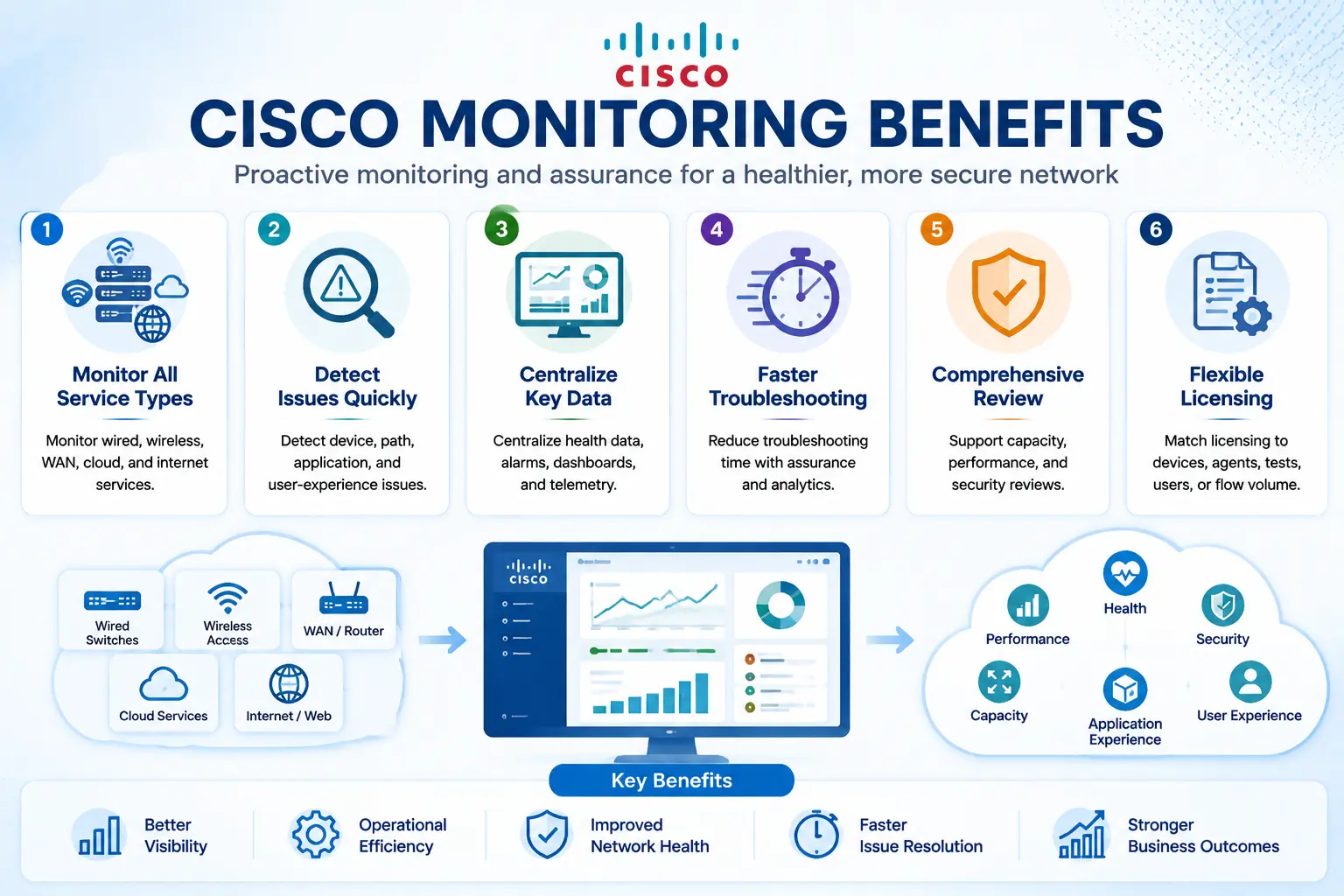
- Monitor wired, wireless, WAN, cloud, and internet services
- Detect device, path, application, and user-experience issues
- Centralize health data, alarms, dashboards, and telemetry
- Reduce troubleshooting time with assurance and analytics
- Support capacity, performance, and security reviews
- Match licensing to devices, agents, tests, users, or flow volume
Cisco Monitoring At a Glance
Technical role : Network monitoring, assurance, observability, and analytics
Parent category : Cisco Networking
Coverage : Campus, branch, WAN, data center, cloud, internet, and endpoints
Main platforms : Cisco Catalyst Center, Cisco ThousandEyes, Meraki Dashboard, and Cisco Secure Network Analytics
License approach : Product-specific subscriptions and capacity entitlements
Deployment : Cloud-managed, on-premises, virtual, or hybrid
Cisco Monitoring Category Overview
Cisco Monitoring helps administrators determine whether infrastructure and digital services are operating as expected. Basic monitoring tracks availability, interfaces, utilization, clients, and faults. Advanced assurance adds path analysis, telemetry correlation, application performance, and user-experience information to show where a service problem begins.
The correct platform depends on the visibility gap. Catalyst Center manages and assures supported enterprise networks. ThousandEyes measures service delivery across owned and third-party networks, including internet, SaaS, and cloud paths. Meraki Dashboard monitors and manages Meraki devices through the cloud. Secure Network Analytics examines flow telemetry to identify unusual behavior and potential threats.
How Cisco Monitoring Works
Cisco monitoring platforms collect information from devices, controllers, agents, endpoints, cloud services, applications, and traffic sources. Depending on the product, this may include device telemetry, wireless-client metrics, synthetic tests, path traces, flow records, logs, or application transactions. The platform processes this information and presents health scores, alarms, topology views, reports, and recommended actions. Administrators can then trace a problem through the local network, WAN, internet provider, cloud service, application path, or security event.
Devices, Agents and Traffic Sources → Data Collection → Analysis and Correlation → Dashboards and Alerts → Investigation and Action
Main Cisco Monitoring Platforms
| Platform | Primary monitoring role | Typical licensing angle |
|---|---|---|
| Cisco Catalyst Center | Campus and branch management, assurance, client visibility, and automation | Catalyst or Cisco DNA subscription, device coverage, and feature tier |
| Cisco ThousandEyes | Internet, SaaS, cloud, WAN, endpoint, and digital-experience assurance | Units, agents, users, tests, package, and subscription term |
| Cisco Meraki Dashboard | Cloud monitoring and management for Meraki networks | Subscription or co-termination licensing associated with managed devices |
| Cisco Secure Network Analytics | Flow visibility, behavioral analytics, and threat detection | Flow Rate licensing measured in flows per second |
These platforms address different operational layers and should not be treated as direct substitutes for one another.
Licensing and Ordering Models
Cisco Monitoring does not use one universal entitlement. Catalyst Center capabilities are generally linked to Catalyst or Cisco DNA software subscriptions assigned to supported infrastructure. ThousandEyes licensing may include units, Endpoint Agents, users, tests, or packaged assurance offers.
Meraki currently supports subscription and co-termination licensing for managed devices, while per-device licensing is limited to existing customers. Cisco Secure Network Analytics uses Flow Rate entitlements based on the amount of flow telemetry collected and analyzed. Before ordering, confirm the required platform, number and type of monitored devices, visibility scope, deployment model, expected test or flow volume, subscription duration, and existing Cisco agreements.
Features and Benefits
Cisco Monitoring gives operations teams a clearer view of device health, path changes, client experience, application reachability, and traffic behavior. This makes it easier to distinguish a local device issue from a WAN, internet, cloud, application, or security problem. Historical reporting supports capacity planning and trend analysis, while assurance and synthetic testing can identify service degradation before a complete outage occurs. Flow-based monitoring adds behavioral and security context, allowing network and security teams to work from a shared source of operational information.
Compatibility and Requirements
Compatibility depends on the selected product. Confirm supported device models, software releases, cloud or virtual infrastructure, agent and collector locations, telemetry sources, scale, data retention, Smart Account access, and restricted-network requirements. The platform must also match the monitoring objective. Catalyst Center does not replace internet-path assurance, ThousandEyes does not replace complete device lifecycle management, and Secure Network Analytics is not a general campus configuration platform.
Activation and Delivery
Cisco monitoring licenses are generally delivered electronically through the relevant Cisco account or cloud portal. Activation may involve a Cisco Smart Account and Virtual Account, Meraki organization, ThousandEyes account, product registration, agent deployment, or collector configuration.
Before activation, verify license ownership, subscription dates, device inventory, software compatibility, required integrations, and administrative access. Existing entitlements should also be reviewed before an expansion or renewal.
Pricing Factors and Quote Process
Cisco Monitoring pricing depends on the selected platform, device or user quantity, required agents or tests, flow capacity, subscription term, and deployment model. Complete the price-quote form with Cisco as the brand and Cisco Monitoring as the product. Existing license inventories, device lists, or technical requirements can be attached, while product tiers and additional options can be clarified during the quote process.
Cisco Monitoring pricing depends on your license type, deployment model and support requirements.