

Imagicle Virtual Receptionist is an automated call handling solution designed to help organizations manage incoming calls through intelligent voice menus, self-service options, and automated routing workflows. An Imagicle Virtual Receptionist License enables businesses to provide professional call experiences, reduce manual operator workload, and improve communication availability.
Quick Benefits
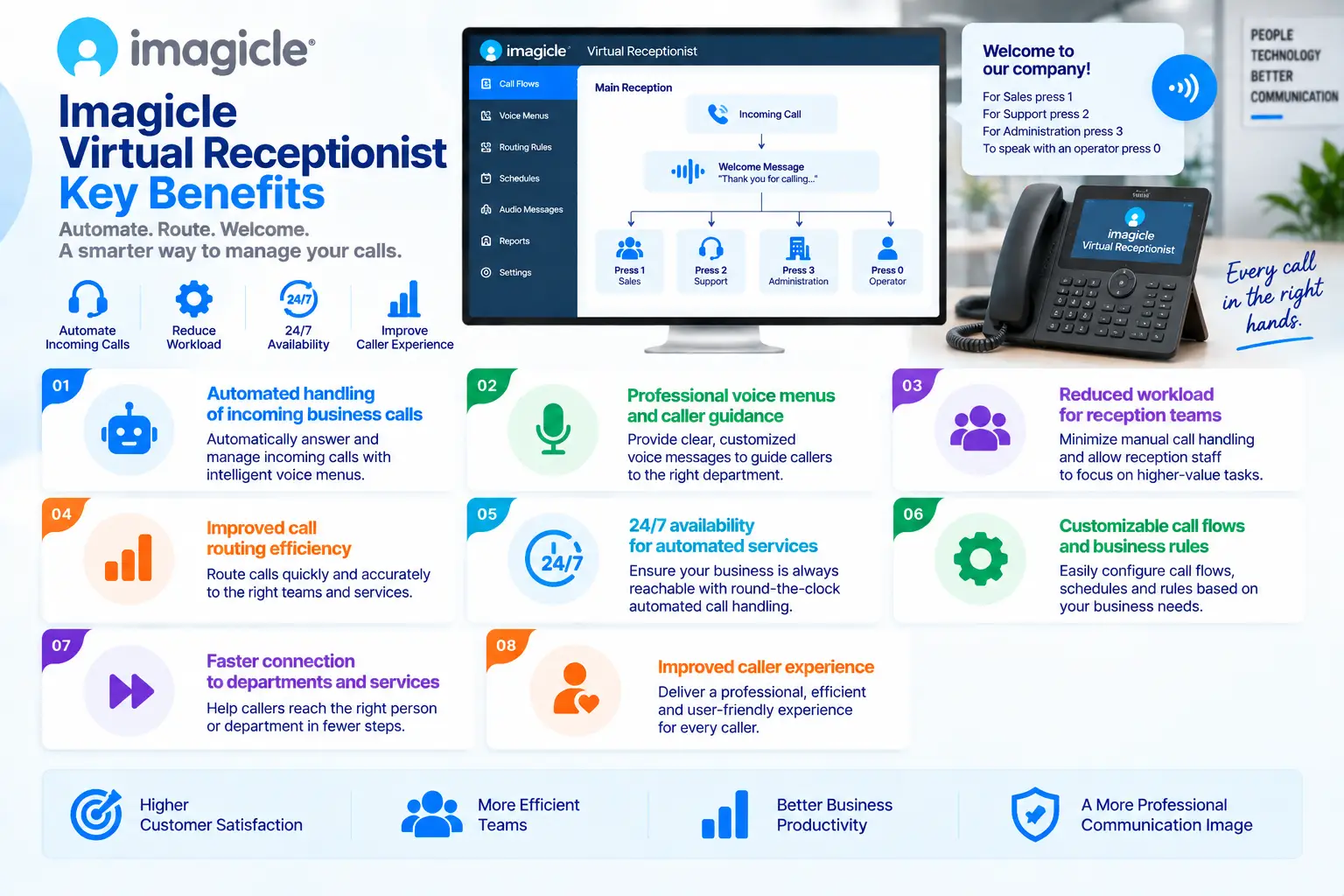
- Automated handling of incoming business calls
- Professional voice menus and caller guidance
- Reduced workload for reception teams
- Improved call routing efficiency
- 24/7 availability for automated communication services
- Customizable call flows and business rules
- Faster connection to departments and services
- Improved caller experience
Imagicle Virtual Receptionist At a Glance
What it is: Automated receptionist and intelligent call routing solution
Parent category: Imagicle License
Primary role: Automate incoming call management through voice interaction and routing workflows
Main users: Enterprises, reception teams, customer service departments, IT administrators, and organizations handling high call volumes
Core capabilities: Automated greetings, IVR menus, call routing, business rules, self-service workflows, and communication automation
Integration platforms: Cisco Unified Communications Manager, Cisco Webex, and supported collaboration environments

License Overview
An Imagicle Virtual Receptionist License is generally determined by the complexity of the automated communication workflows and the number of services that need to be managed through the virtual receptionist.
Unlike traditional receptionist solutions that depend on dedicated employees answering and transferring calls manually, virtual receptionist licensing focuses on the automated call scenarios, configured menus, integrations, and communication requirements. Organizations should evaluate the expected call volume, number of departments, required voice menus, routing logic, business hours, and self-service requirements before selecting the appropriate license model.
For smaller organizations, a simple automated greeting and department selection workflow may be sufficient. Larger enterprises may require multiple virtual receptionists, different call flows, multilingual menus, and integration with existing communication processes. When selecting an Imagicle Virtual Receptionist License, businesses should consider both current communication needs and future expansion to ensure that automated workflows can grow with the organization.
Product Overview
Automated Receptionist Experience
The first interaction a customer has with an organization often begins with a phone call. When reception teams are unavailable or call volumes increase, businesses need a reliable way to guide callers toward the correct destination.
Imagicle Virtual Receptionist provides an automated alternative by answering incoming calls and directing callers through predefined communication paths.
This allows organizations to maintain a professional first impression while reducing dependency on manual call handling.
Intelligent Voice Menu Management
Effective automated reception requires more than a simple recorded greeting.
Imagicle Virtual Receptionist enables organizations to create structured voice menus that help callers quickly reach the correct department, service, or employee.
For example, callers can select options for sales, support, billing, or other departments without waiting for a receptionist.
This improves navigation efficiency and reduces unnecessary transfers.
Business Rules and Call Routing
Organizations often need different call behavior depending on time, department availability, or business conditions.
Imagicle Virtual Receptionist supports configurable routing workflows that allow businesses to define how calls should be handled in different situations.
During working hours, calls can be directed to available teams, while after-hours calls can follow alternative paths such as voicemail, emergency contacts, or automated information services.
This flexibility helps organizations maintain consistent communication availability.
Core Technical Flow
Incoming Caller
→ Enterprise Telephony Platform (Cisco CUCM / Webex Environment)
→ Imagicle Virtual Receptionist Voice Menu
→ Caller Selection / Automated Workflow
→ Department, Extension, Queue, or Service Destination
→ Call Completion
Options and Licensing Models
| Licensing Factor | Description | Suitable For |
|---|---|---|
| Call Flows | Number of automated receptionist scenarios configured | Organizations with different communication workflows |
| Departments / Destinations | Number of services, teams, or extensions available | Multi-department organizations |
| Voice Menus | Complexity and number of caller interaction paths | Businesses requiring advanced routing |
| Extensions / Users | Connected communication resources | Enterprise telephony environments |
| Advanced Features | Additional automation and customization capabilities | Organizations requiring complex workflows |
| Support and Subscription | Updates, maintenance, and technical assistance | Long-term deployments |
The correct licensing model depends on the complexity of automated workflows, communication structure, and required level of customization.
Features and Benefits
Imagicle Virtual Receptionist helps organizations improve incoming call management by providing an automated communication layer between callers and internal teams. Instead of relying only on manual reception processes, businesses can create structured workflows that guide callers efficiently.
A major benefit is improved availability. Automated reception services can operate outside normal working hours and ensure that callers receive consistent guidance even when employees are unavailable.
The solution also improves operational efficiency by reducing repetitive call-handling tasks. Reception and support teams can focus on higher-value interactions while routine routing activities are managed automatically.
For organizations with multiple departments or high call volumes, a virtual receptionist provides a professional communication experience while improving internal resource utilization.
Compatibility and Requirements
Before deploying Imagicle Virtual Receptionist, organizations should evaluate their communication architecture and automation requirements.
Important considerations include:
- Existing telephony platform
- Number of departments
- Required call flows
- Business hour schedules
- Voice menu requirements
- Integration needs
- User and extension structure
Imagicle Virtual Receptionist is commonly deployed alongside Cisco Unified Communications Manager and Cisco Webex environments. Organizations should design their call workflows before implementation to ensure that automated routing matches real business processes.
Activation and Deployment
Imagicle Virtual Receptionist deployment begins with activating the purchased license and preparing the communication environment.
Typical deployment steps include:
- License registration and activation
- Connecting the telephony platform
- Creating voice menus
- Configuring routing rules
- Testing automated call scenarios
Organizations usually start with essential communication workflows before expanding automation across additional departments.
Pricing and Quote Process
Pricing for an Imagicle Virtual Receptionist License depends mainly on the number of automated workflows, call flow complexity, required features, integration environment, and deployment requirements.
Before requesting a quote, organizations should define:
- Required automated call scenarios
- Number of departments involved
- Existing communication platform
- Voice menu requirements
- Expected call volume
- Support and subscription needs
Accurate planning helps organizations select the appropriate automation capabilities without unnecessary licensing costs.
Organizations should also consider future growth because additional departments, locations, or communication services may require expanded virtual receptionist workflows.
Imagicle pricing depends on your selected applications, licensing model, deployment environment, subscription term, and support needs.