

Cisco XDR License provides access to Cisco Extended Detection and Response capabilities for organizations that need to correlate security telemetry, prioritize threats, investigate incidents, and automate response across multiple security domains. Cisco XDR is a cloud-native security operations platform that brings together telemetry from Cisco and supported third-party security products to provide a unified view of threats.
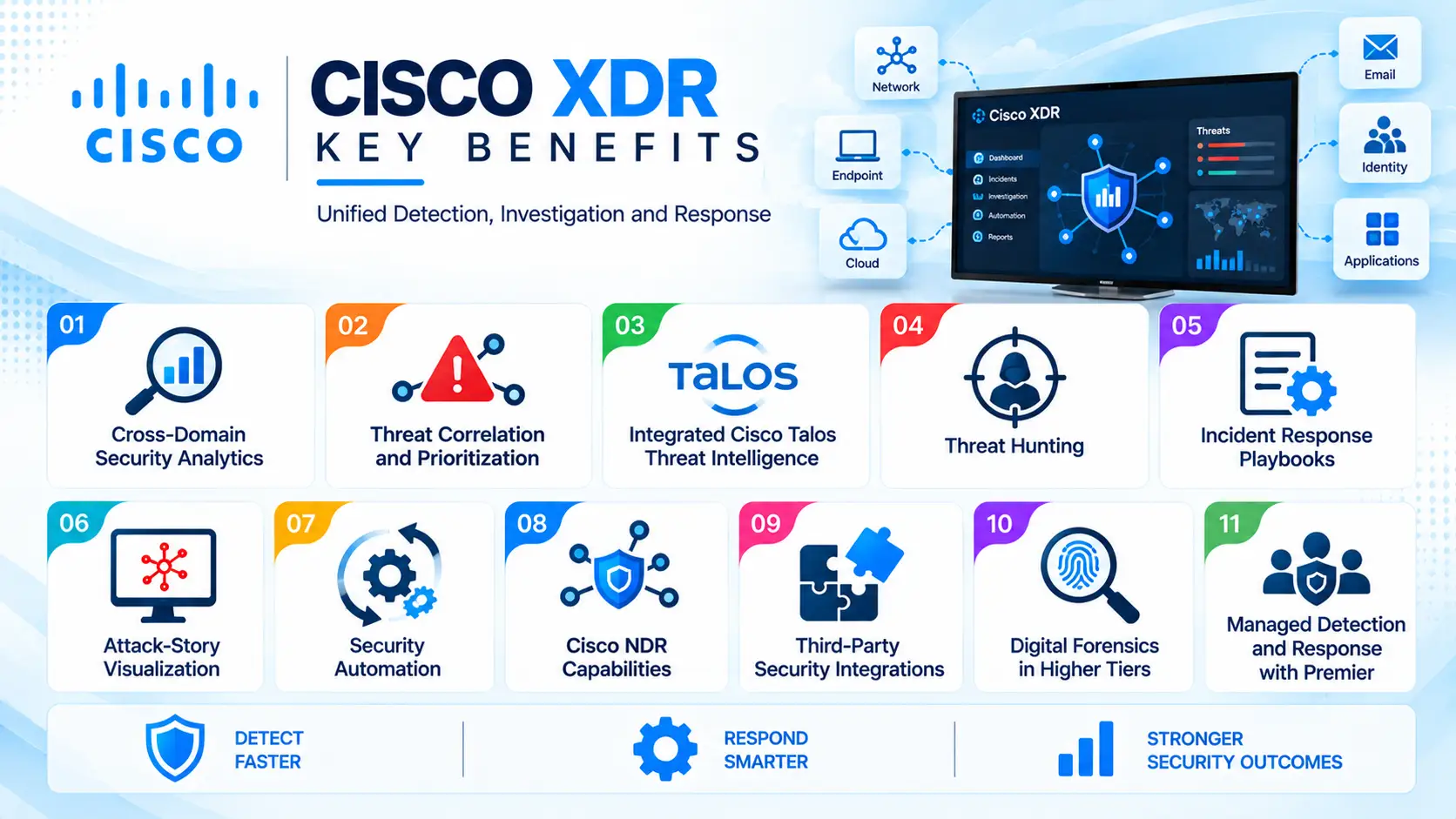
Cisco XDR Key Benefits
- Cross-domain security analytics
- Threat correlation and prioritization
- Integrated Cisco Talos threat intelligence
- Threat hunting
- Incident response playbooks
- Attack-story visualization
- Security automation
- Cisco NDR capabilities
- Third-party security integrations
- Digital forensics in higher tiers
- Managed detection and response with Premier
Cisco XDR License At a Glance
What it is: Cloud-based Extended Detection and Response platform.
Parent Category: Cisco Security
Primary role: Security analytics, threat correlation, investigation, and response.
Deployment: Cloud-native security service.
License tiers: Essentials, Advantage, and Premier.
Core capabilities: Security analytics, threat intelligence, threat hunting, incident prioritization, response automation, and attack investigation.
Third-party integrations: Available with Advantage and Premier.
Data ingestion: 2 GB per user per month is included by default.
Data retention: 90 days is included by default, with longer retention options available.
Managed service: Cisco Managed XDR/MXDR capabilities are available with Premier.

License Overview
The Cisco XDR License is structured around three service tiers: Essentials, Advantage, and Premier. The tiers share the core XDR platform but differ in third-party integrations, forensic capabilities, and managed security services.
Cisco XDR Essentials provides the core XDR capabilities and native integrations across the Cisco security portfolio. Advantage builds on Essentials by adding commercially supported and curated integrations with selected third-party security tools. Premier adds Cisco-managed detection and response services together with additional incident-response and security-assessment capabilities.
Cisco currently includes 2 GB of data ingestion per user per month and 90 days of data retention as the standard entitlement. Additional ingestion and longer retention periods can be purchased when the organization’s security telemetry exceeds the included capacity.
Licensing Highlights
The appropriate Cisco XDR tier should be selected according to the organization’s security stack and SOC operating model.
Essentials is suitable when the organization primarily relies on Cisco security technologies and needs centralized XDR analytics, investigation, hunting, and response.
Advantage is more appropriate for mixed environments where security teams need supported integrations with selected third-party security products.
Premier is intended for organizations that want to extend the platform with Cisco-managed detection and response, Talos Incident Response services, and security assessments.
When sizing a subscription, also consider the number of licensed users, expected telemetry volume, required retention period, third-party integrations, and whether managed detection and response is required.
Product Overview
Cisco XDR brings security telemetry from multiple sources into a common investigation environment. It applies analytics and correlation to identify relationships between events that may appear unrelated when viewed inside individual security products.
The platform can combine information from Cisco security products and supported third-party technologies, helping analysts establish a broader understanding of an attack.
For example, an endpoint detection may be correlated with network activity, identity information, threat intelligence, or other telemetry to create a more complete incident picture.
Core Technical Flow
Telemetry Collection
→ Security events and data are collected from supported Cisco and third-party sources.
Correlation
→ Cisco XDR analyzes the available telemetry and identifies relationships between events.
Incident Prioritization
→ Related activity is organized into incidents and prioritized according to risk.
Investigation
→ Analysts review attack stories, asset context, threat intelligence, and available evidence.
Response
→ Analysts use response actions and automation playbooks to contain or remediate threats.
Verification
→ Security teams validate the response and continue monitoring for related activity.
Options & Licensing Models
| License Tier | Best For | Main Capabilities |
|---|---|---|
| Cisco XDR Essentials | Cisco-focused security environments | XDR analytics, correlation, threat intelligence, hunting, incident response, automation, and core Cisco integrations |
| Cisco XDR Advantage | Mixed Cisco and third-party environments | Essentials capabilities plus curated third-party integrations and XDR forensics |
| Cisco XDR Premier | Organizations requiring managed security operations | Advantage capabilities plus Cisco Managed XDR/MXDR, Talos Incident Response, and Technical Security Assessments |
Cisco currently identifies Essentials, Advantage, and Premier as the three main Cisco XDR license tiers.
Features & Benefits
Security Analytics and Correlation
Cisco XDR correlates security telemetry from multiple sources to help analysts identify related activity and reduce the number of isolated alerts that need to be investigated manually.
Threat Intelligence
Cisco XDR incorporates Cisco Talos intelligence and can combine additional threat-intelligence sources to provide more context around suspicious activity.
Threat Hunting
Security analysts can investigate suspicious behavior across available telemetry and use threat-hunting capabilities to search for indicators and attack patterns.
Incident Response
Built-in response playbooks allow analysts to automate or initiate response actions after an incident has been identified. This can shorten the time between detection and containment.
Compatibility & Requirements
Cisco XDR is designed to work with Cisco security technologies as well as supported third-party security products.
Before selecting a license, organizations should evaluate:
- Number of XDR users
- Expected telemetry volume
- Cisco security products already deployed
- Third-party security products
- Required data-retention period
- Required integrations
- SOC operating model
- Need for managed detection and response
The 2 GB per user per month included ingestion should be compared with the organization’s actual telemetry requirements. If the environment generates substantially more data, additional ingestion capacity should be included in the commercial configuration.
How Activation Works
Cisco XDR is delivered as a cloud-based service. After selecting the appropriate subscription, the organization establishes its XDR environment and connects the required telemetry sources.
A typical deployment involves:
- Select the appropriate XDR tier.
- Provision the Cisco XDR subscription.
- Connect Cisco security products and required data sources.
- Configure third-party integrations where applicable.
- Configure users, roles, and security workflows.
- Validate telemetry ingestion and incident correlation.
- Configure response and automation playbooks.
- Begin operational monitoring and investigation.
Cisco Secure Firewall can also be integrated with Cisco XDR, but the XDR subscription is separate from the firewall license.
Pricing + Quote
Cisco XDR pricing depends on the selected tier, number of users, telemetry requirements, data-retention period, third-party integrations, and managed-service requirements.
For an accurate quotation, provide:
- Number of users
- Expected data ingestion
- Required retention period
- Cisco security products
- Third-party security products
- Required XDR tier
- Forensic requirements
- Managed detection requirements
- Talos Incident Response requirements
- Subscription duration
For organizations with a primarily Cisco security stack, Essentials may provide the required functionality. Environments containing multiple security vendors may benefit from Advantage, while organizations looking for a managed SOC extension should evaluate Premier.
Cisco XDR pricing depends on your license type, deployment model and support requirements.