

Cisco Secure DDoS provides distributed denial-of-service protection for organizations that need to maintain application, network, and service availability during large-scale or sophisticated DDoS attacks. The platform combines behavioral analysis, machine learning, real-time attack detection, and automated mitigation to identify malicious traffic while allowing legitimate users to continue accessing protected services.
Cisco Secure DDoS can protect against network-layer, transport-layer, and application-layer attacks and supports multiple deployment models, including on-premises mitigation, cloud-based protection, hybrid architectures, and protection directly at the network edge. This flexibility allows enterprises, service providers, and operators of critical infrastructure to select an architecture based on bandwidth, network design, latency requirements, and expected attack volume.
Quick Benefits
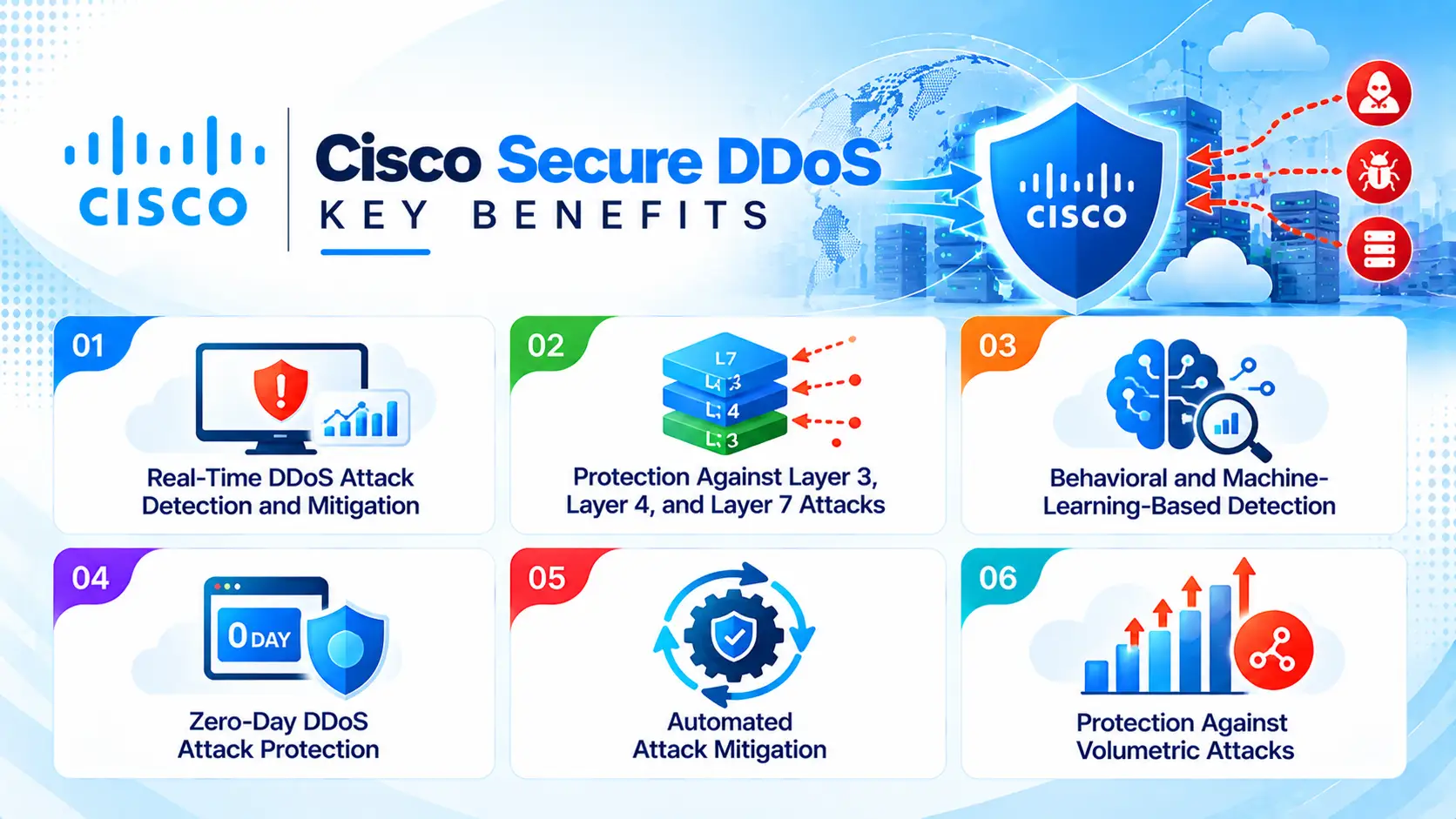
- Real-time DDoS attack detection and mitigation
- Protection against Layer 3, Layer 4, and Layer 7 attacks
- Behavioral and machine-learning-based detection
- Zero-day DDoS attack protection
- Automated attack mitigation
- Protection against volumetric attacks
- SSL-based DDoS protection
- On-premises, cloud, and hybrid deployment
At a Glance
- Product: Cisco Secure DDoS Protection
- Category: DDoS Protection and Mitigation
- Primary Use: Maintaining network and application availability
- Attack Coverage: Layers 3, 4, and 7
- Detection: Behavioral analysis and machine learning
- Deployment: Cloud, on-premises, hybrid, or network edge
- On-Premises Platform: DefensePro X
- Virtual Option: DefensePro Virtual Appliance

Cisco Secure DDoS License Overview
Cisco Secure DDoS licensing depends on the selected protection architecture because the portfolio includes different technologies for on-premises, virtual, cloud, hybrid, and network-edge deployments.
For on-premises environments, Cisco Secure DDoS Protection uses DefensePro X appliances with scalable mitigation throughput. Organizations select the appropriate platform and clean-traffic capacity according to network bandwidth and expected attack volume.
DefensePro Virtual Appliance provides similar DDoS protection capabilities for supported virtualized and cloud environments where a dedicated physical appliance may not be appropriate.
Cisco Secure DDoS Edge Protection uses a different licensing model. Detectors are deployed directly on supported Cisco IOS XR routers and are licensed per router. The centralized controller is included as part of the overall solution and does not require a separate controller license.
The final license design should therefore be based on the deployment location, protected bandwidth, number of routers, required mitigation capacity, and whether cloud scrubbing or hybrid protection is required.
Cisco Secure DDoS Product Overview
Cisco Secure DDoS is designed to detect abnormal traffic patterns that indicate an attempt to exhaust bandwidth, infrastructure resources, application capacity, or service availability.
Traditional threshold-based DDoS systems may have difficulty distinguishing sudden legitimate traffic increases from malicious activity. Cisco Secure DDoS uses behavioral baselines and adaptive algorithms to understand normal traffic behavior and detect deviations that may represent an attack.
Once malicious activity is identified, mitigation policies can be applied automatically to remove attack traffic while preserving legitimate sessions.
The solution can address volumetric attacks designed to consume network bandwidth, protocol attacks that target networking resources, and application-layer attacks that attempt to exhaust servers or application services.
For organizations operating large distributed networks, Secure DDoS Edge Protection can move detection and mitigation closer to the attack source by using compatible Cisco routers as enforcement points.
Core Technical Flow
Cisco Secure DDoS continuously monitors traffic and establishes a baseline of normal network and application behavior.
When traffic behavior deviates significantly from the established baseline, the system evaluates multiple characteristics to determine whether the change represents legitimate demand or malicious activity.
Machine-learning and behavioral algorithms analyze traffic patterns, rates, protocols, sessions, and application behavior to identify suspicious activity.
If an attack is confirmed, Cisco Secure DDoS generates or applies the appropriate mitigation policy. Malicious traffic can then be filtered while legitimate connections continue to reach the protected application or network.
In edge deployments, detectors running on supported Cisco routers analyze traffic directly and can enforce mitigation close to the network edge. A centralized controller distributes attack information and protective signatures across the deployed detector infrastructure.
Security teams can monitor attack information, mitigation actions, traffic characteristics, and ongoing protection status from the associated management environment.
Options & Licensing Models
| Cisco Secure DDoS Option | Primary Purpose | Typical Environment |
|---|---|---|
| DefensePro X | High-performance on-premises DDoS detection and mitigation | Data centers, enterprises and service providers |
| DefensePro Virtual Appliance | Software-based DDoS protection | Private cloud and supported virtual environments |
| Cloud DDoS Protection | Upstream mitigation of large volumetric attacks | Internet-facing applications and networks |
| Hybrid Protection | Combines local mitigation with cloud scrubbing | Enterprises requiring multi-layer protection |
| Secure DDoS Edge Protection | Detects and mitigates DDoS directly on supported routers | ISPs, telecom networks and large distributed networks |
| Edge Detector License | Enables Edge Protection functionality on supported routers | Licensed per participating router |
| Scalable Throughput License | Defines mitigation capacity for DefensePro platforms | Sized according to protected traffic requirements |
DefensePro X models support different programmable mitigation capacities, allowing organizations to scale clean throughput according to expected traffic volumes without necessarily replacing the entire hardware platform.
Features & Benefits
Behavioral Detection and Automated DDoS Mitigation
Cisco Secure DDoS uses adaptive behavioral analysis and machine-learning techniques to distinguish malicious traffic from legitimate changes in network activity. This approach helps detect known attacks as well as previously unseen or zero-day DDoS techniques. Automated mitigation can react quickly when an attack begins, reducing dependence on manual intervention and helping maintain network and application availability during rapidly developing events.
Multi-Layer Protection Across Network and Applications
The platform protects against a broad range of attacks targeting Layers 3, 4, and 7, including volumetric floods, protocol attacks, application exhaustion attempts, and encrypted DDoS traffic. By analyzing traffic behavior rather than relying exclusively on static signatures, Cisco Secure DDoS can protect different network and application resources while minimizing unnecessary blocking of legitimate users.
Flexible On-Premises, Cloud, Hybrid, and Edge Protection
Cisco Secure DDoS supports multiple deployment strategies so protection can be placed where it provides the greatest value. DefensePro X provides dedicated on-premises mitigation, virtual appliances support software-defined environments, cloud protection can absorb large upstream attacks, and hybrid architectures combine local and cloud defenses. Secure DDoS Edge Protection extends this model further by detecting and mitigating attacks directly on compatible Cisco routers before malicious traffic consumes deeper network resources.
Compatibility & Requirements
Before selecting Cisco Secure DDoS, organizations should evaluate:
- Internet connection and protected bandwidth
- Normal and peak traffic volumes
- Expected DDoS attack size
- Network-layer and application-layer protection requirements
- Physical or virtual deployment preference
- Cloud scrubbing requirements
- Hybrid mitigation requirements
- Number and location of protected data centers
Activation and Deployment
Cisco Secure DDoS deployment begins with network assessment and traffic sizing. Organizations should identify critical applications, public IP ranges, internet links, normal traffic patterns, and the maximum expected attack volume.
For DefensePro X deployments, the appropriate appliance model and mitigation capacity are selected and positioned within the network architecture. Traffic monitoring and enforcement policies are then configured according to the protected network.
Virtual deployments follow a similar process but use the DefensePro Virtual Appliance within supported infrastructure.
For hybrid architectures, local mitigation can handle many attacks while larger volumetric events can be redirected to cloud scrubbing infrastructure.
Secure DDoS Edge Protection requires compatible Cisco IOS XR routers. Detector components are deployed on participating routers while the controller provides centralized coordination and distributes attack intelligence across the environment.
A baseline-learning and tuning period should be completed before relying fully on automated enforcement so legitimate traffic patterns and application behavior are accurately understood.
Cisco Secure DDoS Pricing and Quote
Cisco Secure DDoS pricing depends heavily on the selected architecture and required mitigation capacity.
For DefensePro X deployments, important variables include appliance model, clean-traffic throughput, required scalability, redundancy, and deployment location. Virtual environments require appropriate DefensePro Virtual Appliance sizing.
Edge Protection is licensed per supported router, with three-year or five-year license terms available for the detector component. The controller is included with the overall Edge Protection solution and does not require a separate license.
Cloud and hybrid DDoS protection pricing depends on factors such as protected bandwidth, application scope, network architecture, and required service level.
Before requesting a quote, prepare normal and peak traffic volumes, internet bandwidth, required mitigation throughput, number of protected sites, number of routers, deployment model, high-availability requirements, and expected attack profile.
Cisco Secure DDoS pricing depends on your license type, deployment model and support requirements.