

Cisco Secure Email License provides organizations with protection against phishing, Business Email Compromise, spam, ransomware, malicious attachments, unsafe URLs, and sensitive-data leakage across enterprise email environments. Delivered through Cisco Secure Email Gateway and related cloud-based security services, the platform combines threat intelligence, malware analysis, email filtering, encryption, and data-protection capabilities within a centralized email-security architecture.
With a Cisco Secure Email License, organizations can secure inbound and outbound email traffic, inspect suspicious files and URLs, enforce messaging policies, and reduce the risk of sensitive information leaving the organization. Depending on the selected license bundle, security teams can extend basic threat protection with Data Loss Prevention, email encryption, advanced malware analysis, and additional threat-detection capabilities.
Quick Benefits
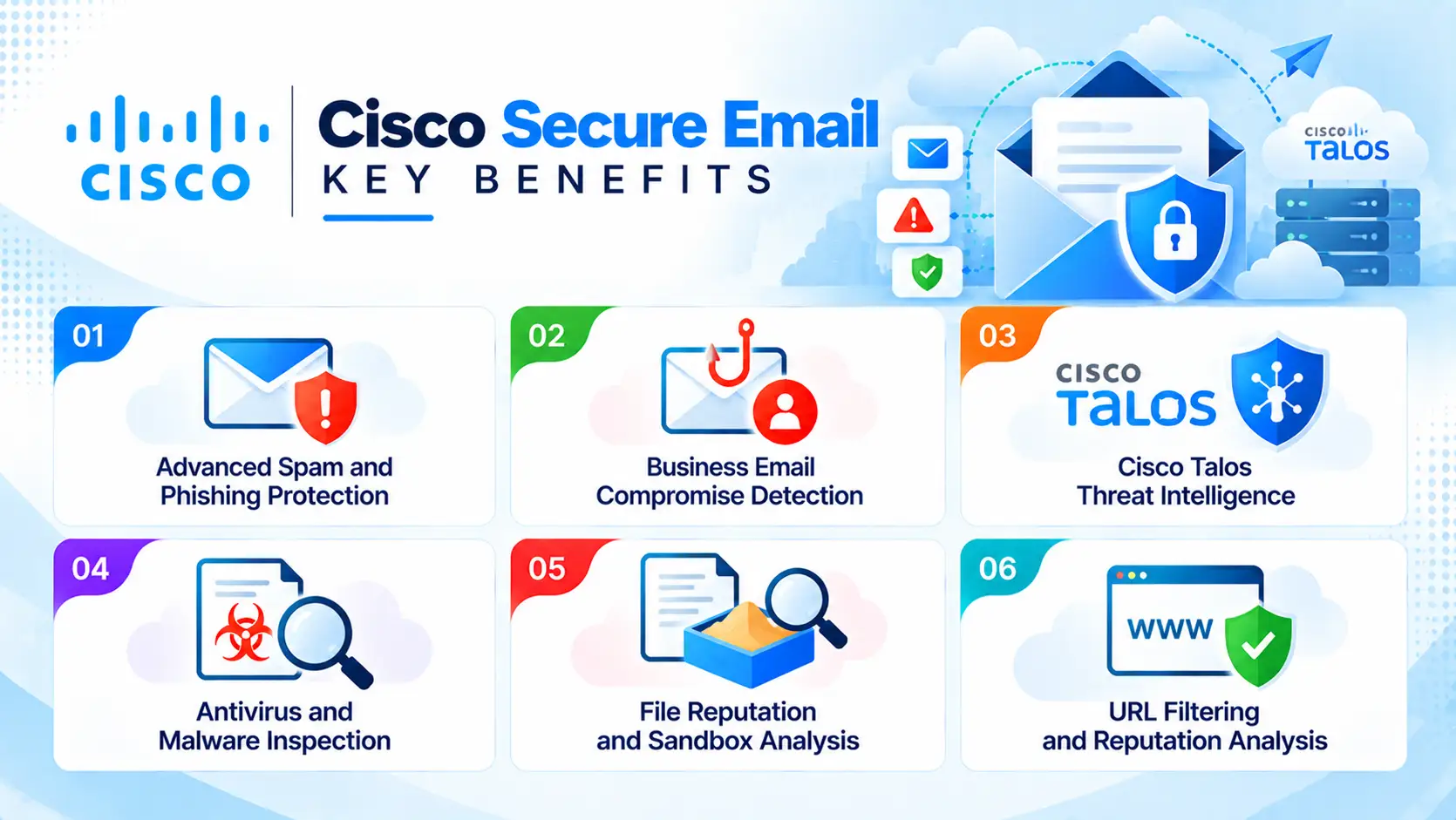
- Advanced spam and phishing protection
- Business Email Compromise detection
- Cisco Talos threat intelligence
- Antivirus and malware inspection
- File reputation and sandbox analysis
- URL filtering and reputation analysis
- Outbreak Filters for emerging threats
- Data Loss Prevention capabilities
- Secure email encryption
At a Glance
- Product: Cisco Secure Email Gateway
- Primary Keyword: Cisco Secure Email License
- Category: Email Security
- Primary Use: Inbound and outbound email protection
- License Bundles: Essentials and Advantage
- License Metric: Per user / mailbox
- Subscription Terms: 1, 3, or 5 years
- Threat Intelligence: Cisco Talos
- Malware Protection: Cisco Secure Malware Defense and Malware Analytics
- Deployment: Cloud, on-premises, or hybrid
- Advanced Option: Cisco Secure Email Threat Defense
- Management: Cisco Secure Email and Web Manager for applicable deployments
Cisco Secure Email License Overview
Cisco Secure Email licensing is designed around the number of users or mailboxes that require protection. Cisco currently provides two primary Secure Email Gateway software bundles: Essentials and Advantage.
Secure Email Essentials provides the core security capabilities required to protect enterprise email environments. It includes anti-spam protection, antivirus scanning, sender-domain reputation, URL filtering, outbreak detection, graymail controls, and Cisco Secure Email malware defense and analytics.
Secure Email Advantage includes all Essentials functionality and adds Data Loss Prevention, Cisco Secure Email Encryption Service, and Safe Unsubscribe. This makes Advantage more appropriate for organizations that need to protect sensitive outbound information in addition to blocking inbound threats.
Additional capabilities such as Secure Email Threat Defense, domain protection, image analysis, additional antivirus engines, and centralized management can be licensed separately depending on the deployment architecture and security requirements.
Cisco Secure Email licenses are generally available as one-, three-, or five-year term subscriptions.
Cisco Secure Email Product Overview
Cisco Secure Email Gateway operates as a security layer between enterprise mail systems and external email infrastructure. Messages can be inspected before they are delivered to users, allowing malicious or unwanted content to be blocked before it reaches the mailbox.
Inbound messages can be evaluated using sender reputation, domain information, URL analysis, antivirus scanning, file reputation, sandboxing, and additional threat intelligence from Cisco Talos.
Outbound email can also be analyzed for policy violations and sensitive information. When Advantage licensing is deployed, organizations can use DLP policies to identify confidential data and apply encryption or other controls before a message leaves the environment.
Cisco Secure Email can operate in cloud, on-premises, and hybrid architectures, allowing organizations to integrate email security with environments such as Microsoft 365, Google Workspace, Microsoft Exchange, and other supported mail platforms.
Core Technical Flow
The process begins when an email enters or leaves the organization’s mail environment.
Cisco Secure Email first analyzes sender reputation, message metadata, domains, and other contextual information to determine whether the message presents an immediate risk.
The message can then pass through anti-spam, antivirus, URL filtering, and malware-inspection engines. Suspicious files may be evaluated using reputation information and advanced malware analysis to determine whether they are malicious.
Cisco Outbreak Filters can temporarily quarantine suspicious messages associated with emerging threats until additional threat intelligence becomes available.
For outbound traffic, Advantage deployments can inspect message content for sensitive information using DLP policies. Messages containing protected data can be blocked, quarantined, logged, or encrypted depending on organizational policy.
Approved messages are delivered to their destination, while relevant security events remain available for tracking, investigation, and reporting.
Options & Licensing Models
| License Option | Main Capabilities | Typical Use |
|---|---|---|
| Secure Email Essentials | Anti-spam, antivirus, URL filtering, outbreak filters, graymail detection, malware defense and analytics | Core enterprise email threat protection |
| Secure Email Advantage | All Essentials capabilities plus DLP, email encryption and Safe Unsubscribe | Organizations requiring threat protection and outbound data security |
| Secure Email Threat Defense | Advanced threat detection, investigation and email visibility | Microsoft 365 enhancement or advanced gateway-based protection |
| Domain Protection | DMARC-based domain protection | Preventing unauthorized use of organizational domains |
| Secure Email Management | Centralized reporting, tracking and quarantine management | Multi-appliance, on-premises and hybrid deployments |
| 1-Year Subscription | Shorter subscription term | Flexible or initial deployments |
| 3-Year Subscription | Multi-year licensing | Standard enterprise deployments |
| 5-Year Subscription | Long-term subscription | Established enterprise email-security programs |
Cisco Secure Email uses quantity-based subscription licensing according to the protected user or mailbox population. The appropriate package should be selected according to both inbound threat-protection requirements and outbound data-security requirements.
Features & Benefits
Advanced Threat Protection for Email-Borne Attacks
Cisco Secure Email combines Talos threat intelligence, sender and domain reputation, URL filtering, antivirus scanning, Outbreak Filters, and malware analysis to identify malicious email before it reaches users. File reputation and sandbox-based analysis provide additional protection against suspicious attachments, while continuous intelligence updates help identify emerging phishing, ransomware, and Business Email Compromise campaigns. This layered approach reduces reliance on a single detection method and improves protection against both known and newly developing threats.
Data Protection, Encryption, and Policy Enforcement
Secure Email Advantage extends the platform beyond inbound threat filtering by protecting sensitive information in outbound messages. Data Loss Prevention policies can identify confidential or regulated content and apply actions based on organizational requirements. Cisco Secure Email Encryption can protect sensitive communications in transit, while Safe Unsubscribe provides controlled handling of legitimate marketing messages. Together, these capabilities help organizations enforce messaging policies while reducing accidental or unauthorized data exposure.
Centralized Visibility and Flexible Email Security Architecture
Cisco Secure Email supports cloud, on-premises, and hybrid deployment models, allowing organizations to align email security with their existing mail infrastructure. Centralized reporting, message tracking, quarantine management, and integration with Cisco Secure Email Threat Defense provide additional visibility into email activity and security events. Organizations can therefore manage traditional gateway protection while also extending threat detection into modern cloud-email environments.
Compatibility & Requirements
Before ordering a Cisco Secure Email License, organizations should assess:
- Total number of protected users or mailboxes
- Required Essentials or Advantage functionality
- Microsoft 365, Google Workspace, or Exchange architecture
- Cloud, on-premises, or hybrid deployment requirements
- Existing Cisco Secure Email Gateway appliances
- Anti-spam and antivirus requirements
- Malware sandboxing requirements
- Data Loss Prevention requirements
- Email encryption requirements
- Secure Email Threat Defense requirements
- Domain and DMARC protection requirements
- Centralized reporting and management requirements
- SIEM and SOC integration requirements
- Email retention and compliance policies
The exact deployment architecture should be validated against the organization’s mail-flow design, mail platform, user count, security requirements, and required add-ons before the final license quantity is determined.
Activation and Deployment
Cisco Secure Email deployment begins by identifying the protected mail domains, number of users or mailboxes, deployment model, and required software bundle.
For gateway-based deployments, administrators configure mail routing so inbound or outbound messages pass through Cisco Secure Email before reaching their final destination. DNS and MX records may also need to be adjusted according to the selected architecture.
Security policies are then configured for spam, malware, URL filtering, outbreak detection, message content, and user groups.
Advantage deployments can additionally configure DLP dictionaries, classification policies, encryption actions, and outbound data-security controls.
Organizations using Cisco Secure Email Threat Defense can integrate it with the existing gateway architecture or use it to add additional visibility and threat detection in supported cloud-email environments.
Testing should include inbound delivery, outbound routing, quarantine behavior, malware detection, URL filtering, DLP rules, and message tracking before full production enforcement.
Cisco Secure Email License Pricing and Quote
Cisco Secure Email License pricing depends primarily on the selected bundle, number of users or mailboxes, subscription duration, deployment model, and required add-on services.
Cisco offers one-, three-, and five-year term subscriptions, with pricing tiers based on the number of protected mailboxes. Essentials is generally appropriate when the main objective is inbound threat protection, while Advantage is more suitable when DLP, encryption, and outbound data controls are also required.
Additional products such as Secure Email Threat Defense, Domain Protection, or centralized Secure Email Management may affect the final bill of materials.
Before requesting a quote, prepare the protected mailbox count, required package, subscription term, mail platform, deployment type, existing Cisco Email infrastructure, and any requirements for DLP, encryption, threat defense, or centralized management.
Cisco Secure Email pricing depends on your license type, deployment model and support requirements.