

Cisco Secure Client License provides organizations with secure remote access, endpoint visibility, posture assessment, network access control, and additional security capabilities through a unified endpoint client. Formerly known as Cisco AnyConnect Secure Mobility Client, Cisco Secure Client brings VPN connectivity and multiple endpoint-security modules into a single application that can support users working from corporate networks, home environments, and remote locations.
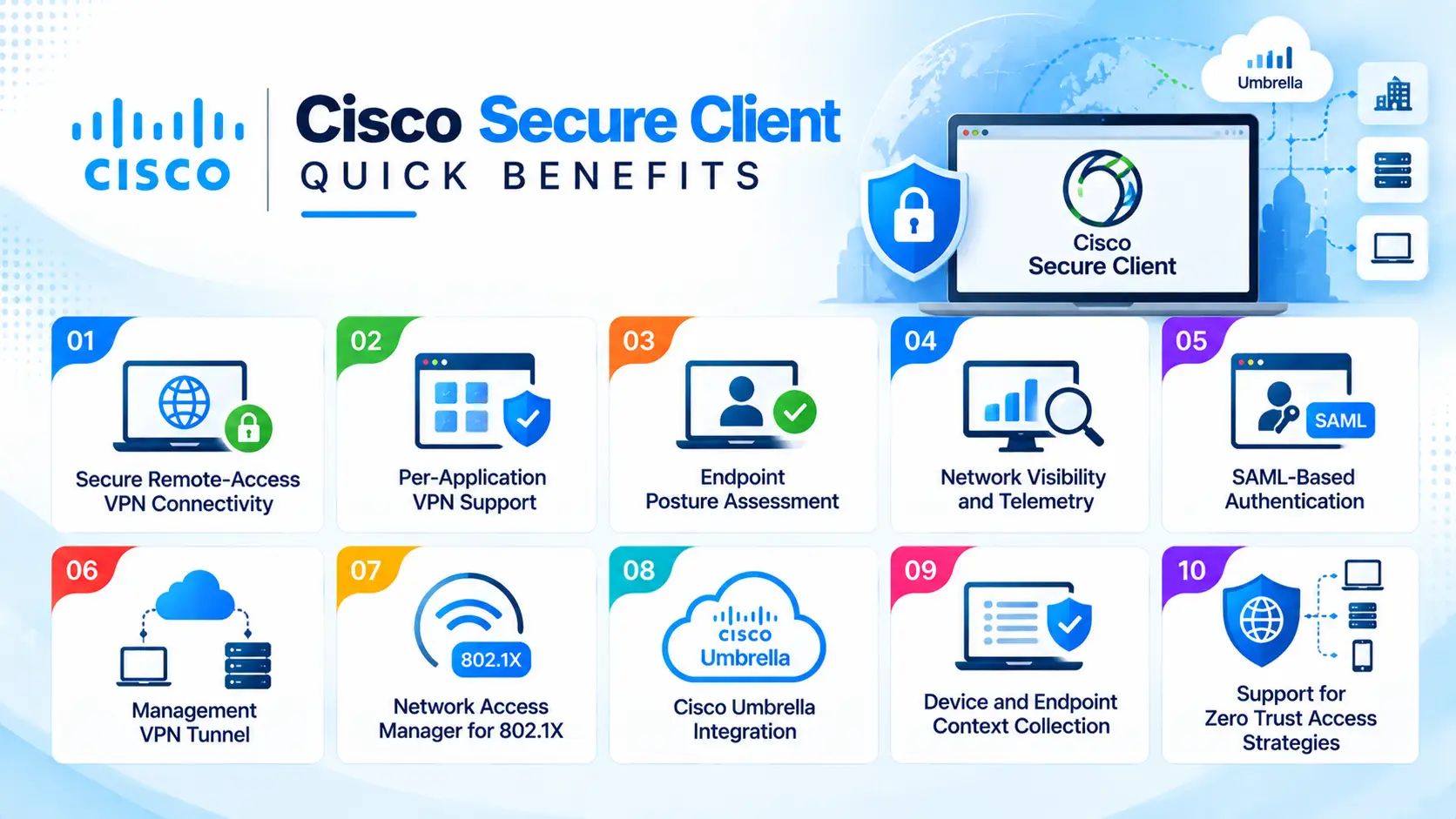
Quick Benefits
- Secure remote-access VPN connectivity
- Per-application VPN support
- Endpoint posture assessment
- Network visibility and telemetry
- SAML-based authentication
- Management VPN Tunnel
- Network Access Manager for 802.1X
- Cisco Umbrella integration
- Device and endpoint context collection
- Support for Zero Trust access strategies
At a Glance
- Product: Cisco Secure Client
- Parent Category: Cisco Security
- Category: Secure Remote Access and Endpoint Security
- Primary Use: VPN, endpoint visibility and posture
- Main Editions: Advantage and Premier
- Additional Option: VPN Only
- License Metric: Unique users for Advantage and Premier
- Subscription Terms: 12 to 60 months

Cisco Secure Client License Overview
Cisco Secure Client licensing is designed around the capabilities required by users rather than simply the number of simultaneous VPN connections. The main commercial tiers are Cisco Secure Client Advantage and Cisco Secure Client Premier.
Advantage is intended for organizations requiring core Secure Client functionality such as device and system VPN, per-application VPN, basic endpoint context, Network Access Manager, Cisco Umbrella Roaming integration, and supported third-party IKEv2 remote-access connectivity.
Premier includes all Advantage capabilities and adds advanced functions such as Network Visibility Module, endpoint posture capabilities, SAML authentication, Management VPN Tunnel, and next-generation encryption.
Cisco also provides a VPN Only license for organizations that primarily require remote-access VPN functionality without the broader endpoint and security modules provided by Advantage or Premier.
Cisco Secure Client Product Overview
Cisco Secure Client consolidates multiple connectivity and security functions into a common endpoint application. Instead of deploying separate software packages for VPN access, network posture, endpoint telemetry, and network-access functions, administrators can deploy the relevant Secure Client modules according to organizational requirements.
For remote users, the client can establish encrypted connectivity to supported VPN headends and provide secure access to internal applications and services. Enterprises can also configure per-application VPN policies so that only selected application traffic is routed through the protected connection.
In more advanced deployments, Secure Client can collect endpoint posture information, provide network telemetry, and integrate with Cisco security products such as Cisco Identity Services Engine, Secure Firewall, Umbrella, and Secure Endpoint.
This modular architecture allows the same client framework to support traditional VPN deployments as well as broader Zero Trust and Secure Access strategies.
Core Technical Flow
The process normally begins when a user connects to a protected corporate resource from Cisco Secure Client. The endpoint establishes communication with the configured VPN or security service and presents the required authentication information.
The associated Cisco infrastructure authenticates the user and evaluates the applicable access policies. Depending on the architecture, this may include identity information, certificates, SAML authentication, endpoint posture, and additional contextual conditions.
After successful authentication, Secure Client establishes the appropriate protected connection. This may be a full device VPN, per-application VPN, or another supported access method.
If posture capabilities are enabled, the endpoint can also be evaluated against organizational compliance requirements before full access is granted. Network and endpoint telemetry can additionally be collected where the corresponding modules and licenses are deployed.
Options & Licensing Models
| License Option | Main Capabilities | Typical Use |
|---|---|---|
| Secure Client Advantage | VPN, per-application VPN, endpoint context, Network Access Manager, Umbrella Roaming and supported IKEv2 access | Standard enterprise secure-access deployments |
| Secure Client Premier | All Advantage functions plus Network Visibility, posture, SAML, Management VPN Tunnel and advanced encryption | Advanced security, visibility and compliance environments |
| VPN Only | Remote-access VPN-focused functionality | Organizations primarily requiring VPN connectivity |
| Advantage Subscription | Unique-user licensing with subscription and software support | Flexible enterprise deployments |
| Premier Subscription | Advanced feature licensing based on unique users | Enterprises requiring Premier capabilities |
| Advantage Perpetual | Perpetual Advantage entitlement with separate support requirements | Organizations preferring perpetual licensing |
Advantage and Premier subscription licenses can generally be purchased for periods between 12 and 60 months. The appropriate quantity should correspond to the total number of unique users consuming Secure Client services within each licensing tier.
Features & Benefits
Secure Remote Access and Flexible VPN Connectivity
Cisco Secure Client provides encrypted remote connectivity for employees, administrators, and other authorized users accessing corporate resources outside the trusted network. Organizations can deploy device-wide VPN connections or use per-application VPN to protect only selected application traffic. Support for multiple Cisco VPN headends and enterprise authentication methods allows Secure Client to fit into both existing remote-access environments and newer security architectures.
Endpoint Posture, Visibility, and Access Control
Advanced Secure Client deployments can evaluate endpoint compliance and provide additional visibility into user and network activity. Premier licensing adds capabilities such as Network Visibility Module and posture functions that can work with Cisco Identity Services Engine or Secure Firewall. These controls help organizations determine whether a device meets security requirements before granting access and provide contextual telemetry that can support investigation, monitoring, and policy enforcement.
Integrated Security and Centralized Client Architecture
Cisco Secure Client consolidates VPN, network access, endpoint context, Umbrella integration, and other security capabilities into a common client framework. This can reduce the operational complexity associated with managing several independent endpoint applications. Organizations can enable only the modules they require while integrating Secure Client with a broader Cisco security architecture involving Secure Firewall, ISE, Umbrella, and Secure Endpoint.
Compatibility & Requirements
Before purchasing a Cisco Secure Client License, organizations should determine:
- Total number of unique users
- Required Advantage or Premier capabilities
- Existing Cisco Secure Firewall or VPN headend
- Current ASA, FTD, router, or cloud access architecture
- Endpoint operating systems and versions
- Remote-access VPN requirements
- Per-application VPN requirements
- SAML authentication requirements
- Endpoint posture and compliance requirements
- Cisco ISE integration requirements
- Network Visibility Module requirements
- Umbrella or Secure Endpoint integrations
- Management VPN requirements
Operating-system and feature support can vary between Secure Client releases and modules. Compatibility should therefore be checked against the planned Secure Client version and the corresponding Cisco headend before deployment.
Activation and Deployment
Cisco Secure Client deployment normally begins by identifying the required client modules and selecting the appropriate license tier. Administrators then configure the VPN headend, authentication method, access policies, and endpoint profiles.
The Secure Client package can be distributed through supported enterprise software-management tools or through the configured Cisco infrastructure. Only the modules required for the environment need to be installed.
For enterprise migrations from AnyConnect, administrators should review existing profiles, VPN configurations, authentication methods, posture integrations, and legacy Plus or Apex entitlements before moving to Secure Client 5.
Pilot deployment is recommended before broad rollout so that VPN connectivity, SAML authentication, endpoint posture, application access, and profile behavior can be validated with representative users and endpoint platforms.
Cisco Secure Client License Pricing and Quote
Cisco Secure Client License pricing depends on the selected license tier, number of unique users, subscription duration, and required Secure Client capabilities.
Advantage and Premier subscriptions are generally available from 12 to 60 months. Advantage can also be purchased as a perpetual license, while VPN Only provides another perpetual option for organizations primarily interested in remote-access VPN functionality.
When requesting a quote, prepare the number of unique users, required license tier, subscription duration, VPN headend type, current Cisco infrastructure, authentication architecture, endpoint operating systems, and any requirements for posture, SAML, Network Visibility, or Management VPN.
Cisco Secure Client pricing depends on your license type, deployment model and support requirements.