

Cisco Duo License provides organizations with identity and access security capabilities designed to verify users, evaluate devices, and control access to applications before a connection is permitted. Cisco Duo combines multi-factor authentication (MFA), passwordless authentication, Single Sign-On (SSO), device trust, contextual access policies, and identity-security capabilities within a cloud-delivered platform.
Quick Benefits
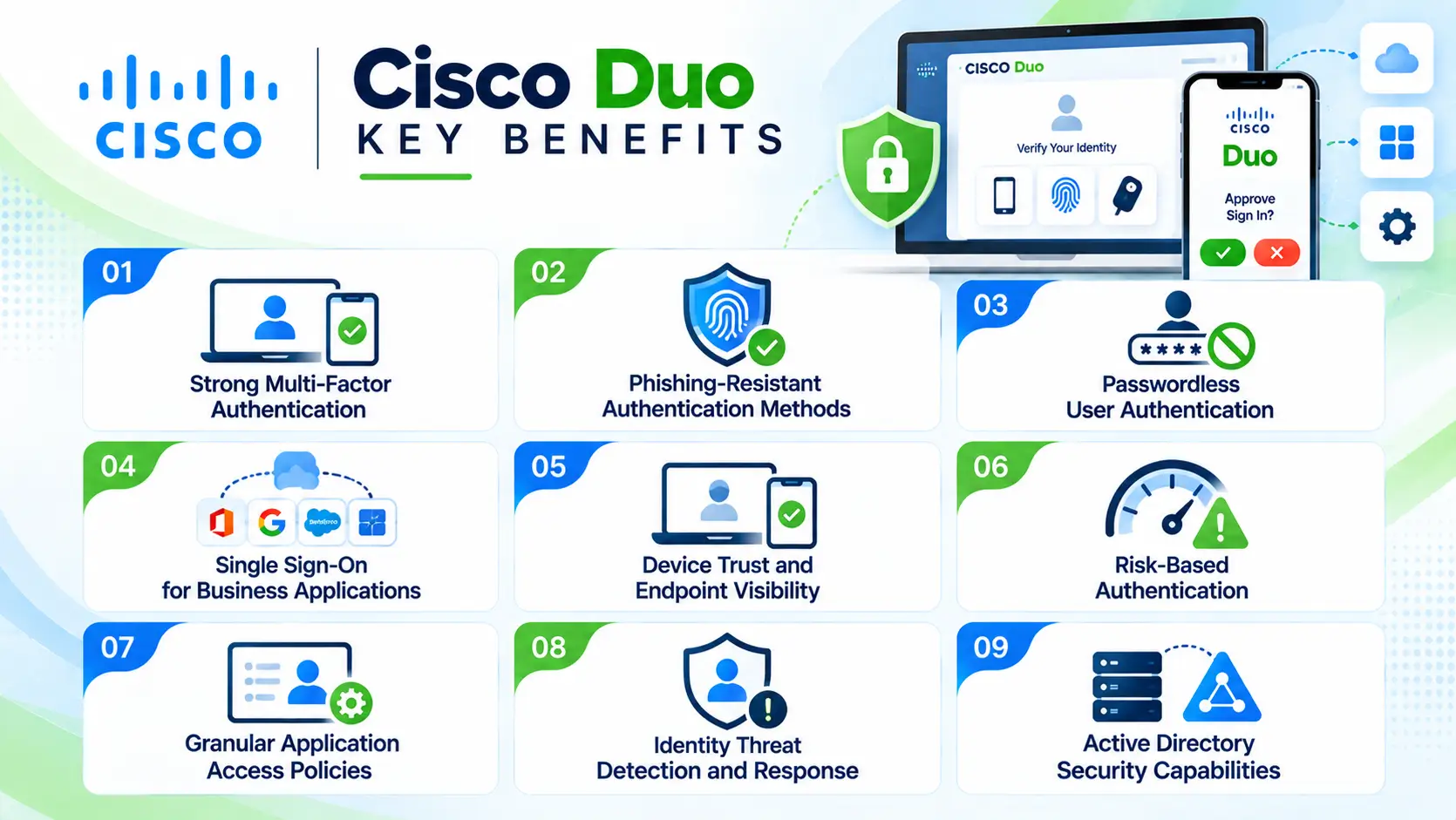
- Strong multi-factor authentication
- Phishing-resistant authentication methods
- Passwordless user authentication
- Single Sign-On for business applications
- Device trust and endpoint visibility
- Risk-based authentication
- Granular application access policies
- Identity threat detection and response
- Active Directory security capabilities
At a Glance
- Product: Cisco Duo
- Parent Category: Cisco Security
- Primary Use: Secure user and device authentication
- Authentication: MFA, passwordless, Duo Push, security keys and other supported methods
- Access Control: User, application, device, location and risk-based policies
- Device Security: Trusted Endpoints and device posture visibility
- SSO: Available with paid Duo editions
- Identity Security: Advanced capabilities available in higher editions
- Deployment: Cloud-delivered service
- License Editions: Duo Free, Essentials, Advantage and Premier
- Typical Environments: SaaS, VPN, cloud, Windows, web applications and private resources

Cisco Duo License Overview
A Cisco Duo License determines which authentication, access-security, device-trust, and identity-security capabilities an organization can use. Cisco currently separates Duo into multiple editions, allowing customers to choose between basic MFA requirements and more advanced Zero Trust and identity-security deployments.
At the entry level, Duo provides strong MFA for small environments. The commercial editions progressively add capabilities such as SSO, passwordless authentication, Trusted Endpoints, risk-based authentication, identity visibility, Active Directory protection, and secure remote access.
Licensing should therefore be selected according to more than the number of users. The organization should first determine which applications need protection, whether device trust is required, whether authentication risk needs to be evaluated dynamically, and whether Duo will be used primarily for MFA or as part of a broader Zero Trust architecture.
For larger enterprise environments, it is also important to identify administrators, employees, contractors, external users, and other identities that will consume Duo services before defining the required license quantity.
Cisco Duo Product Overview
Cisco Duo operates as an identity-security layer between the user and the protected application. When a user attempts to access an integrated application, Duo evaluates authentication requirements and applicable policies before allowing the session to continue.
This model reduces the security risk associated with compromised passwords because possession of a valid password alone may no longer be sufficient to access protected resources.
Duo can also evaluate information about the endpoint making the request. Organizations can distinguish between trusted and unmanaged devices and apply different access policies accordingly. For example, an organization may permit access from a managed corporate laptop while restricting the same application when accessed from an unknown device.
In advanced deployments, Cisco Duo extends beyond MFA and contributes to broader identity-security controls. Capabilities available in higher editions can analyze authentication risk, provide visibility across identity systems, protect Active Directory environments, and support Zero Trust access to private applications.
Core Technical Flow
The Cisco Duo authentication process begins when a user attempts to access a protected application or resource.
The primary application first validates the user’s identity using its normal authentication mechanism or an integrated identity provider. Duo then introduces the required secondary authentication and policy evaluation.
Depending on configuration, the user may authenticate using Duo Push, a supported passkey or security key, passwordless authentication, or another permitted authentication method.
At the same time, Duo can evaluate contextual information such as the user’s group, target application, endpoint trust status, device security information, and applicable access policy.
The policy engine determines whether the authentication should be accepted, challenged, restricted, or denied. Advanced deployments can also use risk signals to modify authentication requirements dynamically.
After successful verification, the user receives access to the requested resource. Authentication activity is recorded centrally, giving administrators visibility into authentication attempts, users, applications, devices, and policy decisions.
Options & Licensing Models
| Cisco Duo Edition | Primary Licensing Scope | Suitable For |
|---|---|---|
| Duo Free | Strong MFA, application integrations and Duo authentication for up to 10 users | Small environments, testing and basic MFA |
| Duo Essentials | MFA, phishing-resistant authentication, passwordless access, SSO, Trusted Endpoints and unlimited applications | Organizations implementing modern MFA and basic device trust |
| Duo Advantage | Essentials capabilities plus Identity Intelligence, risk-based authentication, Duo Passport, session protection and Active Directory Defense | Enterprises requiring adaptive authentication and broader identity security |
| Duo Premier | Advanced Duo capabilities plus comprehensive Zero Trust access, VPN-less private-resource access and enhanced device trust | Organizations requiring extensive Zero Trust and device-security controls |
The correct Cisco Duo License should be selected according to the organization’s actual security architecture rather than simply purchasing the highest edition.
For example, an organization that mainly requires MFA, SSO, passwordless authentication, and identification of trusted corporate endpoints may find Essentials appropriate. Environments requiring adaptive authentication and stronger identity-threat visibility may require Advantage, while Premier is more appropriate when comprehensive device trust and Zero Trust remote access are required.
Features & Benefits
Strong Authentication and Passwordless Access
Cisco Duo strengthens user authentication through multi-factor authentication, phishing-resistant methods, and passwordless access. These capabilities reduce reliance on passwords alone and help limit the impact of credential theft, password reuse, and phishing attacks. Organizations can combine Duo Push, supported passkeys, security keys, and other approved authentication methods to create a more resilient sign-in process while keeping access relatively simple for legitimate users.
Device Trust, SSO, and Risk-Based Access
Cisco Duo combines Single Sign-On, Trusted Endpoints, and contextual access policies to evaluate both the user and the device before access is granted. Administrators can distinguish between managed and unmanaged endpoints, apply application-specific access requirements, and use risk-based authentication to introduce stronger verification when suspicious or unusual activity is detected. This helps organizations enforce adaptive access controls without applying the same restrictions to every user and session.
Identity Security and Zero Trust Protection
Advanced Cisco Duo editions extend beyond MFA by adding identity-security, Active Directory protection, ITDR capabilities, and Zero Trust access controls. These functions help organizations identify identity-related risks, strengthen protection around directory environments, and control access to private applications based on user, device, and contextual signals. With Duo Premier, organizations can also support VPN-less access scenarios as part of a broader Zero Trust architecture.
Compatibility & Requirements
Before ordering a Cisco Duo License, review the systems and applications that Duo will protect.
Important information includes:
- Total number of users requiring Duo authentication
- Current identity provider and directory architecture
- Microsoft Active Directory or Entra ID environment
- VPN and remote-access platforms
- SaaS and cloud applications requiring MFA
- On-premises applications requiring protection
- Windows, macOS, Linux, Android and iOS endpoints
- Requirement for Trusted Endpoints
- Existing endpoint-management or MDM platforms
- Passwordless authentication requirements
Trusted Endpoints can work with Duo Desktop and supported device-management integrations to identify managed systems. Organizations should verify the specific operating-system, application and integration requirements against the planned Duo deployment.
Activation and Deployment
Cisco Duo deployment normally begins by creating the Duo tenant and connecting the required identity, application and endpoint environments.
Administrators then add the applications that require protection. Depending on the application, integration may use SAML, RADIUS, Duo Authentication Proxy, native Duo integrations, APIs, or other supported authentication mechanisms.
Users are enrolled in Duo and appropriate authentication methods are configured. Administrators can then define policies controlling authentication methods, users, groups, applications, endpoint requirements, and other contextual conditions.
A phased rollout is generally preferable for enterprise deployments. Organizations can initially protect a small group of users and applications, verify authentication behavior, test emergency-access procedures, and validate device policies before expanding Duo to the broader environment.
For organizations implementing Trusted Endpoints, Duo Desktop or the relevant device-management integration should also be tested before access from unmanaged devices is blocked.
Cisco Duo License Pricing and Quote
Cisco Duo License pricing depends primarily on the selected edition and number of licensed users. Cisco currently offers Duo Free, Essentials, Advantage, and Premier editions, with progressively broader authentication, identity-security, device-trust, and Zero Trust capabilities.
Before requesting a commercial quote, organizations should define the number of users, required edition, applications requiring protection, device-trust requirements, identity infrastructure, remote-access architecture, and required advanced security capabilities.
This information helps prevent both under-licensing and purchasing an edition containing capabilities that the organization does not require.
For enterprise environments, a licensing assessment should also determine whether Duo is being deployed only as an MFA solution or whether capabilities such as SSO, Trusted Endpoints, risk-based authentication, ITDR, Active Directory Defense, and Zero Trust private access will form part of the final architecture.
Cisco Duo pricing depends on your license type, deployment model and support requirements.