

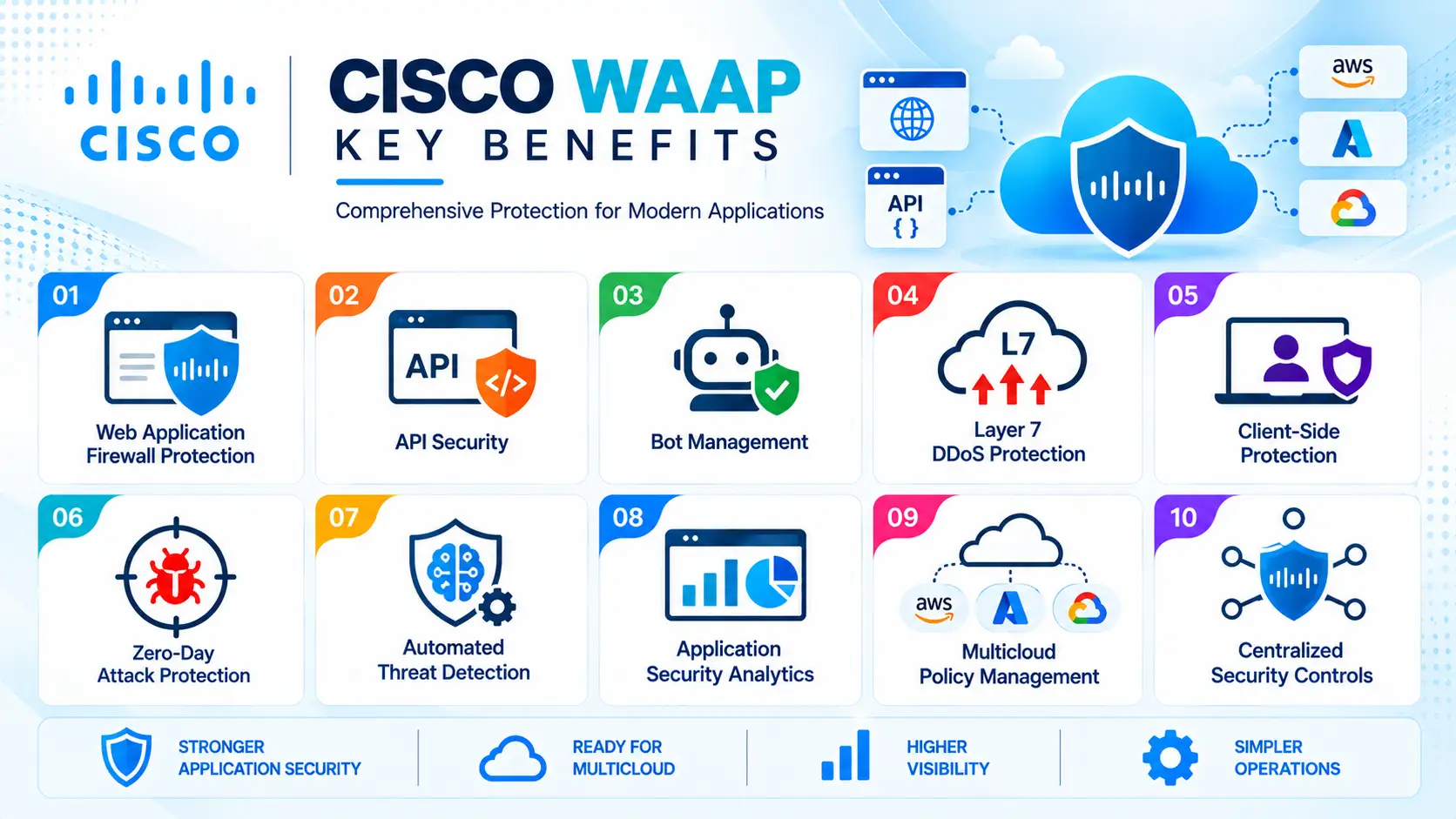
Cisco WAAP License provides access to Cisco Web Application and API Protection capabilities for organizations that need to protect web applications, APIs, and online services from application-layer attacks. Cisco WAAP combines Web Application Firewall (WAF), API security, bot protection, DDoS mitigation, and client-side protection into a cloud-delivered application-security platform.
Quick Benefits
- Web application firewall protection
- API security
- Bot management
- Layer 7 DDoS protection
- Client-side protection
- Zero-day attack protection
- Automated threat detection
- Application security analytics
- Multicloud policy management
- Centralized security controls
Cisco WAAP License At a Glance
What it is: Cloud-based Web Application and API Protection service.
Vendor: Cisco
Primary role: Protection of web applications, APIs, and online services.
Core technologies: WAF, API protection, bot management, DDoS protection, and client-side security.
Deployment: Cloud-based application-security service.
Service plans: Essentials, Advantage, and Premier.
DDoS capacity: 1 Gbps with Essentials and 10 Gbps with Advantage and Premier; additional DDoS options are available.
Typical users: Enterprises, application owners, security teams, e-commerce platforms, SaaS providers, and organizations operating internet-facing applications.
Licensing model: Subscription-based service plans.
License Overview
The Cisco WAAP License is structured around cloud-based service plans rather than a traditional hardware appliance. The selected plan determines the level of application protection, automation, analytics, support, and additional security capabilities available to the organization.
Cisco currently provides three primary service plans: Essentials, Advantage, and Premier. Essentials provides core WAF, API protection, basic bot protection, zero-day protection, and 1-Gbps network DDoS protection. Advantage adds capabilities such as Advanced WAF, AI-based correlation, increased DDoS protection, and client-side detection. Premier adds advanced bot management, API discovery, API business-logic attack protection, and client-side mitigation.
The appropriate license should therefore be selected according to the application’s exposure, API architecture, expected traffic, bot activity, DDoS risk, and required security controls.
Licensing Highlights
Cisco WAAP licensing is primarily service-plan based. Organizations should first determine the required protection level and then identify optional services that may need to be added.
Common sizing considerations include:
- Number of protected applications
- Web traffic volume
- API exposure
- DDoS requirements
- Bot-management requirements
- Client-side protection
- Required support level
- Data-retention requirements
Cisco also provides optional capabilities such as Web DDoS Protection, PCI DSS 4 compliance extensions, DNS services, threat intelligence, CDN, additional DDoS capacity, and premium support.
Product Overview
Cisco WAAP is designed to protect applications at the application layer rather than simply controlling network connectivity.
A web request can pass through the WAAP security layer before reaching the protected application. The service evaluates the request against WAF rules, application-security policies, API controls, bot-detection mechanisms, and other applicable protections.
This architecture is useful for applications hosted across public clouds, private infrastructure, or multicloud environments because security policies can be applied without requiring the same WAF infrastructure at every application location.
Core Technical Flow
Client Request
→ User or automated client sends a request to the protected application.
WAAP Inspection
→ Cisco WAAP evaluates the request and its application context.
Security Analysis
→ WAF, API, bot, DDoS, and other applicable controls inspect the traffic.
Policy Decision
→ Legitimate requests are allowed while malicious or suspicious traffic is blocked or mitigated.
Application Delivery
→ Approved traffic continues to the protected application.
Security Analytics
→ Events and security information are available for monitoring and investigation.
Options & Licensing Models
| Plan | Main Purpose | Key Capabilities |
|---|---|---|
| Essentials | Core application protection | WAF, API protection, basic bot protection, zero-day protection, 1-Gbps network DDoS |
| Advantage | Advanced application security | Essentials capabilities plus Advanced WAF, AI-based correlation, 10-Gbps DDoS, client-side detection, advanced support |
| Premier | Comprehensive application protection | Advantage capabilities plus Bot Manager, API discovery, API business-logic protection, client-side mitigation |
| Optional Add-ons | Extend protection | Web DDoS, PCI DSS 4, threat intelligence, DNS, CDN, additional DDoS, premium support |
The current Cisco service-plan matrix shows that WAF, API protection, basic bot protection, access controls, rate limiting, reporting, and analytics are available across all three primary plans, while more advanced API, bot, and client-side capabilities are concentrated in Advantage and Premier.
Features & Benefits
Web Application Firewall
The WAF component protects internet-facing applications against common and advanced web attacks. Cisco’s WAAP solution is designed to address major application-security attack vectors while maintaining application availability.
API Protection
API security extends protection beyond traditional web pages to application interfaces. Cisco WAAP can provide API discovery and, in the Premier tier, capabilities for identifying and protecting against API business-logic attacks.
Bot Management
Automated traffic can consume resources, scrape information, abuse application functionality, or attempt account attacks. Bot protection helps distinguish legitimate automation from malicious or unwanted activity.
Advanced Bot Manager capabilities are included with the Premier plan.
DDoS Protection
WAAP includes network DDoS protection within its service plans, while additional Web DDoS and higher-capacity options can be added according to requirements. The standard plan levels currently provide 1 Gbps with Essentials and 10 Gbps with Advantage and Premier.
Client-Side Protection
Client-side protection addresses threats involving third-party JavaScript and browser-side application components. Cisco describes capabilities for detecting and mitigating threats such as malicious third-party services and JavaScript supply-chain attacks.
AI-Assisted Security
Cisco WAAP uses automation and AI-based analysis to reduce manual security-policy work and improve detection and correlation. Advanced capabilities include AI-based correlation and automated security processes across application and API protection.
Compatibility & Requirements
Cisco WAAP is intended for organizations operating internet-facing web applications, APIs, and online services.
Before selecting a license, evaluate:
- Number of applications
- Web traffic throughput
- API architecture
- Application hosting environment
- Expected bot activity
- DDoS exposure
- Client-side JavaScript dependencies
- Compliance requirements
- Required security integrations
- Support requirements
The multicloud nature of the application environment should also be considered because Cisco positions WAAP for consistent application-security policies across multicloud environments.
How Activation Works
Cisco WAAP is delivered as a cloud service. After the appropriate service plan is selected, the protected applications and traffic flows are configured within the WAAP environment.
A typical implementation involves:
- Select the appropriate WAAP service plan
- Define the applications and APIs to protect
- Configure application-security policies
- Configure DNS or traffic routing as required
- Enable WAF and API protections
- Configure bot and DDoS controls
- Validate legitimate and malicious traffic handling
- Move the application into production protection
For organizations migrating from another WAF, policy tuning and application testing should be performed before full production enforcement.
Pricing + Quote
Cisco WAAP pricing depends on the selected service plan, protected applications, traffic volume, security capabilities, optional services, and subscription term.
For an accurate quotation, provide:
- Number of applications
- Expected web traffic
- API scope
- Required WAAP plan
- DDoS requirements
- Bot-management requirements
- Client-side protection requirements
- Compliance requirements
- Optional services
- Subscription duration
A basic web application deployment may fit the Essentials plan, while applications with significant API exposure, automated traffic, advanced bot activity, or client-side security requirements may justify Advantage or Premier.
Cisco WAAP pricing depends on your license type, deployment model and support requirements.