

BIG-IP Velos is F5’s modular, chassis-based platform for organizations that need BIG-IP application delivery and security services at very high scale. Officially branded F5 VELOS, the platform combines chassis, system controllers, high-performance blades, F5OS, and isolated BIG-IP tenants in an architecture designed for large enterprises, service providers, telecommunications networks, and other environments where a fixed appliance may not provide enough capacity or expansion room.
VELOS replaces the earlier VIPRION chassis architecture and takes a different approach to scaling. Instead of treating the chassis as one large BIG-IP system, administrators can divide hardware into chassis partitions and deploy multiple BIG-IP or supported BIG-IP Next tenants with dedicated compute and networking resources.
Quick Benefits
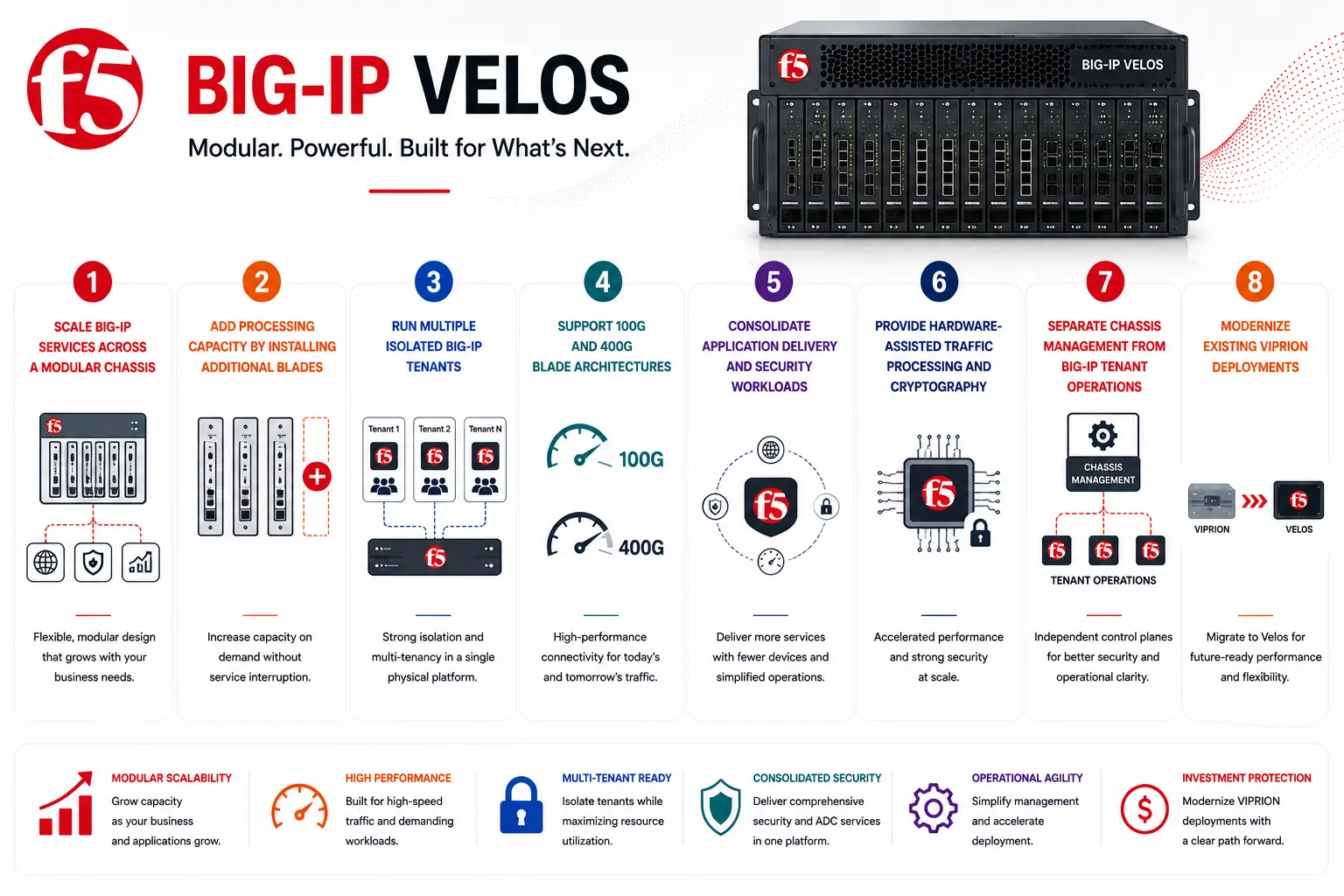
- Scale BIG-IP services across a modular chassis
- Add processing capacity by installing additional blades
- Run multiple isolated BIG-IP tenants
- Support 100G and 400G blade architectures
- Consolidate application delivery and security workloads
- Provide hardware-assisted traffic processing and cryptography
- Separate chassis management from BIG-IP tenant operations
- Modernize existing VIPRION deployments
BIG-IP Velos At a Glance
What it is: Modular high-performance ADC and application security platform
Official product name: F5 VELOS
Product family: BIG-IP License
Current chassis: CX410 and CX1610
Platform software: F5OS
Typical use: Large ADC environments, application security, service providers, telecommunications, AI data delivery, and high-volume application infrastructure
Licensing: System-level Base Registration Key with applicable add-on entitlements
Migration role: Current chassis-based replacement platform for F5 VIPRION
BIG-IP Velos License Overview
VELOS licensing is applied at the system level. A Base Registration Key identifies the purchased entitlements, while additional keys can enable other licensed functions. F5 documentation states that the base registration key and associated add-on keys are preinstalled on a new VELOS system.
For classic BIG-IP deployments, the system license and associated add-on keys apply across the chassis partitions and BIG-IP tenants. This is important in a consolidated design: administrators do not normally license each classic BIG-IP tenant as though it were a completely separate physical appliance.
The exact services available still depend on the purchased entitlement. An organization may require BIG-IP traffic management, DNS, application security, network firewalling, access services, or a combination of functions. The license design should therefore be reviewed together with the chassis and tenant architecture rather than after the hardware has already been selected.
BIG-IP Velos Product Overview
VELOS consists of three main hardware layers: the chassis, system controllers, and blades. System controllers provide centralized management connectivity, while the blades perform the traffic-processing work. F5OS provides the platform layer used to manage chassis resources, partitions, networking, and tenants.
VELOS Chassis and Blades
| Component | Role |
|---|---|
| CX410 | 4RU modular chassis with eight quarter-width slots |
| CX1610 | 16RU chassis with 32 quarter-width slots |
| BX110 | 100 Gbps-class quarter-width traffic-processing blade |
| BX520 | 400 Gbps-class half-width high-performance blade |
| System Controllers | Platform management, external connectivity, CLI, webUI, and APIs |
| BIG-IP Tenant | Isolated BIG-IP software instance using assigned chassis resources |
F5 currently states that the CX410 can support up to eight BX110 blades or four BX520 blades, while the larger CX1610 supports up to sixteen BX520 blades.
The BX110 includes two 100GbE QSFP28 interfaces and supports breakout configurations for 25G and 10G connectivity. The newer BX520 increases per-blade capacity substantially and was introduced for demanding workloads including AI data delivery and high-scale telecommunications environments.
Core Technical Flow
Client Traffic → VELOS Chassis → Blade Processing → BIG-IP Tenant → Licensed Application Service → Application
Traffic enters through interfaces on the VELOS blades. The platform layer directs that traffic toward the appropriate tenant according to the configured VLANs, interfaces, and chassis resources. Inside the tenant, BIG-IP performs the familiar application-delivery workflow. LTM can make load-balancing and health decisions, while licensed security, DNS, firewall, or access functions apply their respective policies before traffic reaches the backend application.
This separation is important operationally. The VELOS administrator manages the chassis, partitions, blade resources, and tenant deployment, while individual BIG-IP tenants can retain their own configuration and operational boundaries. A tenant receives dedicated vCPU and memory allocations and can be restricted to specific network connectivity.
Options & Licensing Models
A VELOS design normally involves four purchasing decisions:
Chassis size: CX410 fits deployments that require modular capacity without a full 16RU chassis, while CX1610 targets much larger scale.
Blade capacity: BX110 provides 100 Gbps-class connectivity, while BX520 increases compute and network capacity for substantially larger workloads.
Tenant architecture: Resources can be concentrated into a few large BIG-IP tenants or divided among multiple smaller workloads. Current VELOS software supports multitenancy, with tenant capacity depending on blade type, allocated CPU, memory, and software compatibility.
BIG-IP services: Licensing must cover the application-delivery and security functionality required by the tenants.
Features & Benefits
The biggest advantage of BIG-IP Velos is scale without losing workload separation. A service provider, for example, can divide chassis resources among different BIG-IP environments rather than operating many independent physical ADCs.
Capacity can also grow incrementally. An organization may start with a partially populated chassis and add blades as application traffic increases. That is fundamentally different from replacing a fixed appliance once its physical processing ceiling is reached.
VELOS also provides strong automation potential. System controllers expose CLI, webUI, and REST API management, while current BIG-IP releases support cloud-init for automated initial provisioning of tenants on VELOS.
For customers moving away from VIPRION, the platform provides a more modern chassis architecture while preserving the ability to operate familiar BIG-IP services. F5 explicitly positions VELOS as the next-generation replacement for VIPRION chassis systems.
Compatibility & Requirements
Before ordering or expanding a VELOS environment, confirm:
- CX410 or CX1610 chassis requirement
- BX110 or BX520 blade type and quantity
- Required BIG-IP services
- BIG-IP or BIG-IP Next tenant version
- Number and size of planned tenants
- CPU and memory allocation
- 10G, 25G, 40G, 100G, or higher connectivity requirements
- HA and chassis-resiliency design
- Power and rack requirements
- Existing VIPRION migration requirements
Software compatibility needs particular attention because F5OS, blade generation, and BIG-IP tenant versions must be supported together. F5 maintains a dedicated F5OS hardware/software support matrix for VELOS.
How BIG-IP Velos Activation Works
New VELOS systems arrive with a Base Registration Key preinstalled. When internet connectivity is available, the administrator can activate the system through the system-controller web interface using F5’s licensing service. For disconnected environments, VELOS also supports manual activation. The administrator generates a dossier, obtains the corresponding license information through F5’s licensing workflow, and installs it on the platform. Add-on keys can then be applied for additional purchased capabilities.
As of F5OS 2.0.0, released in June 2026, F5 unified the previously separate F5OS-A software for rSeries and F5OS-C software for VELOS into a common F5OS release.
BIG-IP Velos Pricing & Quote Process
BIG-IP Velos pricing depends heavily on the physical architecture. The main factors are the chassis, blade generation and quantity, BIG-IP services, number and size of tenants, interface requirements, redundancy, power configuration, optics, and support. A CX410 with a limited number of blades represents a very different deployment from a heavily populated CX1610 supporting large numbers of application workloads.
For pricing, enter F5 as the brand and BIG-IP Velos as the product. If the project is replacing VIPRION, include the current chassis, blade configuration, licensed BIG-IP modules, traffic levels, and tenant or vCMP layout. This provides a much better basis for selecting the replacement platform than matching chassis names alone.
F5 pricing depends on your product edition, license type, deployment model, traffic needs, term, and support requirements.