

Imagicle Virtual Agents is an intelligent communication solution designed to automate customer interactions through virtual assistants, conversational workflows, and AI-powered support capabilities. An Imagicle Virtual Agents License enables organizations to improve service availability, automate repetitive requests, and provide faster responses across business communication channels.
Quick Benefits
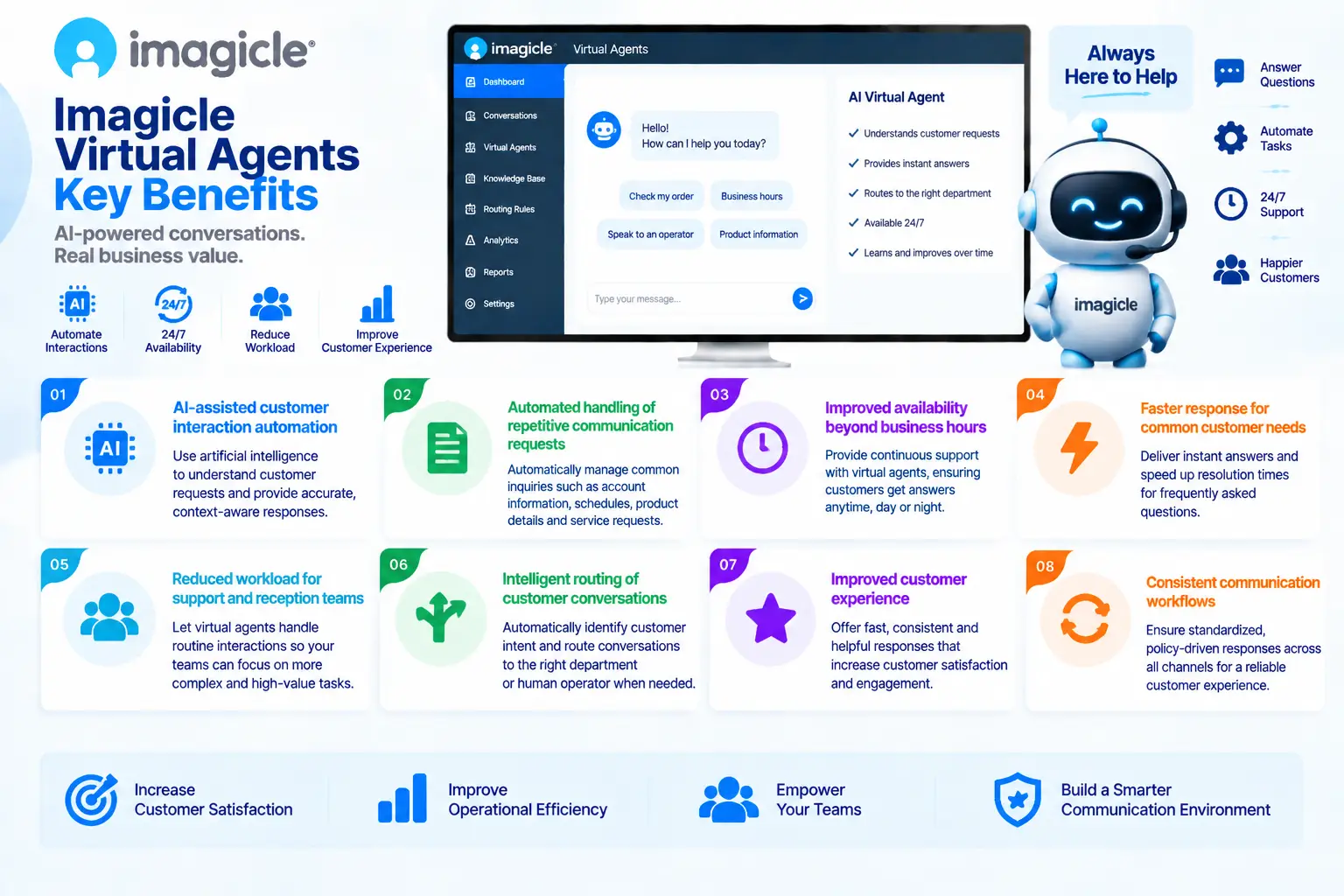
- AI-assisted customer interaction automation
- Automated handling of repetitive communication requests
- Improved availability beyond business hours
- Faster response for common customer needs
- Reduced workload for support and reception teams
- Intelligent routing of customer conversations
- Improved customer experience
- Consistent communication workflows
Imagicle Virtual Agents At a Glance
What it is: AI-powered virtual agent and automated communication solution
Parent category: Imagicle License
Primary role: Automate customer and business communication interactions using intelligent virtual assistants
Main users: Customer service teams, enterprises, support departments, communication managers, and organizations requiring automated assistance
Core capabilities: Virtual assistants, conversational workflows, automated responses, customer guidance, and communication automation
Integration platforms: Imagicle communication environments, Cisco collaboration platforms, and supported enterprise communication systems
Deployment: Cloud, hybrid, and supported enterprise deployment models
License Overview
An Imagicle Virtual Agents License is generally determined by the level of automation required, the number of virtual agents deployed, interaction volume, and the communication workflows that need to be automated. Unlike traditional communication applications that are mainly licensed around users or extensions, virtual agent solutions are often evaluated based on the number of automated services, customer interactions, integrations, and AI capabilities required by the organization.
Organizations should evaluate the types of requests they want to automate, expected conversation volume, departments involved, required integrations, and escalation workflows before selecting the appropriate license model. For example, a customer support department may use virtual agents to answer frequently asked questions and guide customers toward the correct service, while a larger enterprise may require multiple virtual assistants across different business areas. When selecting an Imagicle Virtual Agents License, organizations should consider both current automation goals and future expansion because additional services, departments, and communication channels may increase requirements over time.
Product Overview
AI-Based Communication Automation
Modern organizations receive large numbers of repetitive customer and employee requests that do not always require direct human assistance.
Imagicle Virtual Agents provide an automated communication layer that helps organizations handle common interactions through intelligent virtual assistants.
By automating routine conversations, businesses can improve response speed while allowing employees to focus on more complex tasks.
Automated Customer Assistance
Many customer interactions involve repeated questions, service requests, or basic information needs.
Imagicle Virtual Agents help organizations create automated workflows that guide users through predefined communication paths.
Instead of waiting for an available employee, customers can receive immediate assistance for supported requests.
This improves service availability and creates a more consistent communication experience.
Intelligent Conversation Workflows
Effective automation requires more than simple menu-based routing.
Imagicle Virtual Agents support structured conversational workflows that allow organizations to design how interactions should progress.
Businesses can define responses, decision paths, and escalation scenarios according to their operational requirements.
This helps create more natural communication experiences while maintaining control over business processes.
Core Technical Flow
Customer Request / Incoming Interaction
→ Imagicle Virtual Agent Interface
→ Intent Recognition and Workflow Processing
→ Automated Response or Action
→ Escalation to Human Agent if Required
→ Interaction Completion and Reporting
Options and Licensing Models
| Licensing Factor | Description | Suitable For |
|---|---|---|
| Virtual Agents | Number of automated assistants deployed | Organizations with multiple services or departments |
| Interaction Volume | Number of conversations processed | Businesses with different communication scales |
| Automation Workflows | Complexity and number of conversational scenarios | Organizations requiring customized automation |
| Integrations | Connected communication platforms and systems | Enterprise environments |
| AI Capabilities | Required intelligence and automation features | Businesses seeking advanced assistance |
| Support and Subscription | Updates, maintenance, and technical assistance | Long-term production deployments |
Features and Benefits
Imagicle Virtual Agents help organizations improve communication efficiency by introducing automation into customer and employee interactions. Instead of depending entirely on human teams for every request, businesses can provide immediate assistance for common scenarios while maintaining structured escalation paths.
A key benefit is improved service availability. Virtual agents can support communication outside standard working hours and provide consistent responses regardless of demand levels. The solution also helps organizations optimize resources by reducing repetitive tasks handled by support teams. Employees can focus on complex interactions while automated workflows manage routine requests. For businesses looking to modernize customer communication, virtual agents provide a practical way to combine automation with existing unified communications environments.
Compatibility and Requirements
Before deploying Imagicle Virtual Agents, organizations should evaluate their communication environment and automation requirements.
Important considerations include:
- Existing communication platforms
- Types of interactions to automate
- Required integrations
- Expected conversation volume
- Escalation workflows
- Security and access requirements
- Data management policies
Organizations should define automation objectives clearly before deployment to ensure that virtual agent workflows match real business processes. Integration requirements may vary depending on the communication platforms and applications involved.
Activation and Deployment
Imagicle Virtual Agents deployment begins with activating the purchased license and preparing the required communication environment.
Typical deployment steps include:
- License registration and activation
- Configuring virtual agent workflows
- Connecting communication channels
- Defining automated responses
- Testing interaction scenarios
Organizations usually begin with limited use cases before expanding automation across additional services and departments.
Pricing and Quote Process
Pricing for an Imagicle Virtual Agents License depends mainly on the number of virtual agents, interaction volume, required automation capabilities, integrations, and deployment requirements.
Before requesting a quote, organizations should define:
- Number of virtual assistants required
- Target communication scenarios
- Expected interaction volume
- Required integrations
- Automation complexity
- Support and subscription requirements
Accurate planning helps organizations select the appropriate automation capacity without unnecessary licensing expenses. Organizations should also consider future growth because additional services, departments, and communication channels may increase virtual agent requirements.
Imagicle pricing depends on your selected applications, licensing model, deployment environment, subscription term, and support needs.