

Cisco Cyber Vision License provides industrial organizations with visibility, security monitoring, vulnerability assessment, and threat-detection capabilities for Operational Technology (OT) and Industrial Control System (ICS) environments. Designed specifically for industrial networks, Cisco Cyber Vision helps organizations discover connected assets, understand industrial communication patterns, evaluate device risk, and detect suspicious behavior without disrupting critical operations.
Quick Benefits
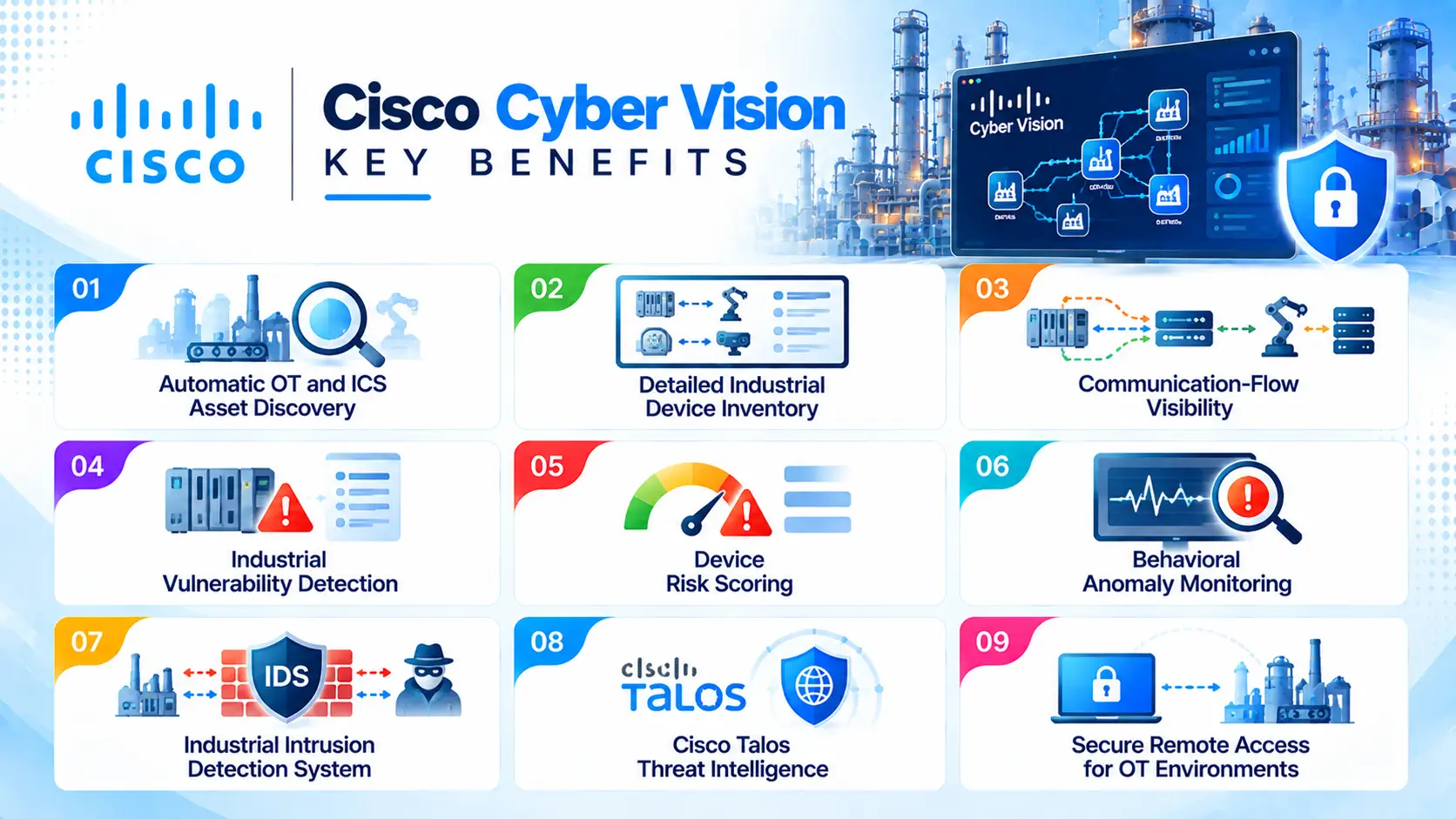
- Automatic OT and ICS asset discovery
- Detailed industrial device inventory
- Communication-flow visibility
- Industrial vulnerability detection
- Device risk scoring
- Behavioral anomaly monitoring
- Industrial Intrusion Detection System
- Cisco Talos threat intelligence
- Secure remote access for OT environments
At a Glance
- Product: Cisco Cyber Vision
- Parent Category: Cisco Security
- Primary Use: Industrial asset visibility and threat detection
- License Tiers: Essentials and Advantage
- License Metric: Number of monitored endpoints
- Subscription Terms: 1, 3, 5, or 7 years
- Licensing Platform: Cisco Smart Licensing
- Offline Licensing: Specific License Reservation
- Management: Cisco Cyber Vision Center
- Detection: Passive monitoring, behavioral analysis, and IDS

Cisco Cyber Vision License Overview
Cisco Cyber Vision licensing is based primarily on the number of industrial endpoints monitored by the platform. Cisco currently provides two main subscription levels: Essentials and Advantage.
The Essentials license focuses on foundational OT visibility and vulnerability management. It provides device inventory, communication-pattern identification, inventory reporting, vulnerability identification, vulnerability-data export, control-system event tracking, and access to the REST API.
The Advantage license includes all Essentials capabilities and adds more advanced security functions. These include device risk scoring, security posture reporting, intrusion detection, behavioral monitoring, alerts on deviations from defined baselines, advanced integrations, and secure remote access.
Cyber Vision licenses are available in one-, three-, five-, and seven-year subscription terms. Organizations can purchase endpoint license packs according to the actual number of devices that require monitoring.
Cisco Cyber Vision Product Overview
Cisco Cyber Vision is designed to provide cybersecurity visibility inside industrial networks where traditional IT security tools may not understand proprietary protocols, industrial controllers, or operational processes.
Sensors collect information from industrial network traffic and forward relevant metadata to Cisco Cyber Vision Center. The platform analyzes this data to identify devices, vendors, communication relationships, industrial protocols, and device behavior.
This gives security teams visibility into assets such as PLCs, HMIs, industrial PCs, drives, controllers, sensors, and other OT equipment that may otherwise be difficult to inventory.
Cyber Vision also adds operational context. Instead of treating each endpoint simply as an IP address, it can identify the role of devices and the industrial communications occurring between them. This helps teams distinguish legitimate production activity from potentially suspicious changes.
Core Technical Flow
Cisco Cyber Vision begins by collecting telemetry from supported sensors deployed throughout the industrial network.
These sensors observe OT traffic and extract relevant information without requiring software agents on most industrial devices. Collected metadata is then sent to the Cyber Vision Center for analysis.
The Center builds an inventory of discovered devices and communication relationships. Administrators can review asset identity, industrial protocols, vulnerabilities, network activity, and communication dependencies.
With Advantage licensing, Cyber Vision can establish behavioral baselines and generate alerts when devices or communication patterns deviate from expected behavior.
IDS capabilities can also analyze industrial traffic using supported Snort signatures and Cisco Talos intelligence.
Security data can then be shared with platforms such as Cisco ISE, Cisco XDR, Splunk, QRadar, and ServiceNow OT Management for broader investigation, access control, or operational workflows.
Options & Licensing Models
| License Option | Main Capabilities | Typical Use |
|---|---|---|
| Cyber Vision Essentials | Asset inventory, communication mapping, vulnerabilities, activity tracking, reporting, REST API | Organizations beginning OT visibility and vulnerability management |
| Cyber Vision Advantage | Essentials plus risk scoring, IDS, behavioral monitoring, secure remote access, and advanced integrations | Enterprises requiring complete OT security monitoring |
| Talos IDS Subscriber Rules | Expanded industrial IDS signatures with faster rule availability | Environments requiring advanced IDS coverage |
| 1-Year Subscription | Short-term endpoint licensing | Initial deployment or flexible projects |
| 3-Year Subscription | Multi-year licensing | Standard production deployments |
| 5-Year Subscription | Long-term subscription | Enterprise OT security programs |
| 7-Year Subscription | Extended lifecycle licensing | Industrial environments with long equipment lifecycles |
Cyber Vision Advantage subscriptions ordered or renewed under Cisco’s current licensing model also include Cisco Secure Equipment Access Advantage for the same number of licensed endpoints.
Features & Benefits
Industrial Asset Visibility and Vulnerability Management
Cisco Cyber Vision automatically identifies industrial devices and builds a detailed inventory of assets, communication relationships, protocols, and operational activity. This helps organizations eliminate blind spots that commonly exist in OT networks and provides a more accurate view of what is connected. Vulnerability information can then be associated with discovered devices, allowing security teams to prioritize remediation according to asset criticality and operational risk rather than relying only on generic vulnerability scores.
Behavioral Monitoring, IDS, and Threat Detection
Cyber Vision Advantage extends visibility with behavioral monitoring and intrusion detection. Administrators can define expected device and application behavior and receive alerts when communication patterns deviate from established baselines. IDS capabilities use Snort technology and Cisco Talos intelligence to detect known attack patterns and suspicious industrial activity. These capabilities help identify unauthorized changes, compromised assets, reconnaissance activity, and other threats without requiring intrusive scanning of sensitive OT systems.
Secure OT Access and Enterprise Security Integration
Cisco Cyber Vision integrates industrial security with broader enterprise security operations. Advantage licensing supports integrations with Cisco ISE, Cisco XDR, SIEM platforms such as Splunk and QRadar, and ServiceNow OT Management. Secure remote access capabilities can also be delivered through Cisco Secure Equipment Access, allowing organizations to control technician and third-party access to industrial assets. This helps bridge traditional IT and OT security workflows while maintaining controls appropriate for production environments.
Compatibility & Requirements
Before ordering a Cisco Cyber Vision License, organizations should evaluate:
- Number of industrial endpoints requiring monitoring
- Required Essentials or Advantage capabilities
- Number and location of industrial sites
- Cyber Vision Center deployment requirements
- Physical, virtual, VM, or Docker sensor requirements
- Existing industrial Ethernet infrastructure
- Supported Cisco industrial switches and routers
- Industrial protocols in use
- IDS requirements
The Cyber Vision Center can be deployed as a hardware or virtual appliance, while sensors can run on several supported Cisco network platforms and dedicated sensor architectures.
Activation and Deployment
Deployment begins by identifying the industrial sites, network segments, and endpoints that require visibility. Sensor placement should provide adequate coverage of critical OT communications without changing production traffic flows.
The Cisco Cyber Vision Center is then deployed and connected to the required sensors. As telemetry is collected, the platform begins discovering assets, communication relationships, protocols, and vulnerabilities.
After the initial inventory is established, administrators can organize devices, review vulnerabilities, and define behavioral baselines.
Advantage deployments can then enable IDS, risk scoring, advanced integrations, and secure remote-access capabilities as required.
Cyber Vision uses Cisco Smart Licensing for entitlement management. Environments without persistent internet connectivity can use Specific License Reservation, making the platform suitable for highly restricted or air-gapped industrial networks.
Cisco Cyber Vision License Pricing and Quote
Cisco Cyber Vision License pricing depends primarily on the number of monitored endpoints, selected Essentials or Advantage tier, subscription duration, and required IDS capabilities.
Endpoint license packs can be sized according to the number of devices requiring monitoring. Subscription terms are available for one, three, five, or seven years.
Additional costs may apply for Cyber Vision Center hardware, dedicated sensors, Talos subscriber IDS rules, or supporting infrastructure depending on the deployment architecture.
Before requesting a quote, prepare the endpoint count, required license tier, subscription term, number of sites, Center deployment model, sensor architecture, IDS requirements, remote-access requirements, and required integrations.
Cisco Secure Access pricing depends on your license type, deployment model and support requirements.