

Cisco Secure Web License provides organizations with secure web gateway capabilities for controlling, inspecting, and protecting web traffic across enterprise networks. Delivered through Cisco Secure Web Appliance, formerly known as Cisco Web Security Appliance or WSA, the platform helps organizations reduce exposure to malicious websites, malware, risky applications, and unauthorized web activity.
With a Cisco Secure Web License, security teams can apply URL filtering, application controls, malware protection, traffic inspection, reporting, and threat-intelligence capabilities to user web traffic. Depending on the selected license tier, organizations can extend protection from core web-policy enforcement to advanced malware analysis, file reputation, sandboxing, and behavioral threat detection.
Quick Benefits
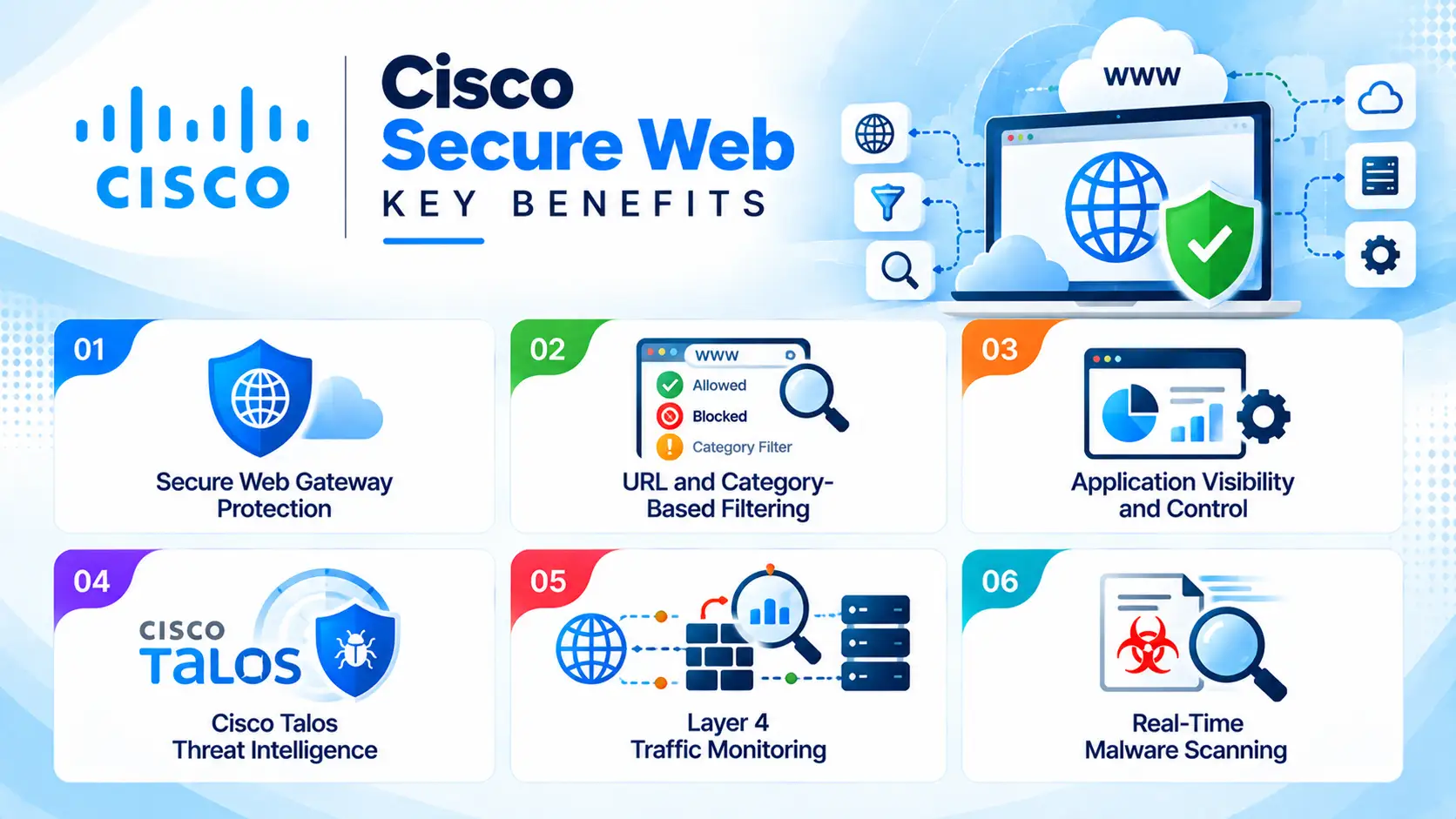
- Secure web gateway protection
- URL and category-based filtering
- Application Visibility and Control
- Cisco Talos threat intelligence
- Layer 4 traffic monitoring
- Real-time malware scanning
- Advanced malware protection
- File reputation and sandbox analysis
- Centralized web-access policies
At a Glance
- Product: Cisco Secure Web Appliance
- Parent Category: Cisco Security
- Former Name: Cisco Web Security Appliance
- Category: Secure Web Gateway
- Primary Use: Web traffic security and access control
- License Tiers: Essentials, Advantage, and Premier
- Subscription Terms: 1, 3, or 5 years
- License Metric: User-based quantity tiers
- Deployment: Physical or virtual appliance
- Virtual Platform: Cisco Secure Web Virtual Appliance
- Threat Intelligence: Cisco Talos
- Licensing Management: Cisco Smart Licensing on current AsyncOS releases
Cisco Secure Web License Overview
Cisco Secure Web licensing determines which web-security and malware-protection capabilities are available on the Secure Web Appliance. Cisco currently provides three main software tiers: Essentials, Advantage, and Premier.
The Essentials tier provides the foundation for enterprise web-security enforcement. It includes Cisco Talos threat intelligence, Layer 4 traffic monitoring, Application Visibility and Control, URL filtering, policy management, reporting, and support for third-party DLP integration.
Advantage builds on Essentials by adding real-time malware scanning, making it more appropriate for organizations that require stronger inspection of downloaded content and web-based threats.
Premier provides the broadest protection level. It includes the capabilities available in Advantage and adds advanced malware protection, file reputation and analysis, sandbox-related threat inspection, and additional advanced threat-detection capabilities.
Cisco Secure Web licenses are offered as term-based subscriptions and use tiered pricing according to the number of users rather than the number of endpoint devices.
Cisco Secure Web Product Overview
Cisco Secure Web Appliance operates as a secure web gateway between users and external web resources. Web requests can be inspected before reaching their destination, allowing the appliance to determine whether the requested site, application, or content complies with organizational security policies.
Administrators can use URL categories, user identity, application information, destination reputation, and other contextual data to determine whether traffic should be allowed, blocked, redirected, or inspected.
The platform also incorporates Cisco Talos threat intelligence to help identify malicious domains, suspicious destinations, malware, and emerging web threats.
For organizations requiring additional malware protection, higher licensing tiers extend inspection beyond basic URL and policy controls by analyzing downloaded files, checking file reputation, and using advanced analysis mechanisms to identify previously unknown threats.
Core Technical Flow
The process begins when a user attempts to access a website or web application.
Traffic is directed through Cisco Secure Web Appliance using the organization’s configured proxy, network, or traffic-redirection architecture. The appliance identifies the user, destination, application, and relevant security-policy context.
URL reputation and category information can then be evaluated against configured access policies. Application Visibility and Control can provide additional information about the service or application being accessed.
If the request is permitted, web content can be inspected according to the configured security controls. Malware scanning and advanced file inspection may be applied when the corresponding Secure Web license capabilities are enabled.
The appliance then allows, blocks, or otherwise handles the request according to policy. Security events, user activity, malware detections, and access information are recorded for reporting and investigation.
Options & Licensing Models
| License Option | Primary Capabilities | Typical Use |
|---|---|---|
| Secure Web Essentials | Talos intelligence, Layer 4 monitoring, AVC, URL filtering, policy management and reporting | Core enterprise web filtering and access control |
| Secure Web Advantage | Essentials capabilities plus real-time malware scanning | Organizations requiring enhanced web-threat protection |
| Secure Web Premier | Advantage plus advanced malware protection, reputation, file analysis and advanced threat detection | Enterprises requiring comprehensive web and malware security |
| 1-Year Subscription | Full licensed functionality for one year | Short-term or flexible deployments |
| 3-Year Subscription | Multi-year subscription entitlement | Standard enterprise deployments |
| 5-Year Subscription | Longer software subscription | Long-term security programs |
| Virtual Appliance License | Secure Web Virtual Appliance entitlement included with supported software bundles | Virtualized or distributed deployments |
Cisco states that a Secure Web Virtual Appliance license is included with Secure Web Appliance software bundles and carries the same term as the associated software services. Virtual instances can therefore provide additional deployment flexibility without requiring the same approach as dedicated physical appliances.
Features & Benefits
Web Access Control and Application Visibility
Cisco Secure Web provides centralized control over how users access websites and internet applications. URL filtering can enforce policies based on website categories and reputation, while Application Visibility and Control gives administrators additional insight into application-level activity. Combined with user-based policies and Layer 4 traffic monitoring, these capabilities help organizations reduce access to malicious, inappropriate, or high-risk destinations while maintaining visibility into legitimate business traffic.
Malware Protection and Advanced Threat Detection
Higher Secure Web license tiers add stronger protection against files and web-based threats. Real-time malware scanning can detect known malicious content, while Premier licensing extends protection with advanced malware analysis, file reputation, and sandbox-based techniques. These controls can help identify threats that may bypass simple signature-based inspection and provide additional context for incident investigation and response.
Centralized Policy, Reporting, and Flexible Deployment
Cisco Secure Web Appliance provides centralized policy administration and reporting for enterprise web traffic. Security teams can review user activity, policy violations, application usage, and threat events from a common platform. The solution can be deployed using physical appliances or Secure Web Virtual Appliances, allowing organizations to adapt deployment to headquarters, data centers, branches, or virtualized infrastructure while maintaining consistent web-security policies.
Compatibility & Requirements
Before ordering a Cisco Secure Web License, organizations should assess:
- Number of users requiring web-security services
- Required Essentials, Advantage, or Premier capabilities
- Existing Secure Web Appliance hardware
- Physical versus virtual deployment requirements
- AsyncOS release and upgrade requirements
- Cisco Smart Licensing readiness
- Proxy and traffic-redirection architecture
- Authentication and directory integration
- URL filtering requirements
- Application-control requirements
- Malware and sandbox-analysis requirements
- Third-party DLP integration
- Centralized reporting requirements
- Cisco Secure Email and Web Manager integration
Current Secure Web Appliance releases use Cisco Smart Licensing. Cisco documentation states that Smart Licensing is mandatory starting with AsyncOS 15.2, and classic licensing commands and interfaces are no longer supported on those releases.
Activation and Deployment
Cisco Secure Web deployment begins by selecting the required software tier and determining whether the environment will use physical or virtual Secure Web Appliances.
Administrators then configure network connectivity, DNS, routing, authentication, proxy behavior, and traffic-redirection methods according to the planned architecture.
On current AsyncOS versions, the appliance should be connected to Cisco Smart Licensing so the required software entitlements can be registered and validated. Cisco’s current setup documentation includes Smart License configuration as part of the initial Secure Web Appliance deployment workflow.
After licensing is activated, administrators can configure access policies, URL filtering, application controls, malware inspection, reporting, and other licensed security services.
A staged rollout is recommended so web filtering, HTTPS inspection, malware controls, authentication, and application policies can be tested before enforcement is expanded to the entire organization.
Cisco Secure Web License Pricing and Quote
Cisco Secure Web License pricing depends primarily on the selected software tier, number of users, subscription duration, and deployment architecture.
Cisco uses quantity-based subscription licensing with pricing tiers based on user counts rather than the number of endpoint devices. Subscription terms are available for one, three, or five years.
Organizations requiring basic web filtering and visibility may choose Essentials, while environments requiring real-time malware scanning should evaluate Advantage. Premier is more appropriate where advanced malware protection, file analysis, reputation services, and comprehensive threat detection are required.
Before requesting a quote, prepare the number of protected users, required license tier, subscription duration, existing Secure Web Appliance models, virtual appliance requirements, AsyncOS version, and any centralized management or security-integration requirements.
Cisco Secure Web pricing depends on your license type, deployment model and support requirements.