

Cisco Edge Platform describes Cisco technologies that place connectivity, security, computing, and application services closer to users, devices, and data sources. It is not one universal product or license. Depending on the project, the term may refer to a secure WAN edge platform, an edge-computing system, or an industrial gateway that processes data beside operational equipment. Moving workloads closer to the source can reduce latency, preserve local operations during WAN disruption, and limit the amount of raw data sent to a remote cloud.
What Cisco Edge Platform Means
A traditional router mainly forwards traffic between a site and external networks. A modern Cisco edge platform may also apply SD-WAN policies, secure traffic, select the best transport, monitor application experience, host virtual network functions, or run local applications. The right architecture depends on the business problem. A branch connecting employees to SaaS services has different requirements from a factory performing machine-vision analysis.
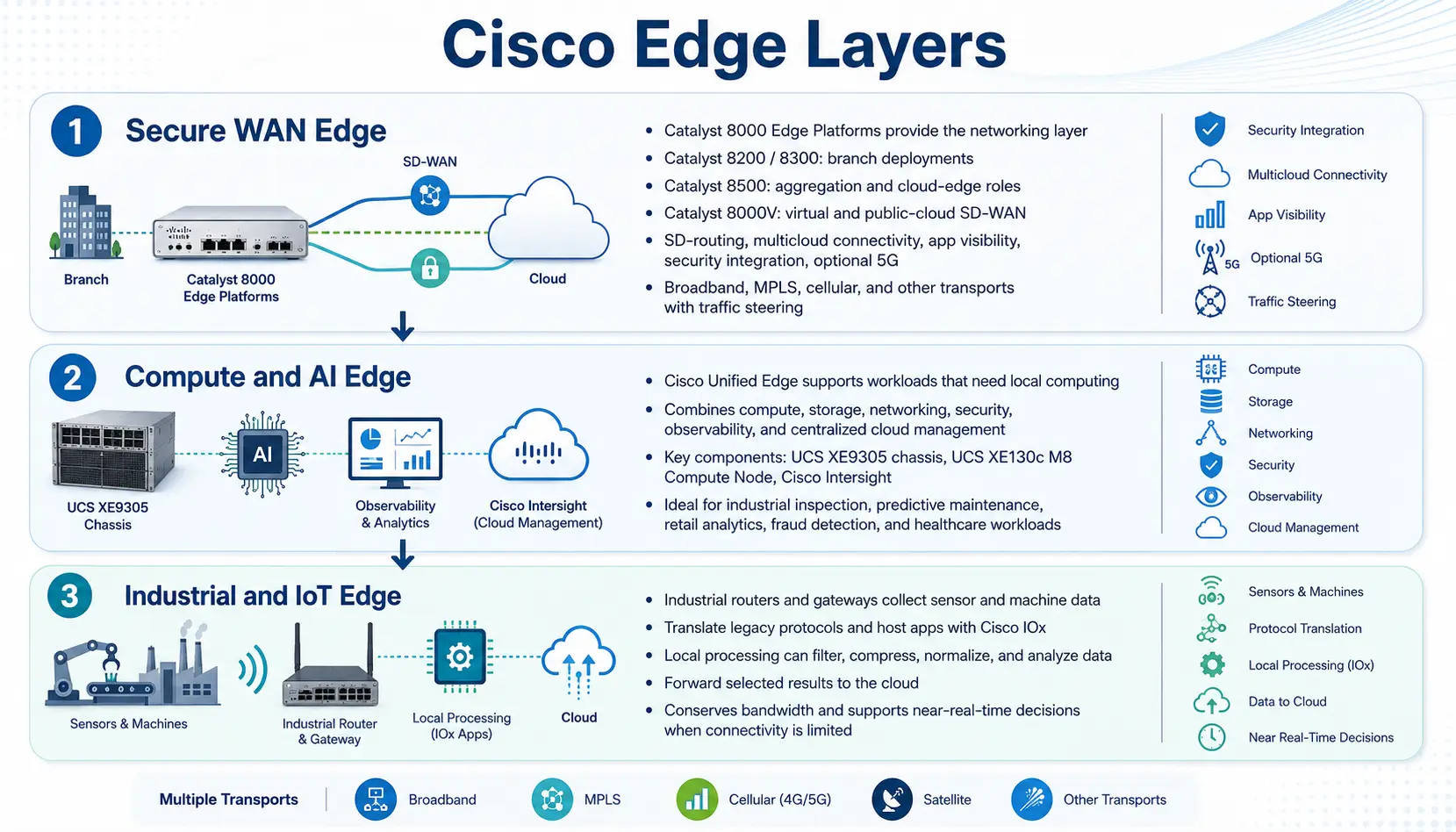
How a Cisco Edge Architecture Works
A Cisco edge design begins with users, sensors, cameras, machines, or applications generating traffic and data at a remote location. The edge platform connects those systems, applies security and routing policy, and decides what should be processed locally and what should be sent to a data center or cloud.
Users, Devices and Sensors → Cisco Edge Platform → Local Networking, Security and Processing → SD-WAN or Cloud Connectivity → Central Management Cisco Catalyst SD-WAN Manager can orchestrate WAN policies and edge routers, while Cisco Intersight manages Unified Edge infrastructure. Industrial deployments may also require gateway and application-management tools suited to operational technology.
Where Cisco Edge Platforms Fit
At a branch, an edge platform can prioritize applications, maintain redundant WAN paths, connect to SaaS services, and direct traffic toward cloud-delivered security. A virtual edge can extend the same policy into public-cloud or colocation environments. In manufacturing, local compute can analyze telemetry or images without sending every data stream to the cloud. Retail sites can continue local transactions during WAN disruption. A factory may combine a Catalyst 8300 for SD-WAN, industrial gateways for machine data, and Unified Edge infrastructure for AI inference. This is why edge should be treated as an architecture rather than one appliance.
Choosing the Right Cisco Edge Platform
The first question is whether the requirement is mainly connectivity, local computing, or industrial data processing. Then evaluate:
- Number and type of locations
- WAN transports and cloud destinations
- Routing, SD-WAN, SASE, and security needs
- Local CPU, GPU, storage, and workload demand
- Environmental and physical constraints
- Management and automation requirements
- Latency, privacy, and offline-operation targets
- Existing Cisco subscriptions and support
A standard branch, an aggregation hub, a cloud transit environment, and an AI-enabled industrial site will not need the same platform.
Commercial and Deployment Considerations
Cisco Edge Platform pricing may include routing hardware, virtual software, SD-WAN subscriptions, security services, compute nodes, storage, management, and support. Cost also changes with performance, redundancy, cloud integration, scale, and subscription term. For quote planning, provide the intended use case, location count, expected bandwidth, hosting environment, security requirements, and whether applications or AI workloads will run locally. The correct platform families and options can then be aligned with the architecture.