

Riverbed SteelHead accelerates supported applications and data transfers across wide area networks. A Riverbed SteelHead license should match your deployment, optimized capacity, and software release. Riverbed licensing now includes Flex subscriptions with portability across supported hardware, virtual, and cloud deployments, while existing perpetual installations require a model-specific review.
Quick Benefits
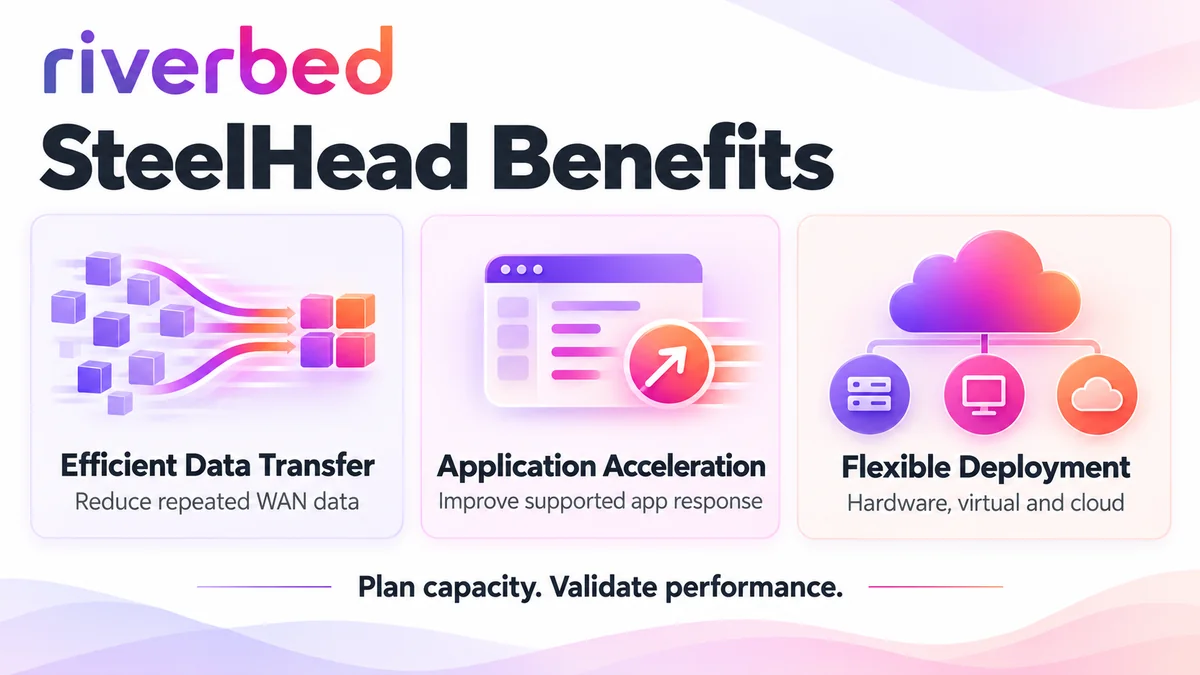
- Reduce repeated data transmission over WAN links
- Improve supported application response across distant sites
- Accelerate suitable backup and replication workloads
- Choose appliance, virtual, or cloud deployment
- Move eligible Flex capacity as infrastructure changes
At a Glance
- Vendor: Riverbed
- Product family: Riverbed License
- Primary use: WAN optimization and application acceleration
- Deployment: SteelHead appliances, SteelHead Virtual, or SteelHead Cloud
- Licensing: Flex subscription or supported model-specific perpetual rights
- Sizing inputs: Traffic, optimized connections, sites, and workloads

Features & Benefits
Efficient Data Transfer and WAN Utilization
Data streamlining reduces repeated transmission of previously transferred data. Transport optimization helps supported connections use available bandwidth more efficiently. For backup, replication, and branch file access, assess the actual workload: encrypted or compressed data may offer different reduction opportunities. Validate results with representative transfers rather than relying on a universal acceleration percentage.
Application Acceleration Across Distributed Sites
Application streamlining reduces inefficient protocol exchanges for supported applications. This can help users working across high-latency links, where additional bandwidth alone may not fix slow response. Review protocol support, encryption requirements, and both optimization peers. A licensed capability still needs the correct configuration and a compatible traffic path to deliver useful results.
Flexible Deployment and Capacity Planning
Hardware, virtual, and cloud options let you position acceleration near the workloads it serves. Eligible Flex subscriptions separate software capacity from deployment, supporting migration across approved platforms. Plan capacity alongside platform resources and growth; moving a license does not make an undersized host or appliance suitable for every workload.
License Overview
SteelHead licensing combines entitlement with supported capacity and capabilities. Confirm optimized bandwidth, connection limits, deployment rights, and subscription or maintenance coverage in the proposed configuration. Inventory existing serial numbers and license details before requesting a renewal or expansion.
For RiOS 10.3, Riverbed identifies Flex as the supported licensing model for XX80 appliances, SteelHead Virtual, and SteelHead Cloud. XX90 appliances support both Flex and perpetual licensing. Older feature-tier names and entitlements must be checked against the installed platform and release; they are not interchangeable with current Flex offerings.
Product Overview
SteelHead uses the Riverbed Optimization System, RiOS, to optimize eligible traffic between supported peers. It can serve branch-to-data-center and cloud connectivity requirements. Appliances provide dedicated resources, while virtual and cloud deployments place resource planning within your infrastructure design. SteelHead SaaS and Mobile requirements should be assessed separately when remote users or SaaS applications are included.
Core Technical Flow
Traffic reaches the local SteelHead through the configured network integration. Eligible connections discover an optimization peer, apply supported data, transport, and application optimization, and deliver reconstructed traffic toward the destination. Administrators check optimized and pass-through connections, then compare application response and WAN usage with the baseline.
Options & Licensing Models
Choose the deployment and supported release first, then confirm its commercial coverage.
| Option | Licensing Consideration | Planning Focus |
|---|---|---|
| SteelHead appliance with Flex | Subscription capacity and eligible portability | Model, interfaces, traffic, and connections |
| SteelHead Virtual | Flex required for RiOS 10.3 | Supported hypervisor, CPU, memory, and storage |
| SteelHead Cloud | Flex required for RiOS 10.3 | Supported cloud, instance resources, and network path |
| XX90 perpetual configuration | Supported alongside Flex in RiOS 10.3 | Purchased rights, model, and support coverage |
| Existing older installation | Release-specific entitlement review | Renewal eligibility and migration requirements |
Compatibility & Requirements
Check supported hardware, hypervisor or cloud platform, RiOS interoperability, and application protocols. Document routing, firewall rules, bypass behavior, and the chosen in-path or out-of-path integration. Review SSL optimization prerequisites where relevant. Align acceleration with your broader network licensing and infrastructure plan.
Activation & Deployment
Prepare the serial number or product identifier, purchased entitlement, and licensing account. Follow the release-specific licensing workflow: supported appliances can fetch licenses automatically, while documented manual routes retrieve keys through the Riverbed licensing portal. Virtual and cloud activation may use tokens or request keys. Schedule any required optimization-service restart.
Verify enabled capacity and subscription status, confirm peer connectivity, and test a representative application. Check pass-through behavior and alerts before extending coverage.
Pricing & Quote Process
Send site count, WAN speeds, peak traffic, optimized connection requirements, application types, and deployment preference. Include existing models, RiOS versions, serial numbers, and renewal dates. Specify growth expectations and whether the project includes cloud workloads, remote users, or SaaS acceleration.
Separate software coverage from hardware, support, and cloud resource costs. Request a Riverbed SteelHead quote for a configuration sized to your traffic and supported licensing route.