

Cisco Prime License covers the licensing and entitlement requirements associated with Cisco Prime Infrastructure, Cisco’s legacy platform for managing wired and wireless enterprise networks. The software brought device inventory, configuration management, monitoring, assurance, reporting, and troubleshooting into a centralized operational interface.
Cisco Prime Infrastructure is no longer available for new orders. Existing customers may still need assistance with entitlement verification, license rehosting, capacity review, support eligibility, or migration planning. Cisco directs Prime Infrastructure users toward Cisco Catalyst Center, formerly Cisco DNA Center, or Cisco Meraki Dashboard depending on their network architecture and management requirements.
Licensing Highlights
- Base licensing for each Prime Infrastructure installation
- Lifecycle licensing based on managed-device quantity
- Assurance licensing for supported performance-monitoring functions
- Collector licensing for NetFlow processing capacity
- Traditional and Smart Licensing workflows
- License review and rehosting for existing deployments
- Migration planning for Cisco Catalyst Center
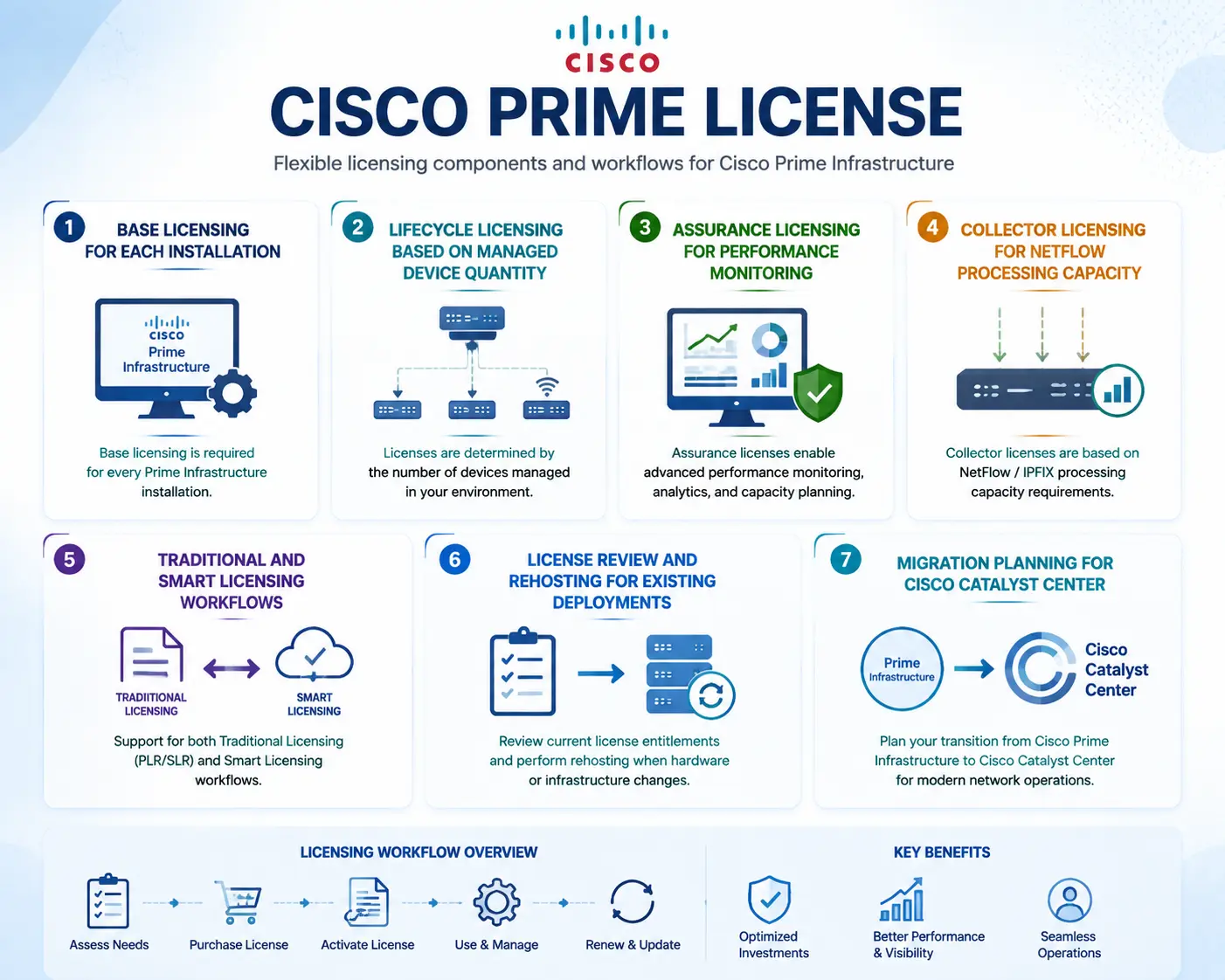
Cisco Prime License At a Glance
Product family : Cisco Networking
Technical role : Wired and wireless network lifecycle management and assurance
Current status : End of sale but supported for eligible customers
Recommended migration platform : Cisco Catalyst Center
License measurements : Installation, managed devices, Assurance devices, and collected flows
Common requests : License validation, rehosting, support review, capacity assessment, and migration planning
Activation methods : Traditional license files or Cisco Smart Licensing, depending on the installed release

Cisco Prime License Overview
Cisco Prime Infrastructure uses several license types rather than one universal entitlement within the broader Cisco License framework. A base license is required for each installation and acts as the prerequisite for other features. Lifecycle licenses regulate the number of devices placed under management, while Assurance licenses cover supported devices using deeper performance and application-monitoring functions.
Collector licensing controls the number of NetFlow records or flows the platform can process. The required license combination therefore depends on the installed Prime Infrastructure release, number of managed devices, enabled features, and use of Assurance or traffic-collection capabilities. Cisco Prime Infrastructure 3.10 also supports Smart Licensing alongside traditional license management.
Since the product is no longer orderable, Cisco Prime License requests should generally focus on an existing deployment. Buyers should confirm what they already own before considering additional capacity, rehosting, renewal support, or migration.
Cisco Prime Infrastructure Product Overview
Cisco Prime Infrastructure provided centralized lifecycle management and assurance for wired and wireless access, campus, and branch networks. Administrators used it to discover Cisco devices, maintain inventory, manage configurations, monitor faults, view client and application performance, and investigate operational problems. Prime Infrastructure has not been renamed Cisco Catalyst Center; instead, Catalyst Center is the newer platform Cisco recommends for supported migration scenarios. Cisco provides migration tools and guidance that can transfer selected devices, site hierarchies, maps, CLI templates, Cisco ISE information, and CMX data from Prime Infrastructure into Catalyst Center, allowing customers to plan a phased transition rather than immediately rebuilding the entire management environment.
Core Technical Flow
Cisco Network Devices → Prime Infrastructure Data Collection → Inventory, Lifecycle and Assurance Analysis → Dashboards and Alerts → Administrator Action
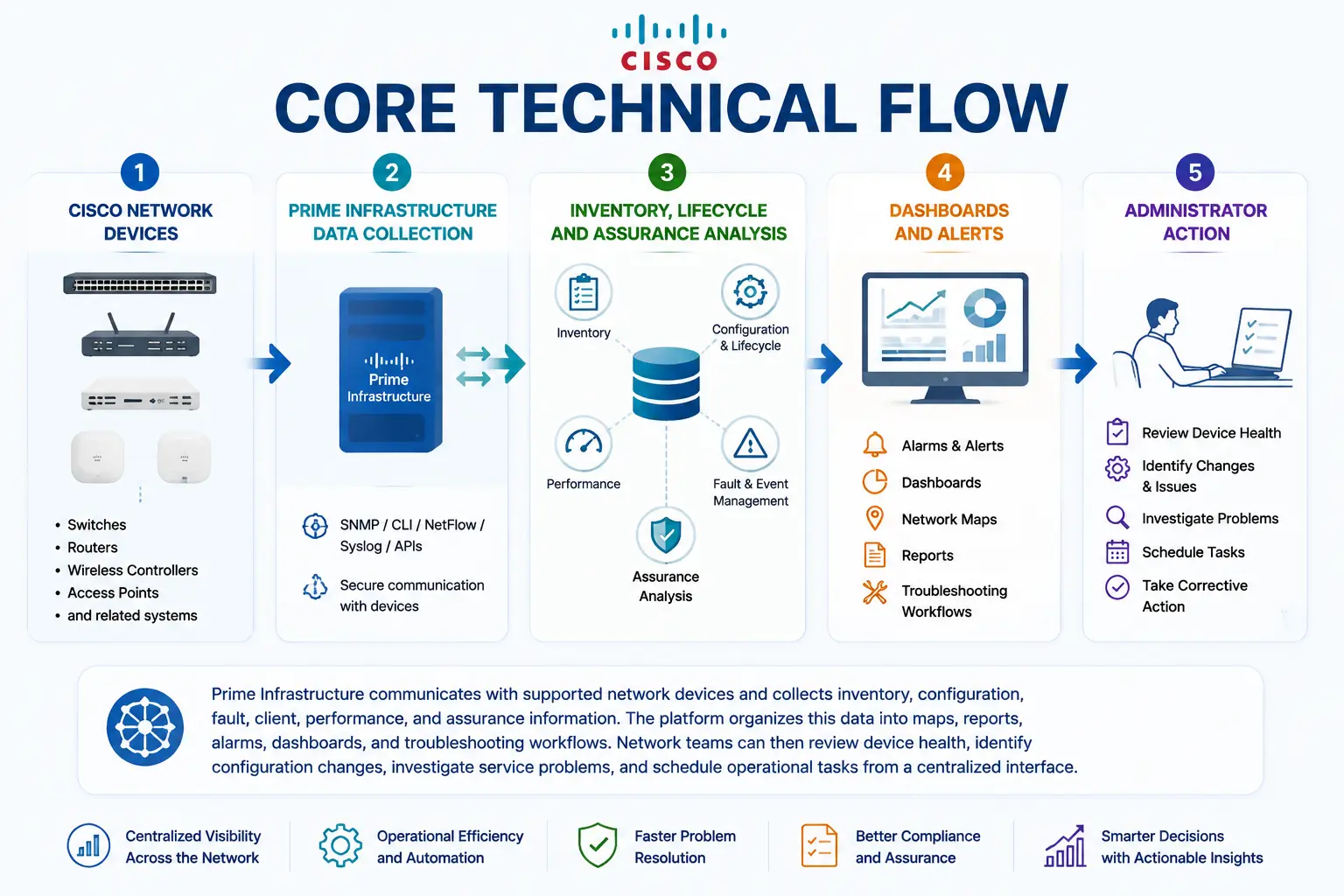
Prime Infrastructure communicates with supported switches, routers, wireless controllers, access points, and related systems. It collects device inventory, configuration, fault, client, performance, and assurance information. The platform organizes this data into maps, reports, alarms, dashboards, and troubleshooting workflows. Network teams can then review device health, identify configuration changes, investigate service problems, and schedule operational tasks from a centralized interface.
Options and Licensing Models
A Cisco Prime Infrastructure installation may include the following license types:
- Base license : Required for each Prime Infrastructure instance
- Lifecycle license : Determines how many supported devices can be managed
- Assurance license : Covers devices using Assurance and performance-monitoring capabilities
- Collector license : Controls supported NetFlow-processing capacity
- Evaluation license : Provides temporary access to selected Lifecycle and Assurance functions
The exact entitlement names and activation process can differ between software versions. Older deployments may rely on traditional license files tied to the Prime Infrastructure instance, while later releases can use Cisco Smart Licensing. Existing customers should not assume that a Catalyst Center subscription directly extends or replaces a Prime license. Migration requires separate compatibility, platform, appliance, and Cisco DNA or networking subscription checks.
Features and Benefits
Cisco Prime Infrastructure gave network teams a unified view of wired and wireless infrastructure. Centralized inventory and configuration tools reduced reliance on device-by-device administration, while fault monitoring and Assurance functions helped teams investigate connectivity and performance issues.
Historical reports also supported capacity planning, compliance reviews, change tracking, and operational troubleshooting. These capabilities remain useful for organizations that continue operating supported Prime Infrastructure environments during a planned migration period.
Cisco Catalyst Center expands this management approach with intent-based automation, network assurance, policy orchestration, software image management, AI-assisted insights, and deeper integration with current Cisco campus platforms. A migration should still begin with a feature comparison, because Prime workflows, reports, device support, and custom templates may not map directly to Catalyst Center.
Compatibility and Requirements
| Area | What to confirm |
|---|---|
| Prime version | Installed release, updates, and patch status |
| Deployment | Physical appliance or supported virtual machine |
| Device scale | Number and type of managed network devices |
| License inventory | Base, Lifecycle, Assurance, and Collector entitlements |
| Licensing method | Traditional licensing or Cisco Smart Licensing |
| Support status | Contract coverage and entitlement eligibility |
| Migration readiness | Catalyst Center version, device support, features, maps, and templates |
| Infrastructure | Catalyst Center appliance or supported virtual deployment requirements |
Cisco Prime Infrastructure 3.10 is no longer sold, but Cisco currently lists support through September 30, 2028 for eligible customers with applicable service coverage.
How Cisco Prime License Activation Works
Traditional Prime Infrastructure licensing uses license files imported into the installed platform. Later releases also provide Smart Licensing workflows that connect the deployment to Cisco Smart Software Manager or an appropriate on-premises licensing environment.
Rehosting may be required when an existing deployment is moved to a new virtual machine or replacement appliance. Before making changes, confirm the current license files, Smart Account, Virtual Account, product version, instance identity, backup status, and active support contract.
For migration projects, the Prime Data Migration Tool can assist with transferring supported operational data to Cisco Catalyst Center. A readiness assessment should be completed first to identify supported devices, transferable data, and functions that require manual redesign.
Pricing Factors and Quote Process
The scope of a Cisco Prime License request depends on the existing deployment, license inventory, managed-device capacity, software version, support status, and whether assistance is required for rehosting or migration. Complete the price-quote form with Cisco as the brand and Cisco Prime License as the product. Existing license files, screenshots, Smart Account details, or infrastructure documents can be attached for review. Migration and Catalyst Center requirements can be clarified during the quote process.
Cisco Prime pricing depends on your license type, deployment model and support requirements.