

BIG-IP R10600 is the entry performance tier of the F5 r10000 Series, built for large enterprise application delivery, security, and consolidation environments where an r5000 appliance no longer provides enough compute, memory, or interface density. Despite being the starting point of the r10000 range, it offers 24 vCPUs for BIG-IP tenants, 256 GB of memory, redundant internal storage, and high-density 25G and 100G connectivity.
The R10600 also gives buyers room to grow inside the same physical appliance. R10600, R10800, and R10900 share the r10000 hardware platform; F5 Pay-as-you-Grow licensing can unlock additional CPU capacity later without requiring a chassis replacement. That makes R10600 useful when the larger hardware architecture is needed now but the full R10900 compute level is not.
Series Highlights
- Entry performance tier of the F5 r10000 Series
- 1RU physical application delivery platform
- 24 vCPUs available for BIG-IP tenants
- 256 GB system memory
- 224 GB memory reserved for tenant workloads
- Up to 24 tenants under minimum-size configurations
- Sixteen 10G/25G SFP+/SFP28 interfaces
- Four 40G/100G QSFP+/QSFP28 interfaces
- Dual 1 TB U.2 SSDs with RAID1 protection
- Dual power supplies
Review BIG-IP R10600 Price List and request a quote tailored to your licensing needs.
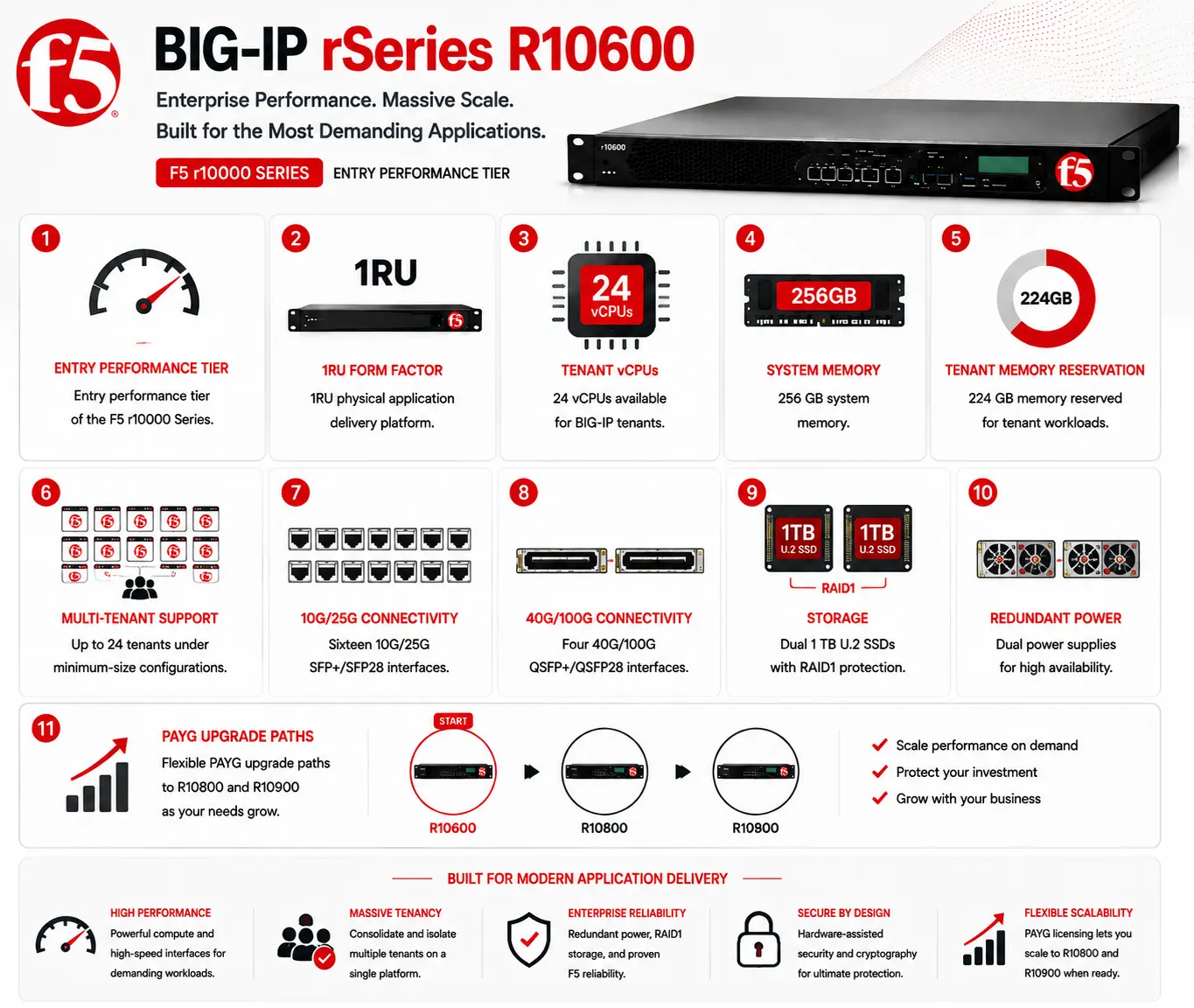
BIG-IP R10600 At a glance
What it is: Entry-tier F5 r10000 Series application delivery and security appliance
Product family: BIG-IP rSeries License
Platform layer: F5OS
Tenant compute: Up to 24 vCPUs
System memory: 256 GB
Memory reserved for tenants: 224 GB
Tenant capacity: Up to 24
Storage: Two 1 TB U.2 SSDs in RAID1
Interfaces: Sixteen 10G/25G plus four 40G/100G ports
Series Overview
The r10000 hardware contains a 24-core Intel Xeon processor with 48 hyperthreaded logical processing cores. Twelve vCPUs are reserved for the F5OS platform layer. The fully enabled hardware can therefore expose 36 vCPUs to BIG-IP tenants, but on R10600 the license limits the available tenant capacity to 24 vCPUs.
Those resources can support one substantial BIG-IP instance or be divided among multiple tenants. Current F5 tenant specifications list a maximum of 24 tenants on R10600, with 224 GB of the system’s 256 GB RAM reserved for tenant use. Actual production density depends on the tenant image, modules, memory, CPU allocation, and traffic rather than the theoretical maximum alone.
The physical platform is a major step above r5000. Sixteen 10G/25G optical interfaces and four 40G/100G ports provide more connection density, while two 1 TB U.2 SSDs add mirrored internal storage.
Licensing and Part Number Guidance
The R10600 designation controls the platform performance tier. It does not determine which BIG-IP License application services are purchased. A system may be configured around LTM for application delivery, or combine traffic management with Advanced WAF, DNS, AFM, APM, or other supported services. The final part-number scope therefore needs to consider the hardware tier, BIG-IP entitlements, support, optics, power, and redundancy together.
Capacity is the second major licensing decision. F5 provides three PAYG levels on the r10000 hardware: R10600, R10800, and R10900. R10600 can be upgraded directly to either higher tier; R10800 can subsequently move to R10900. If the initial design already consumes most of the R10600’s 24 vCPUs, requesting pricing for R10800 at the same time can prevent an unnecessary near-term upgrade.
Common Use Cases
| Use case | Why R10600 can fit |
|---|---|
| Large enterprise ADC | More compute and memory than r5000-class appliances |
| Application security | Capacity for inspection-heavy BIG-IP services |
| SSL/TLS processing | Hardware platform for high encrypted-traffic demand |
| BIG-IP consolidation | Multiple isolated tenants on one appliance |
| Data-center application edge | Dense 25G and 100G connectivity |
| DNS and access services | Separate BIG-IP service roles into tenants |
| iSeries refresh | Modern rSeries platform for larger legacy environments |
| Growth-oriented deployment | PAYG path to R10800 or R10900 |
Models, Licenses, and Ordering Scope
| Area | What to confirm |
|---|---|
| Platform | BIG-IP R10600 |
| BIG-IP services | LTM, DNS, Advanced WAF, AFM, APM, or required combination |
| Compute | vCPU requirement for each tenant |
| Tenant design | Number, image type, CPU, memory, and application role |
| Interfaces | 10G, 25G, 40G, or 100G |
| Availability | Standalone or matched HA appliances |
| PAYG | Remain R10600 or plan R10800/R10900 growth |
| Storage | Dual 1 TB RAID1 SSDs |
| Power | AC, DC, or HVDC configuration |
| Optics | SFP+, SFP28, QSFP+, or QSFP28 |
| Support | Coverage level and term |
| Part numbers | Appliance, software, support, optics, power, and PAYG SKUs |
What to Check Before Requesting a Quote
R10600 should be sized around the workload rather than selected simply because it belongs to a larger series. Document peak application throughput, SSL/TLS traffic, concurrent connections, BIG-IP modules, security inspection, tenant count, and network interfaces. For multi-tenant designs, specify what each tenant will run; a lightweight DNS instance has very different requirements from a multi-module application-security tenant.
Storage and redundancy can matter as well. Unlike the standard r5000 models, r10000 uses two 1 TB SSDs in a RAID1 configuration, and the hardware ships with two power supplies. If the appliance would start close to 24 tenant vCPUs, compare R10800 or R10900 before purchasing. The r10000 chassis already contains the hardware resources required for those PAYG tiers.
Activation and Delivery Notes
Initial configuration is performed at the F5OS platform layer. Licensing, physical interfaces, VLANs, tenant images, and resource allocation are prepared there before the BIG-IP workloads are deployed.
Each tenant receives dedicated vCPU and memory resources and its own BIG-IP management environment. F5 currently recommends at least two vCPUs for a typical tenant; single-vCPU images are intended for lightweight LTM or DNS use and carry operational limitations.
For HA, redundancy is built between corresponding BIG-IP tenants on two separate rSeries appliances. There is no appliance-level HA relationship between their F5OS layers. Before shipment, confirm software entitlement, PAYG tier, tenant plan, optics, power, HA quantity, and support coverage.
F5 pricing depends on your product edition, license type, deployment model, traffic needs, term, and support requirements.