

BIG-IP R12600-DS is the entry performance tier of F5’s r12000-DS Series, built for environments where SSL/TLS processing, application delivery, and security operate at very high scale. Although it is the first model in the r12000-DS range, the platform is considerably larger than the r10000 family: it provides 44 vCPUs for BIG-IP tenants, 512 GB of system memory, dense 25G/100G networking, and dedicated hardware resources for demanding cryptographic workloads.
F5 positions the r12000-DS family as its Turbo SSL rSeries platform. This makes R12600-DS particularly relevant when encrypted application traffic, not simply general ADC throughput, is driving the sizing decision. The same physical hardware can later be upgraded to R12800-DS or R12900-DS through Pay-as-you-Grow licensing.
Series Highlights
- Entry performance tier of the F5 r12000-DS Series
- 1RU high-performance application delivery appliance
- 44 vCPUs available for BIG-IP tenants
- 512 GB DDR4 system memory
- Approximately 470 GB available to tenant workloads
- Up to 44 tenants under minimum-size conditions
- Sixteen 10G/25G SFP+/SFP28 interfaces
- Four 40G/100G QSFP+/QSFP28 interfaces
- Dual 2 TB U.2/U.3 SSDs configured as RAID1
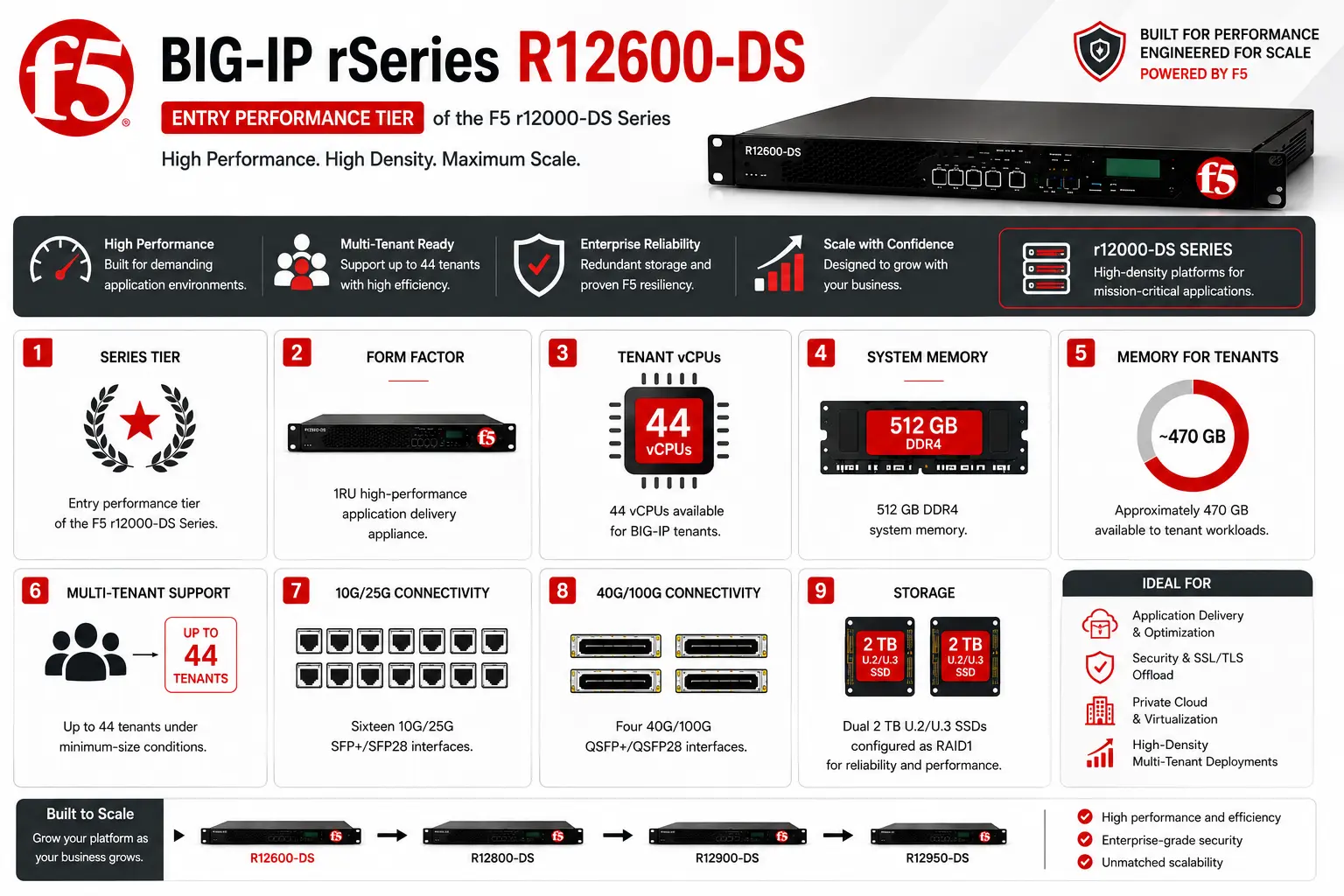
BIG-IP R12600-DS At a glance
What it is: High-capacity F5 rSeries platform optimized for SSL/TLS-heavy application delivery
Product family: BIG-IP rSeries License
Series: r12000-DS
Platform layer: F5OS
Tenant compute: 44 vCPUs
System memory: 512 GB
Memory available to tenants: Approximately 470 GB
Maximum tenant count: Up to 44 under minimum-size configurations
Storage: Dual 2 TB U.2/U.3 SSDs in RAID1
Series Overview
The r12000-DS hardware contains 72 logical vCPUs. Twelve are reserved for the F5OS platform layer, and another 16 are disabled at the R12600-DS license tier. That leaves 44 vCPUs available for BIG-IP tenant workloads. Memory capacity is also a major step above r10000. R12600-DS contains 512 GB of RAM, with F5 documenting roughly 470 GB as available to tenants after F5OS requirements. That larger pool provides more room for substantial multi-module BIG-IP instances or several production tenants.
Where the platform differs most is encrypted traffic. F5 publishes up to 270,000 RSA 2K SSL transactions per second, 208,000 ECDHE-ECDSA P-256 transactions per second, and 95 Gbps bulk encryption for R12600-DS. Published L4/L7 throughput is 195/146 Gbps under F5’s stated test conditions.
Licensing and Part Number Guidance
The R12600-DS designation determines the starting compute tier of the r12000-DS platform. It does not determine which BIG-IP License services are included. The final configuration may involve LTM for application delivery, Advanced WAF for web and API security, DNS, AFM, APM, or another supported BIG-IP combination. The exact ordering scope should therefore include both the hardware tier and the software services that will actually process application traffic.
The second licensing decision is future compute capacity. R12600-DS, R12800-DS, and R12900-DS use the same underlying hardware. F5 allows an R12600-DS to move to either higher model through a PAYG license change, unlocking additional vCPUs without a chassis replacement. If the initial design already requires most of the available 44 vCPUs, compare R12800-DS pricing before ordering rather than planning an upgrade immediately after deployment.
Common Use Cases
| Use case | Why R12600-DS can fit |
|---|---|
| Large TLS termination | High SSL/TLS transaction and bulk encryption capacity |
| Enterprise ADC | High L4/L7 throughput for large application environments |
| Application security | Processing headroom for BIG-IP security services |
| BIG-IP consolidation | Large memory pool and multi-tenant architecture |
| Data-center edge | Dense 25G and 100G connectivity |
| API and web services | High encrypted-session volumes with security inspection |
| Large platform refresh | Higher-scale alternative to r10000 where SSL demand dominates |
| Growth deployment | PAYG path to R12800-DS and R12900-DS |
The r12000-DS architecture is similar to r10000 but includes additional SSL/TLS processing resources, which is why F5 positions this family separately as its Turbo SSL platform.
Models, Licenses, and Ordering Scope
| Area | What to confirm |
|---|---|
| Platform | BIG-IP R12600-DS |
| BIG-IP services | LTM, Advanced WAF, DNS, AFM, APM, or required combination |
| SSL/TLS workload | TPS, bulk encryption, certificates, and cipher requirements |
| Tenant design | Number, vCPU, memory, image type, and role of each tenant |
| Interfaces | 10G, 25G, 40G, or 100G |
| Availability | Standalone or paired HA appliances |
| PAYG | R12600-DS now or planned R12800-DS/R12900-DS upgrade |
| Storage | Dual 2 TB RAID1 SSDs |
| Power | AC or supported DC configuration |
| Optics | SFP+, SFP28, QSFP+, or QSFP28 |
| Support | Required F5 support level and term |
| Part numbers | Hardware, BIG-IP software, PAYG, optics, support, and accessories |
What to Check Before Requesting a Quote
For R12600-DS, SSL/TLS demand should be one of the first sizing inputs, not an afterthought. Document peak application throughput, SSL transactions per second, bulk-encrypted traffic, cipher requirements, concurrent connections, BIG-IP modules, tenant count, and expected growth. An environment using R12600-DS mainly for LTM is very different from one terminating large volumes of TLS while also running Advanced WAF inspection.
Tenant requirements should be calculated separately as well. F5 technically supports up to 44 single-vCPU tenants, but single-vCPU tenants are intended only for very light LTM or DNS workloads and are not the preferred production design. Larger tenants provide more predictable capacity for substantial services. If 44 vCPUs already leave little compute headroom, compare the next PAYG levels before purchase.
Activation and Delivery Notes
Initial configuration takes place through F5OS. Platform licensing, physical interfaces, VLANs, tenant images, vCPU and memory allocation, and hardware acceleration settings are prepared before BIG-IP tenants are placed into service. Crypto and compression acceleration can be enabled for tenants. When enabled, F5OS allocates hardware acceleration resources according to the tenant’s vCPU allocation; disabling it moves those functions into software processing and can materially change performance.
The platform also uses two 2 TB SSDs configured as RAID1, providing redundant internal storage. For HA at the application-delivery layer, corresponding BIG-IP tenants should be deployed on separate rSeries appliances because HA is configured between the BIG-IP instances rather than between their F5OS platform layers. Before delivery, confirm the performance tier, BIG-IP entitlement, tenant allocation, optics, power, support, HA quantity, and expected PAYG path.
F5 pricing depends on your product edition, license type, deployment model, traffic needs, term, and support requirements.