

BIG-IP R5600 is the entry performance tier of the F5 r5000 Series, designed for larger application delivery and security environments that need more memory, tenant density, and network capacity than the r2000 or r4000 platforms provide. It remains a compact 1RU appliance, but introduces 100G interfaces, 128 GB of system memory, and a more scalable multi-tenant architecture.
R5600 is also the starting point of a three-tier Pay-as-you-Grow model. The underlying r5000 hardware can be licensed as R5600, R5800, or R5900, allowing an organization to increase available compute capacity later without replacing the chassis.
Series Highlights
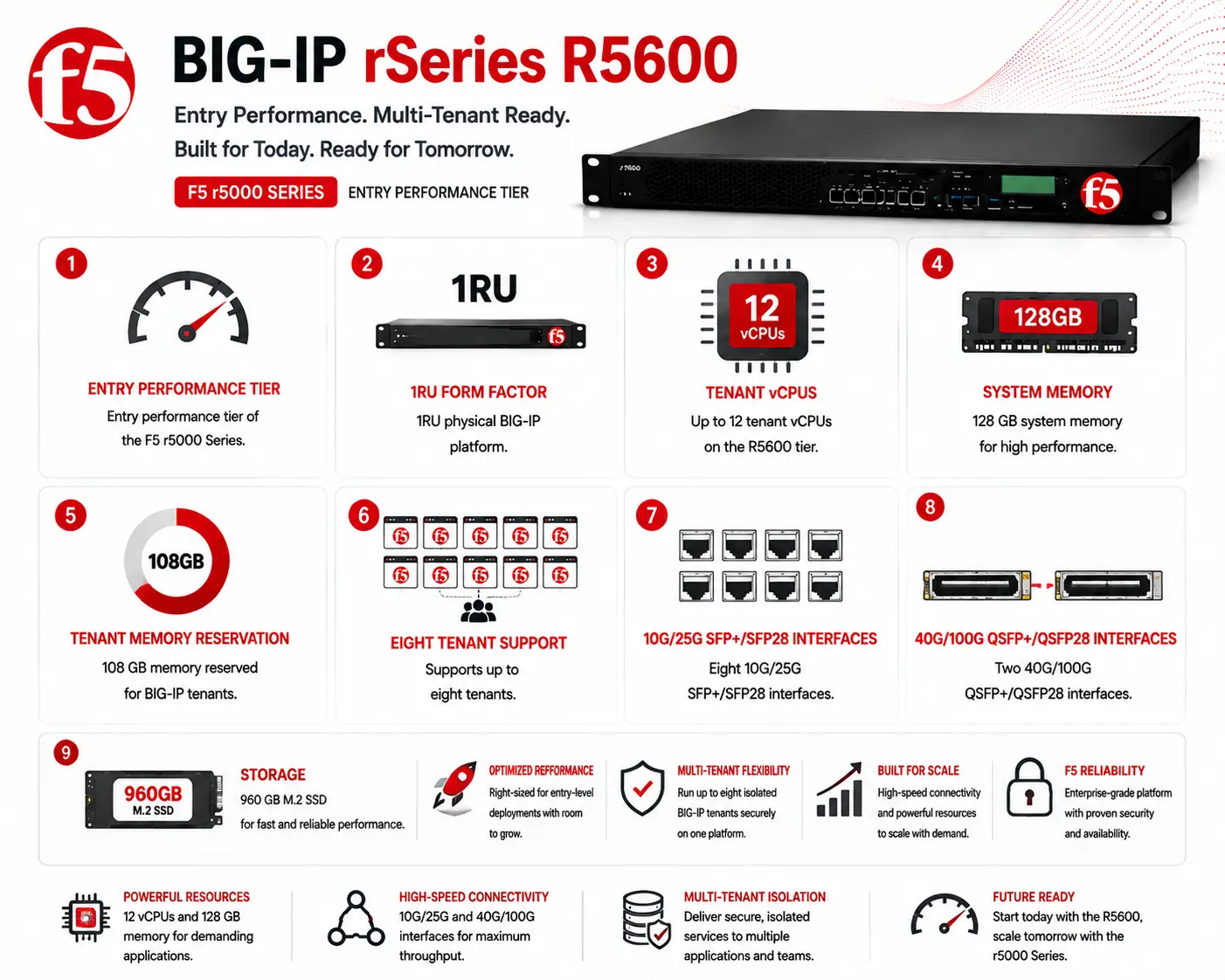
- Entry performance tier of the F5 r5000 Series
- 1RU physical BIG-IP platform
- Up to 12 tenant vCPUs on the R5600 tier
- 128 GB system memory
- 108 GB memory reserved for BIG-IP tenants
- Supports up to eight tenants
- Eight 10G/25G SFP+/SFP28 interfaces
- 960 GB M.2 SSD
Review BIG-IP R5600 Price List and request a quote tailored to your licensing needs.
BIG-IP R5600 At a glance
What it is: Entry-tier F5 r5000 Series application delivery and security appliance
Product family: BIG-IP rSeries License
Platform layer: F5OS
Maximum tenant vCPUs: 12
System memory: 128 GB
Memory reserved for tenants: 108 GB
Tenant capacity: Up to eight
Storage: 960 GB M.2 SSD
Interfaces: Eight 10G/25G ports plus two 40G/100G ports
Typical role: Enterprise ADC, application security, SSL/TLS processing, multi-tenant consolidation, DNS, access, and high-bandwidth application services
Series Overview
The BIG-IP R5600 uses the same underlying r5000 hardware as R5800 and R5900. The platform contains a 16-core Intel Xeon processor with 32 hyperthreaded logical processors. Six logical processors are reserved for the F5OS platform layer, while licensing controls how much of the remaining compute capacity is available for BIG-IP tenants.
On R5600, F5 currently documents a maximum of 12 vCPUs per tenant and up to eight tenants on the system. The appliance carries 128 GB of memory, with 108 GB reserved for tenant workloads. That is a substantial step up from R4800, especially where several application teams, security zones, or BIG-IP service roles need to be separated.
Connectivity also changes at this tier. The r5000 platform provides eight 10G/25G SFP28/SFP+ ports and two high-speed ports capable of 40G or 100G operation. Unlike the smaller r2000/r4000 platforms, r5000 does not support 1G data connectivity.
Licensing and Part Number Guidance
Selecting an R5600 part number starts with the platform, but the final order also depends on the BIG-IP License services that will run on it. A deployment focused on LTM and SSL termination can have a very different software requirement from one combining application delivery with Advanced WAF, DNS, access control, or network-security functions. F5 positions rSeries as a platform for both application delivery and advanced application security.
The second decision is performance tier. R5600, R5800, and R5900 share the same physical r5000 chassis. PAYG licensing unlocks additional compute resources as the appliance moves through those tiers. R5600 is therefore useful when current requirements fit the base level but future growth is expected. If the deployment already requires high tenant density or considerably more compute on day one, comparing R5800 or R5900 at initial purchase may be more economical than planning an early license upgrade.
Common Use Cases
| Use case | Why R5600 can fit |
|---|---|
| Enterprise ADC | More memory and network capacity than r4000 |
| Application security | Supports BIG-IP security services when licensed |
| SSL/TLS processing | Hardware-assisted crypto processing for encrypted applications |
| Multi-tenant consolidation | Supports up to eight tenant environments |
| High-speed application edge | 25G and 100G connectivity |
| DNS and access services | Can separate service roles into individual tenants |
| iSeries migration | Current rSeries platform for larger physical deployments |
| Growth-oriented deployment | PAYG path to R5800 and R5900 |
BIG-IP tenant redundancy is configured between tenants on separate rSeries appliances rather than between tenants inside the same physical system.
Models, Licenses, and Ordering Scope
| Area | What to confirm |
|---|---|
| Platform | BIG-IP R5600 |
| BIG-IP services | LTM, DNS, Advanced WAF, AFM, APM, or required bundle |
| Performance | Traffic, SSL/TLS, connections, and security inspection |
| Tenants | Number, image type, CPU, memory, and role of each tenant |
| Interfaces | 10G, 25G, 40G, or 100G requirements |
| Availability | Standalone or paired HA appliances |
| Growth | Remain R5600 or plan PAYG to R5800/R5900 |
| Storage | 960 GB single SSD architecture |
| Power | AC, DC, HVDC, and redundant PSU requirement |
| Optics | SFP+, SFP28, QSFP+, or QSFP28 |
| Support | F5 support level and term |
| Part number | Hardware, BIG-IP software, PAYG, support, optics, and accessories |
What to Check Before Requesting a Quote
R5600 should usually be evaluated when the architecture needs more than simply additional throughput. Tenant count, memory, high-speed interfaces, and workload consolidation often matter just as much.
Document the expected application traffic, SSL/TLS volume, security inspection, BIG-IP modules, number of tenants, and required 25G or 100G interfaces. If several tenants are planned, include what each tenant will run. Current F5OS supports different tenant image types with different CPU, memory, disk, and module capabilities, so eight lightweight tenants and eight full multi-module tenants are not equivalent sizing exercises.
Also consider storage requirements. Standard r5000 uses a single 960 GB M.2 SSD; organizations that specifically require mirrored internal storage need to evaluate other supported platform variants or larger rSeries architectures.
Activation and Delivery Notes
Initial deployment starts at the F5OS platform layer. Management networking, licensing, VLANs, interface configuration, and tenant images are prepared before BIG-IP workloads are deployed. F5 supports tenant creation through the webUI, CLI, and API.
The tenant image must also match its intended role. Current F5 documentation distinguishes lightweight LTM/DNS images from larger multi-module images, and resource requirements vary significantly between them. For new F5OS 1.8.0-or-later deployments, F5 recommends the newer signed .tar.bundle tenant-image format. Before shipment, confirm the license tier, BIG-IP services, tenant plan, optics, power supplies, support coverage, and whether the initial R5600 deployment should preserve a clear PAYG path.
F5 pricing depends on your product edition, license type, deployment model, traffic needs, term, and support requirements.