

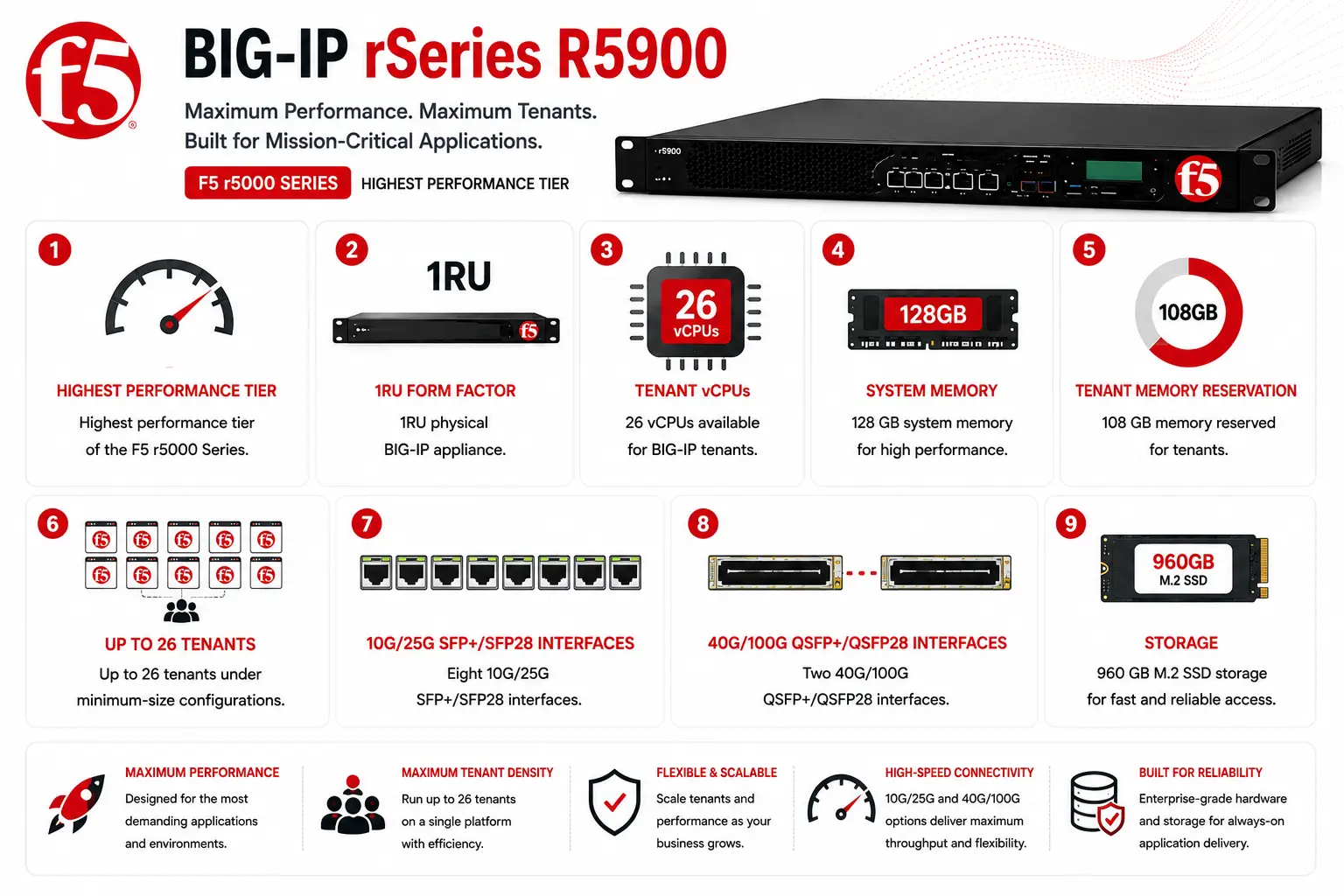
BIG-IP R5900 is the highest performance tier of the F5 r5000 Series, designed for enterprise application delivery, security, and consolidation workloads that need the full compute capacity of the r5000 hardware platform. It combines 26 tenant vCPUs, 128 GB of system memory, 25G and 100G networking, hardware-assisted traffic processing, and flexible BIG-IP tenancy in a compact 1RU appliance.
R5900 shares its physical hardware with R5600 and R5800, but unlike those lower tiers, no tenant-processing capacity is disabled by licensing. This makes it the logical r5000 choice when several production BIG-IP workloads need to coexist, security inspection is demanding, or buying a lower tier would likely lead to an early Pay-as-you-Grow upgrade.
Series Highlights
- Highest performance tier of the F5 r5000 Series
- 1RU physical BIG-IP appliance
- 26 vCPUs available for BIG-IP tenants
- 128 GB system memory
- 108 GB memory reserved for tenants
- Up to 26 tenants under minimum-size configurations
- Eight 10G/25G SFP+/SFP28 interfaces
- Two 40G/100G QSFP+/QSFP28 interfaces
- 960 GB M.2 SSD storage
Review BIG-IP R5900 Price List and request a quote tailored to your licensing needs.
BIG-IP R5900 At a glance
What it is: Fully enabled F5 r5000 Series application delivery and security appliance
Product family: BIG-IP rSeries License
Platform layer: F5OS
Tenant compute: Up to 26 vCPUs
System memory: 128 GB
Memory reserved for tenants: 108 GB
Storage: 960 GB M.2 SSD
Interfaces: Eight 10G/25G ports plus two 40G/100G ports
Typical role: Enterprise ADC, application security, SSL/TLS processing, high-speed application edge, DNS, access services, and BIG-IP consolidation
Series Overview
The r5000 appliance uses a 16-core Intel Xeon processor presented as 32 logical processing cores through hyperthreading. Six vCPUs are reserved for the F5OS platform layer. On BIG-IP R5900, the remaining 26 vCPUs are available to BIG-IP tenants, with none disabled by the performance license.
Those resources can be assigned to one large tenant or divided across multiple instances. F5 currently lists a maximum of 26 tenants, but that number represents minimum-sized configurations. Single-vCPU tenants are supported only for very light workloads and are not the preferred sizing approach for most production systems. Real tenant density will usually be lower once application modules, traffic, memory, and performance requirements are considered.
The network side is equally important. R5900 provides eight 10G/25G interfaces and two 40G/100G interfaces, giving it substantially more uplink capacity than the r4000 platform. The r5000 family does not support 1G production data interfaces.
Licensing and Part Number Guidance
Choosing BIG-IP R5900 defines the platform performance tier, but not the complete software requirement. The final order still needs to match the required BIG-IP License services used by the environment, such as traffic management, DNS, Advanced WAF, AFM, APM, or another supported combination. The final order still needs to match the BIG-IP services used by the environment—such as traffic management, DNS, Advanced WAF, AFM, APM, or another supported combination.
R5900 is also the top of the r5000 Pay-as-you-Grow ladder. R5600 can be upgraded to R5800 or directly to R5900, while R5800 can move to R5900 through a license change. Since all three use the same underlying r5000 hardware, those upgrades unlock additional tenant compute without replacing the physical appliance.
Once an environment reaches R5900, however, there is no higher r5000 PAYG tier. If 26 tenant vCPUs, 128 GB RAM, or the available port density are already close to the expected requirement, the r10000 Series should be compared before the order is finalized.
Common Use Cases
| Use case | Why R5900 can fit |
|---|---|
| Large enterprise ADC | Full r5000 compute allocation for application delivery |
| Application and API security | More processing headroom for inspection-heavy services |
| SSL/TLS processing | Modern Intel crypto acceleration for encrypted traffic |
| BIG-IP consolidation | Multiple isolated workloads on one physical appliance |
| 100G application edge | High-speed interfaces for larger network environments |
| DNS and access services | Separate service roles into dedicated tenants |
| iSeries modernization | F5 maps higher mid-range iSeries workloads toward r5900 |
| Growth-sensitive design | Avoids another PAYG step within the r5000 chassis |
F5’s r5000 architecture also includes FPGA acceleration for selected networking and security functions, including workloads traditionally handled by F5 hardware offload engines.
Models, Licenses, and Ordering Scope
| Area | What to confirm |
|---|---|
| Platform | BIG-IP R5900 |
| BIG-IP services | LTM, DNS, Advanced WAF, AFM, APM, or required bundle |
| Compute | vCPU demand for each planned tenant |
| Tenant design | Number of tenants, software image, CPU, memory, and role |
| Interfaces | 10G, 25G, 40G, or 100G |
| Availability | Standalone appliance or matched HA pair |
| Growth | Whether r5000 provides enough long-term headroom |
| Storage | Single 960 GB M.2 SSD |
| Power | AC, DC, or supported HVDC configuration |
| Optics | SFP+, SFP28, QSFP+, or QSFP28 |
| Support | F5 service level and term |
| Part numbers | Hardware, software entitlement, optics, power, support, and accessories |
The r5000 platform is available with AC, DC, and supported high-voltage DC configurations, so power architecture should be confirmed as part of the quote rather than after procurement.
What to Check Before Requesting a Quote
Start by defining how the 26 available vCPUs will actually be used. A single large LTM and Advanced WAF tenant has a different resource profile from ten smaller tenants serving different applications or operational teams. Record peak throughput, TLS volume, connection load, security inspection, BIG-IP modules, tenant count, and required interface speeds.
If this is an iSeries migration, avoid assuming that an old vCPU count maps directly to the same number on rSeries. F5’s sizing guidance specifically notes that CPU architecture and virtualization behavior differ between generations. For example, F5 identifies R5900 as a migration target for i7600/i7800-class environments but recommends sizing according to actual performance rather than simply copying the old CPU allocation. Also look beyond launch-day requirements. If an R5900 would start with nearly all tenant compute or memory committed, an r10000 platform may provide a better growth path.
Activation and Delivery Notes
Initial setup takes place at the F5OS platform layer. Administrators license the system, configure management and network resources, import the correct BIG-IP tenant image, assign vCPU and memory, attach VLANs, and deploy each tenant. Every tenant receives dedicated compute resources and its own management access.
For new deployments using F5OS-A 1.8.0 or later, F5 recommends the signed .tar.bundle tenant-image format instead of the older .qcow2.zip.bundle format. The newer package supports PKI-based signature validation. HA also needs two physical systems. F5 recommends matching tenants on separate rSeries appliances because there is no F5OS-level HA relationship between two rSeries platforms; the BIG-IP tenants themselves form the failover relationship.
F5 pricing depends on your product edition, license type, deployment model, traffic needs, term, and support requirements.