

Riverbed NetProfiler turns network flow telemetry into visibility for troubleshooting, capacity planning, and security investigations. A Riverbed NetProfiler license defines the purchased flow capacity and capabilities on the chosen deployment. NetProfiler licensing should reflect measured flows per minute, collection architecture, and retention requirements rather than only the number of devices in your network.
Quick Benefits
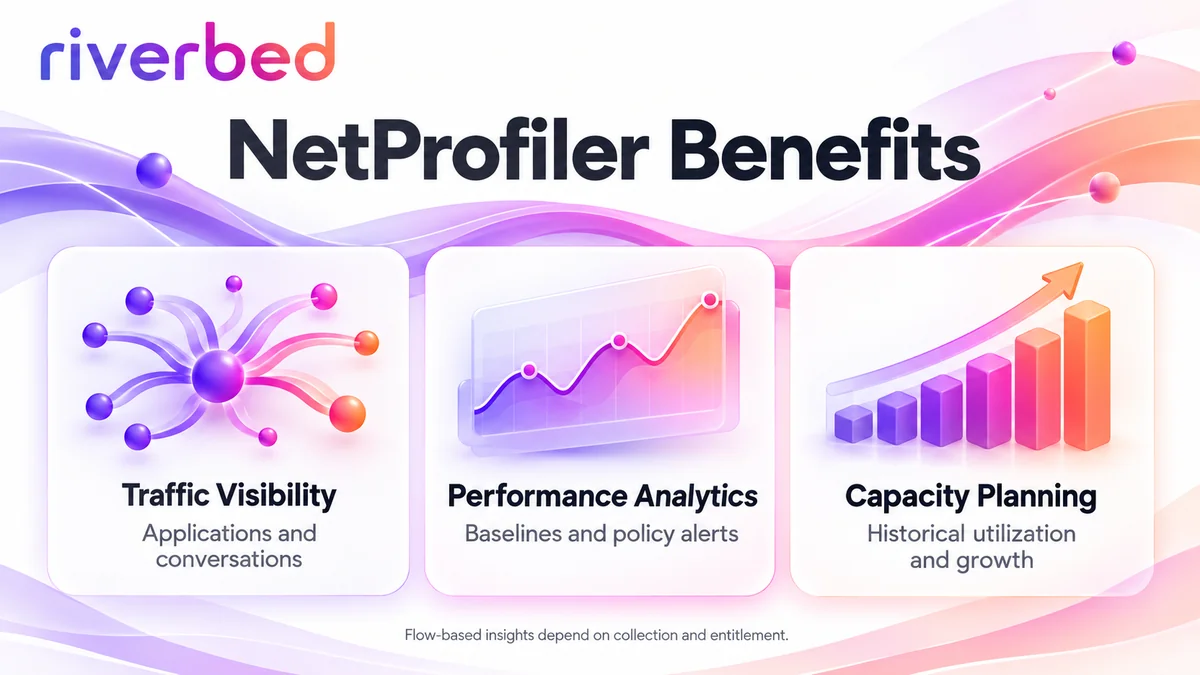
- Visibility into application traffic and network conversations
- Performance baselines and policy-based alerts
- Historical utilization evidence for capacity planning
- Flow context for investigating unusual communications
- Physical, virtual, and cloud deployment options
At a Glance
- Vendor: Riverbed
- Product family: Riverbed License
- Primary role: Network flow monitoring and analysis
- License metric: Applicable deduplicated flows per minute
- Collection: Supported flow exporters and Flow Gateway
- Quote inputs: Flow rate, collectors, deployment, growth, and retention

Features & Benefits
Traffic Visibility and Application Context
NetProfiler analyzes flow records to show which hosts and applications communicate, how traffic uses the network, and where patterns change. Supported exporters supply NetFlow, IPFIX, sFlow, and other telemetry. Flow records summarize communications; coverage depends on exporter configuration.
Performance Analytics and Investigation
Baselines, adaptive analytics, and policy-based alerting help teams identify anomalies and prioritize investigation. Traffic context supports both NetOps troubleshooting and SecOps enquiries. Riverbed IQ can add broader analytical context through supported integrations, but the required platform services and entitlements should be checked separately.
Capacity Planning and Shared Operational Evidence
Historical reports help teams understand utilization, assess changes, and plan growth. Correlation with AppResponse and NetIM can connect flow evidence with packet and infrastructure information. Verify separate monitoring and integration entitlements.
License Overview
NetProfiler capacity licensing uses flows per minute counted after deduplication. Measure the expected rate and allow for growth. Raw and deduplicated volumes differ; device count or WAN bandwidth alone cannot establish entitlement.
Current Riverbed specifications describe Flex license portability across NetProfiler 4280, 4290, and supported virtual or cloud models. Confirm the purchased capacity, subscription scope, and permitted transition. Legacy entitlements require their own review. Flow Gateway has separate capacity and licensing considerations, so collector rights must be identified in the configuration.
Product Overview
Flow Gateway collects supported telemetry and forwards it to NetProfiler for analysis. NetProfiler processes the records, builds traffic views, and provides reports. Deployment can use physical systems or supported virtual and cloud architectures, with resources selected for the intended scale.
NetProfiler complements packet-based tools: it helps identify broad communication patterns, while AppResponse provides packet evidence for deeper investigation. Choose collection points around operational questions.
Core Technical Flow
Configure supported devices to export flow records to the collection layer. Forward the telemetry to NetProfiler, verify source reception and capacity usage, then define host groups, applications, and alert policies. Investigate changes against the historical baseline and validate results after remediation. Validate export completeness and timestamps.
Options & Licensing Models
Compare analytical capacity with deployment and collection requirements.
| Option | Licensing Focus | Planning Requirement |
|---|---|---|
| Physical NetProfiler | Model entitlement and flow capacity | Appliance resources, storage, and support |
| Virtual deployment | Base and applicable expansion rights | Compute, storage throughput, and supported hypervisor |
| Cloud deployment | Cloud-compatible capacity and entitlement | Instance sizing, collection connectivity, and ongoing costs |
| Eligible Flex subscription | Capacity and permitted portability | Approved destination and transition procedure |
| Flow Gateway collection | Collector capacity and separate rights | Export sources, raw volume, and forwarding design |
Compatibility & Requirements
Validate exporter protocols and templates, software interoperability, and the supported deployment matrix. Virtual systems need sufficient CPU, memory, storage, and disk performance for the required flow rate. Larger designs may require expansion components or a dispatcher. Plan management reachability, time synchronization, and retention; exact requirements vary by configuration.
Activation & Deployment
Prepare account access, serial numbers or activation tokens, and the entitlement record. Supported physical appliances can download assigned licenses from Riverbed. Documented virtual procedures generate an activation code from a token, redeem it through the licensing portal, and install the returned keys. Offline systems use the applicable manual key-entry procedure.
Verify the installed flow-capacity license, then test representative exporters. Check source status, received volumes, capacity usage, reports, and alerts before expanding collection.
Pricing & Quote Process
Provide typical and peak deduplicated flow rates, raw collector volumes, exporter count, growth, and retention targets. Specify the deployment model and required Flow Gateway architecture. For renewals, include current capacity, platform, serial or entitlement details, and support expiry.
Request a NetProfiler license quote that separates analysis capacity, collection, support, and infrastructure costs. Align complementary monitoring with your wider network licensing requirements.