

Cisco Catalyst 9400 is a modular enterprise switching family built for campus access, distribution, aggregation, and selected core deployments. Instead of choosing a fixed-port switch, organizations build a Catalyst 9400 configuration around the required chassis, supervisor engine, line cards, power supplies, software subscription, and redundancy design.
The platform is especially useful where high port density, long hardware lifecycle, redundant supervisors, PoE delivery, or future expansion matter more than the simplicity of a fixed switch. Current configurations support everything from standard Gigabit user access to multigigabit endpoints and 100G aggregation.
Series Highlights
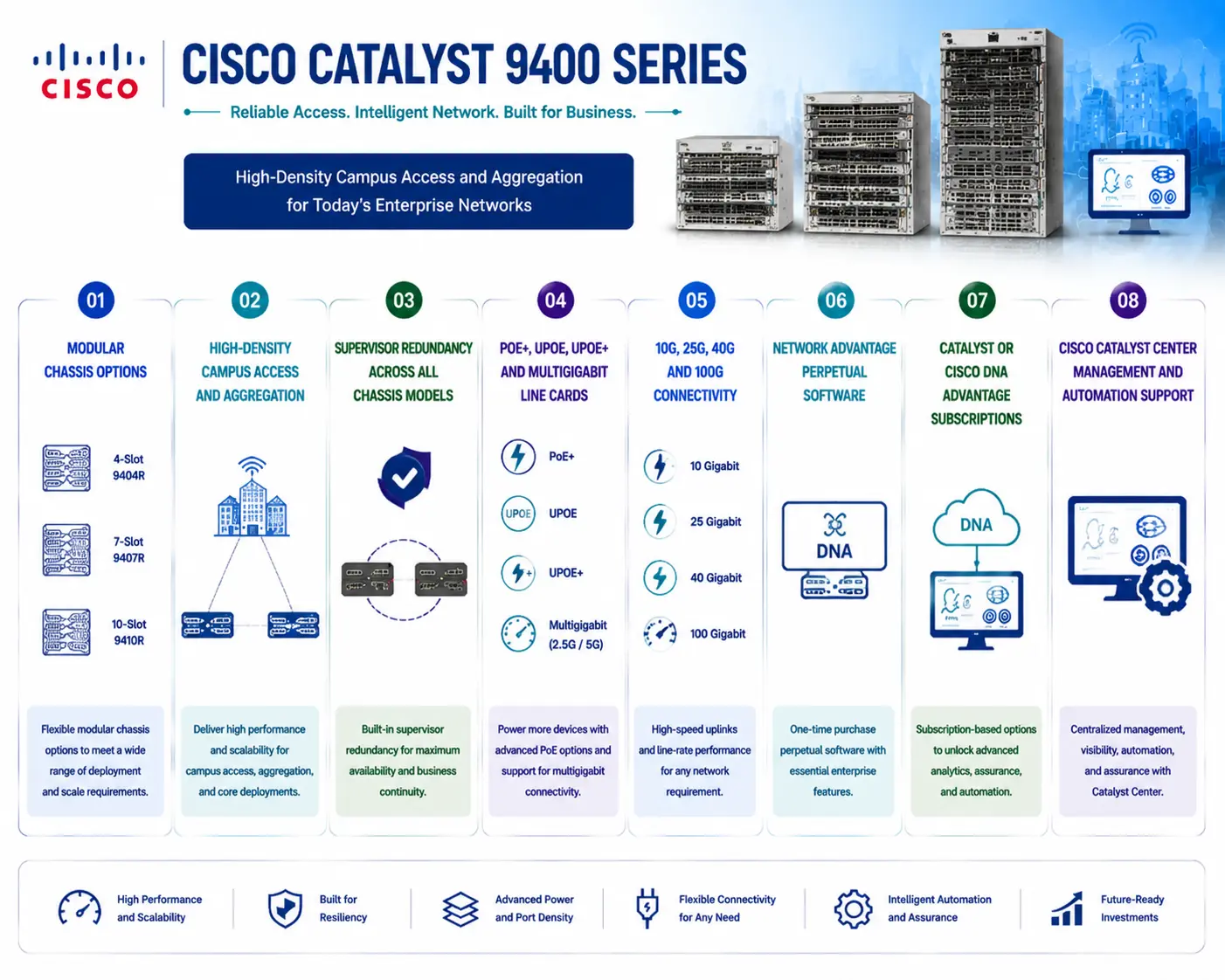
- Modular 4-, 7-, and 10-slot chassis
- High-density campus access and aggregation
- Supervisor redundancy across all chassis models
- PoE+, UPOE, UPOE+, and multigigabit line cards
- 10G, 25G, 40G, and 100G connectivity options
- Network Advantage perpetual software
- Catalyst or Cisco DNA Advantage subscriptions
- Cisco Catalyst Center management and automation support
Review Cisco Catalyst 9400 Price List and request a quote tailored to your licensing needs.
Cisco Catalyst 9400 At a glance
What it is: Modular enterprise campus switching platform
Product family: Cisco Catalyst License
Typical role: Campus access, distribution, aggregation, and selected core switching
Main chassis: C9404R, C9407R, and C9410R
Current supervisors: C9400X-SUP-2 and C9400X-SUP-2XL, alongside supported earlier supervisor generations
Software: Network Advantage with a term-based Catalyst or Cisco DNA Advantage subscription
Ordering scope: Chassis, supervisors, line cards, power, software, optics, redundancy, and support
Series Overview
The Catalyst 9400 chassis separates the switching platform into replaceable components. C9404R provides four slots, while C9407R and C9410R expand capacity for larger access or aggregation deployments. All three chassis support dual supervisor engines for 1+1 redundancy.
Supervisor choice changes the role and scale of the system. C9400X-SUP-2 is optimized for enterprise access and supports 100G uplinks, while C9400X-SUP-2XL is designed for higher-scale aggregation and core requirements. Line-card choices then determine whether the chassis provides copper access, UPOE+, multigigabit connectivity, or higher-speed fiber ports.
Licensing and Part Number Guidance
Cisco Catalyst 9400 supports subscription and perpetual software licensing options within the broader Cisco License framework, depending on the selected software level, feature requirements, and deployment model. Cisco’s current ordering guide states that Network Advantage is included with Catalyst 9400 hardware and an Advantage-level Cisco DNA or Catalyst software subscription is selected with the initial order. Subscription terms are available for three, five, or seven years.
The subscription provides access to automation, assurance, policy, and Cisco Catalyst Center capabilities according to the selected offer. A Cisco Smart Account is mandatory when the switch is ordered, and software entitlements are deposited into Cisco Smart Software Manager.
Part-number selection should never stop at C9404R, C9407R, or C9410R. Those SKUs identify the chassis only. A usable configuration also needs the correct supervisor, line cards, power supplies, subscription, cables, and optics.
Common Use Cases
| Use case | Typical requirement |
|---|---|
| Campus access | High-density users, APs, phones, cameras, and IoT |
| High-power PoE | UPOE/UPOE+ endpoints and modern wireless APs |
| Distribution | Fiber aggregation and advanced Layer 3 routing |
| Core deployment | Higher-scale Supervisor 2XL and high-speed line cards |
| Network refresh | Migration from Catalyst 4500 or older modular platforms |
| Resilient campus | Dual supervisors and redundant power architecture |
Models, Licenses, and Ordering Scope
| Area | What to confirm |
|---|---|
| Chassis | C9404R, C9407R, or C9410R |
| Supervisor | Performance, uplinks, scale, and redundancy |
| Line cards | Copper, fiber, mGig, PoE+, UPOE+, 10/25/40/100G |
| Licensing | Network Advantage and required subscription |
| Power | PoE budget, supply quantity, and redundancy |
| Optics | Required speeds, distances, and transceiver types |
| Management | Standalone operation or Catalyst Center integration |
Cisco currently lists line cards ranging from 48-port Gigabit and multigigabit access modules to 25G, 40G, and 100G fiber options.
What to Check Before Requesting a Quote
Start with the expected port count and switch role. Then confirm copper or fiber requirements, PoE budget, uplink speeds, supervisor redundancy, routing scale, and planned growth. For an upgrade or expansion, provide the existing chassis, supervisor, IOS XE release, installed line cards, and power supplies. Compatibility matters because newer line cards may require a particular supervisor generation or minimum software release.
Activation and Delivery Notes
Catalyst 9400 uses Cisco Smart Licensing. The Smart Account and correct Virtual Account should be prepared before ordering so the subscription and Network Stack entitlements can be assigned correctly. Smart licenses are transferable between the same Catalyst 9400 device type under supported licensing rules. Hardware should also be validated as one system before deployment: chassis, supervisors, line cards, power supplies, IOS XE release, optics, and subscription tier need to be compatible.
Cisco Switch pricing depends on your switch series, license type, deployment model and support requirements.