

Cisco Firewall FWaaS provides cloud-delivered firewall protection for organizations that need to secure internet-bound and private-network traffic without deploying and maintaining a dedicated firewall appliance at every location. As part of Cisco Secure Access, Firewall as a Service extends firewall and intrusion-prevention capabilities to users, devices, branches, and distributed environments.
Quick Benefits
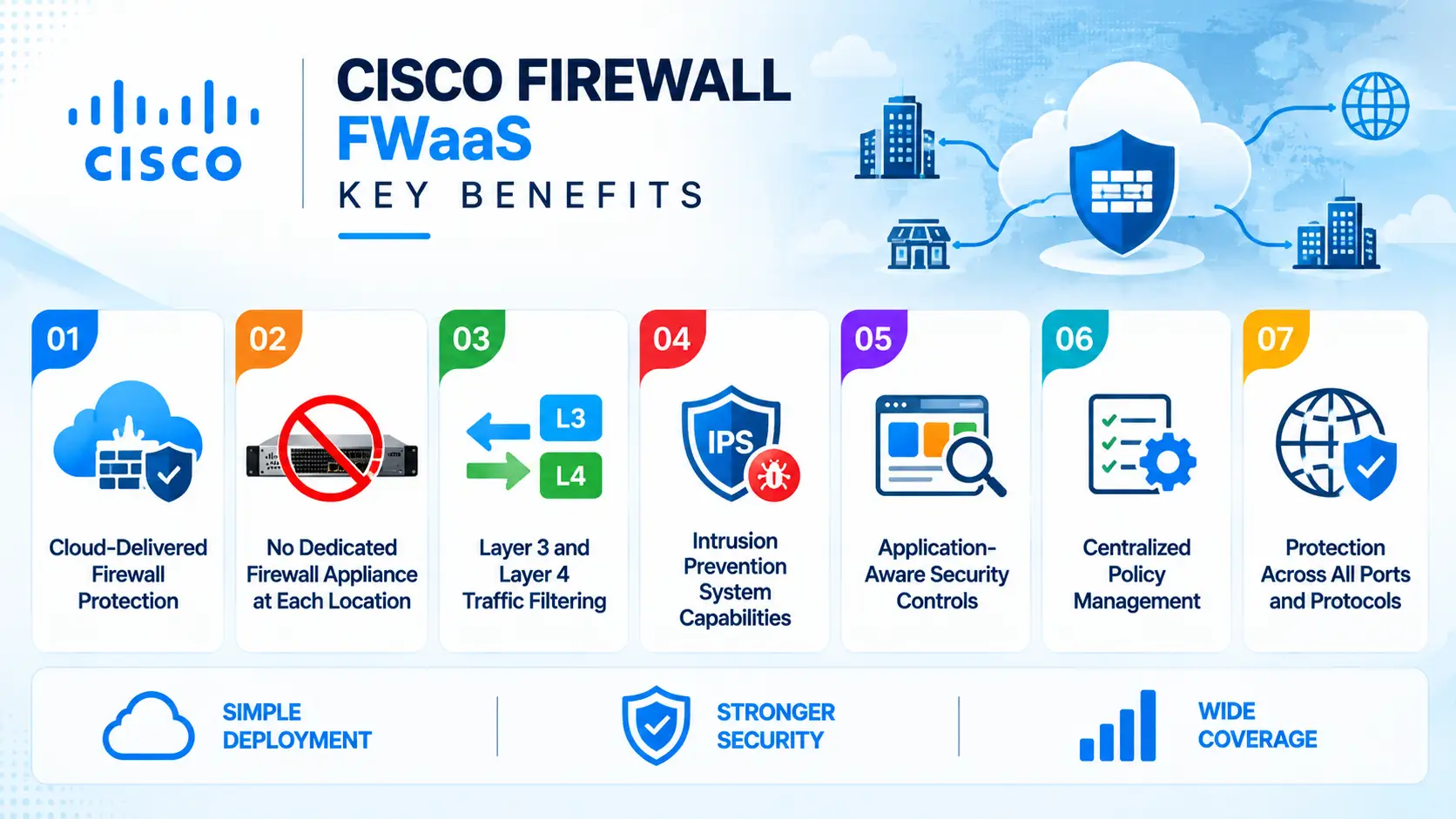
- Cloud-delivered firewall protection
- No dedicated firewall appliance at each location
- Layer 3 and Layer 4 traffic filtering
- Intrusion Prevention System capabilities
- Application-aware security controls
- Centralized policy management
- Protection across all ports and protocols
Cisco Firewall FWaaS At a Glance
What it is: Cloud-delivered Firewall as a Service within Cisco Secure Access.
Parent Category: Cisco Firewall License
Primary role: Cloud-based firewall and traffic-security enforcement
Delivery model: Security service delivered from the cloud
Traffic coverage: Non-web and internet traffic across supported ports and protocols
Firewall layer: Layer 3/Layer 4
Security capabilities: Firewall policies, application visibility, IPS, and related Secure Access security controls
Management: Cisco Secure Access unified dashboard
Typical users: Enterprise users, remote workers, branch offices, distributed networks, and hybrid environments
Architecture: Cloud-delivered SSE service
Main advantage: Centralized security without deploying a physical firewall at every enforcement point
Licensing model: Subscription-based cloud security service
License Overview
The Cisco Firewall FWaaS License provides access to cloud-delivered firewall functionality through Cisco Secure Access. Instead of licensing a physical firewall appliance according to hardware throughput, FWaaS is consumed as a cloud security service.
This changes the way organizations should approach sizing and licensing. The focus moves away from chassis, interfaces, power supplies, and appliance capacity toward users, traffic requirements, locations, security services, subscription scope, and deployment architecture.
Cisco Secure Access combines FWaaS with other SSE capabilities, allowing organizations to build a broader security architecture from a common cloud-delivered platform. Cisco identifies FWaaS alongside services such as Secure Web Gateway, ZTNA, CASB, DLP, and DNS security.
Before requesting a quotation, organizations should determine:
- Number of users and devices
- Internet traffic requirements
- Branch and remote-site coverage
- Required firewall policies
- IPS requirements
- Application-control requirements
- Private-network traffic requirements
- Required Secure Access package
- Subscription duration
Licensing Highlights
Cisco Firewall FWaaS licensing should be evaluated as part of the broader Cisco Secure Access subscription rather than as a standalone hardware firewall license.
The selected Secure Access package determines the combination of cloud security services available to the organization. FWaaS can provide firewall and IPS capabilities while other services can address web traffic, private application access, DNS security, data protection, and cloud application access.
This model can be useful for organizations that want to consolidate several security functions into a common cloud security architecture.
Product Overview
Traditional firewall architectures generally force traffic through a physical or virtual security appliance. That model can become difficult to scale when users work remotely, branches connect directly to the internet, and applications are distributed across multiple cloud environments.
FWaaS changes this architecture by moving firewall enforcement into the cloud.
Users and network traffic can reach Cisco’s cloud security infrastructure, where traffic is evaluated against centrally managed policies before being allowed to continue toward its destination.
This approach reduces dependence on a fixed security perimeter and can provide a consistent firewall policy across geographically distributed environments.
Core Technical Flow
A typical Cisco FWaaS traffic flow can be represented as:
User / Device / Branch
→ Traffic is directed toward Cisco Secure Access
Cloud Security Enforcement
→ Cisco applies the configured firewall and security policies
Layer 3/4 Inspection
→ Source, destination, protocol, and port information are evaluated
Application / IPS Controls
→ Applicable application visibility and intrusion-prevention policies are applied
Policy Decision
→ Traffic is allowed, blocked, or handled according to the configured security policy
Destination
→ Approved traffic continues to the internet or permitted private destination
This architecture allows firewall policies to follow distributed users and network locations rather than depending entirely on a physical firewall at a central site.
Options & Licensing Models
| Option | Purpose | Suitable For |
|---|---|---|
| FWaaS | Cloud-delivered firewall enforcement | Distributed internet and network traffic |
| FWaaS + IPS | Adds intrusion-prevention capabilities | Organizations requiring deeper network threat protection |
| Secure Access Package | Combines FWaaS with additional SSE capabilities | Broader cloud security deployments |
| Secure Internet Access | Protects internet-bound traffic through cloud security controls | Remote users and distributed organizations |
| Secure Private Access | Provides secure access to private applications | Hybrid and zero-trust environments |
| Enterprise Secure Access | Broader combination of SSE capabilities | Organizations consolidating security services |
| Subscription | Time-based access to selected Cisco Secure Access capabilities | Cloud-first security environments |
The exact package names, included capabilities, and commercial terms should be confirmed when preparing the quotation because Cisco Secure Access packages and service capabilities can evolve over time.
Features & Benefits
Cloud-Delivered Firewall
The primary advantage of FWaaS is that firewall functionality is delivered from the cloud rather than requiring a dedicated appliance at each site.
This can simplify security deployment for organizations with remote offices, temporary locations, mobile users, and distributed infrastructure.
Cisco’s SASE architecture guidance describes FWaaS as a cloud-delivered alternative to deploying and maintaining physical or virtual firewall appliances at individual sites.
Layer 3/4 Firewall Protection
FWaaS provides traditional network-layer firewall controls within the cloud service.
Policies can evaluate characteristics such as:
- Source IP
- Destination IP
- Protocol
- Port
- Network location
- Application context
This allows organizations to control non-web traffic that may not be adequately addressed by a traditional secure web gateway alone.
Intrusion Prevention
Cisco Secure Access FWaaS can include IPS capabilities for detecting and blocking network threats.
Cisco describes the service as providing visibility and security controls for traffic between users and destinations or applications across all ports and protocols, with IPS available as part of the FWaaS capability.
This adds threat-prevention capabilities to the basic Layer 3/4 firewall function.
Compatibility & Requirements
Before deploying Cisco Firewall FWaaS, organizations should evaluate their existing network and security architecture.
Important considerations include:
- Number of users
- Number of devices
- Branch locations
- Remote-user population
- Internet traffic volume
- Private application requirements
- Required firewall policies
- IPS requirements
- Application-control requirements
- Existing SD-WAN architecture
- Existing Cisco Secure Access deployment
Common Deployment Environments
Cisco Firewall FWaaS can be considered for:
- Distributed enterprise branches
- Remote-work environments
- Direct internet access architectures
- Hybrid networks
- Cloud-first organizations
How Activation Works
Cisco Firewall FWaaS is delivered through the Cisco Secure Access cloud service.
A typical deployment begins by selecting the appropriate Secure Access subscription and defining the users, traffic sources, locations, and security services that need protection.
The implementation process generally includes:
Subscription
→ Activate the required Cisco Secure Access services.
Identity Integration
→ Connect the organization’s identity and authentication infrastructure.
Traffic Onboarding
→ Direct supported user or network traffic toward the Cisco security service.
Policy Configuration
→ Define firewall, application, and IPS policies.
Security Validation
→ Test allowed and blocked traffic and verify security events.
Operational Deployment
→ Expand the configuration across users, branches, and network environments.
Because the service is cloud-delivered, the organization does not need to deploy a dedicated firewall appliance at each protected location.
Pricing + Quote
The cost of Cisco Firewall FWaaS depends on the selected Cisco Secure Access package, number of users or protected entities, required security capabilities, subscription term, and deployment architecture.
For an accurate quotation, prepare:
- Number of users
- Number of branches
- Remote-user population
- Estimated traffic volume
- FWaaS requirements
- IPS requirements
Unlike a hardware firewall quotation, the organization does not need to calculate chassis capacity, interface modules, power supplies, or physical firewall redundancy for the cloud enforcement layer.
The commercial model should instead be sized around the actual users, traffic, locations, and security services included in the Cisco Secure Access deployment.
Cisco Firewall pricing depends on your license type, deployment model and support requirements.