

HPE Data Protector is the legacy name many organizations still use when sourcing backup and recovery software now offered as OpenText Data Protector. An HPE Data Protector license request should therefore identify the installed version, existing entitlement, and required current offering. When comparing Data Protector license options, align the metric with protected workloads and the Cell Manager architecture before requesting a quotation.
Quick Benefits
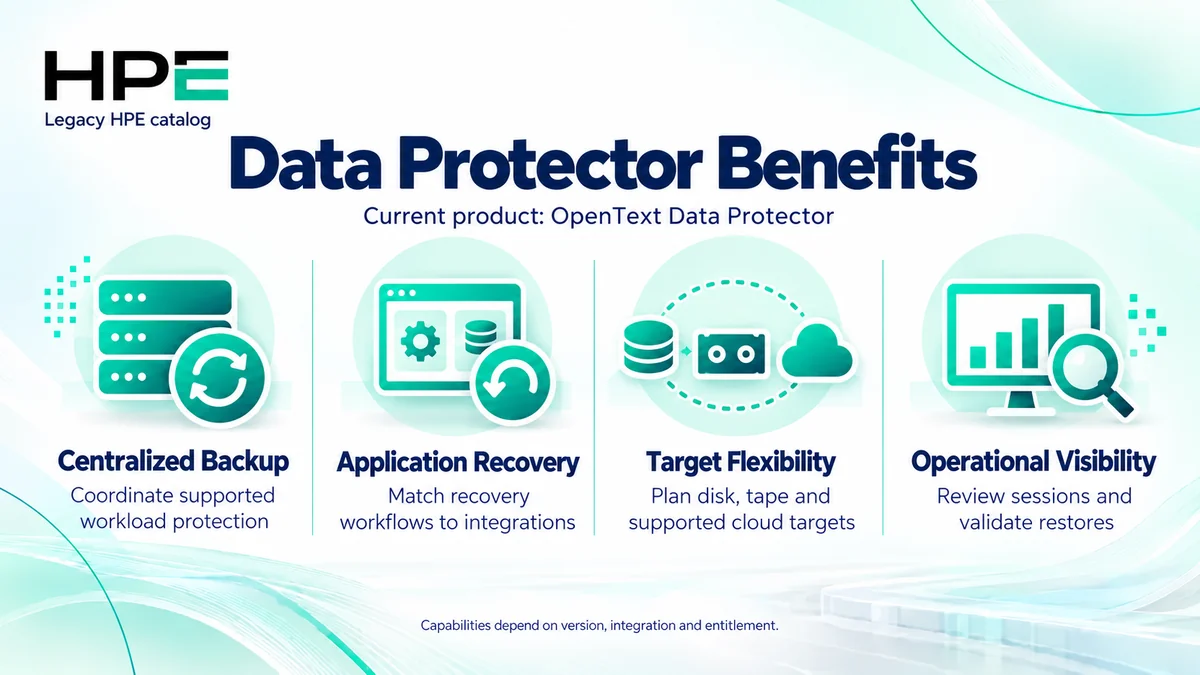
- Centralize backup and recovery across supported workloads.
- Use application integrations for consistent recovery workflows.
- Plan disk, tape, and supported cloud backup targets.
- Review backup sessions and validate recoverability.
At a Glance
- Current product: OpenText Data Protector
- Legacy search name: HPE Data Protector
- Catalog family: HP Software
- Management unit: Data Protector cell
- Documented metrics: Capacity, CPU socket, or feature-based
- Buyer inputs: Version, license report, workloads, and growth

Features & Benefits
Centralized Backup Operations
Data Protector coordinates protection policies across supported physical and virtual systems. Central management helps administrators organize schedules, media, and backup sessions. The design should reflect operational boundaries, backup windows, and recovery objectives rather than simply the number of servers.
Application-Aware Backup and Recovery
Supported database and application integrations provide workflows suited to business-critical workloads. Recovery capabilities vary by integration, version, and entitlement. Specify whether the requirement is file restoration, database recovery, virtual-machine recovery, or a broader disaster-recovery procedure before selecting the package.
Backup Targets and Operational Visibility
Disk, tape, and supported cloud targets allow different retention and recovery designs. Session information, reporting, and alerts help teams investigate failed jobs and protection gaps. A successful backup status should still be followed by representative restore testing and validation of the recovered data.
License Overview
OpenText documents capacity-based, CPU-socket, and feature-based licensing. These models cannot be combined within a single Data Protector Cell Manager. Review installed rights before expanding or changing models; a new purchase should not assume that legacy HPE or Micro Focus entitlements automatically map to a current bundle.
Capacity licensing measures front-end source data under the applicable backup-set rules, rather than compressed repository usage. Socket licensing applies to used CPU sockets on hypervisor hosts under the Express offering. Traditional licensing follows required functions and components. Retaining this category in the HP License catalog supports legacy discovery without implying current HPE product ownership.
Product Overview
The Cell Manager coordinates a Data Protector cell and maintains the Internal Database, which records backup objects, media, and session information. Disk Agents handle filesystem backup, application agents support relevant integrations, and Media Agents communicate with backup devices. Larger environments may use Manager-of-Managers for oversight of multiple cells. Architecture and license quantity must be assessed together.
Core Technical Flow
A configured backup policy starts a session under Cell Manager control. The relevant client or application integration reads the selected data, and a Media Agent writes it to the configured target. Catalog information records the resulting backup objects and media. During recovery, the selected objects are read from the available backup and restored through the appropriate workflow.
Options & Licensing Models
Use the following routes to define the quotation basis. Confirm the exact offering, included features, and migration rights against the proposed order.
| Model | Sizing basis | Buyer check |
|---|---|---|
| Capacity-based | Protected front-end terabytes | Backup-set measurement and bundle scope |
| CPU-socket / Express | Used hypervisor-host sockets | Virtualization estate and included workloads |
| Feature-based / traditional | Required components and functions | Existing base licenses and extensions |
Compatibility & Requirements
Validate the target release against operating systems, hypervisors, databases, backup devices, and application versions in the support matrices. Allow appropriate resources for the Cell Manager and database growth. Confirm network access, credentials, media availability, and recovery-location requirements. Backup-target compatibility does not establish that every application integration or recovery method is supported.
Activation & Deployment
Record existing keys and license usage, back up the Internal Database and configuration, and identify the intended Cell Manager. Use the entitlement documentation and vendor licensing service to obtain the applicable key. Install it through the release’s documented licensing workflow; if centralized licensing is used, confirm allocation to the correct cell. Check entitlement and usage, then run a backup and restore test for a representative workload.
Pricing & Quote
HPE Data Protector pricing requests should distinguish legacy renewal, expansion, and migration to a current OpenText offering. Send installed version, entitlement identifiers, license report, front-end data estimate or socket inventory, target devices, and required integrations. Include growth, support dates, and recovery priorities. Request a Data Protector quote with licensing metric, included capabilities, support, and delivery responsibilities confirmed.