

Cisco Nexus 1000V is a Cisco virtual networking platform designed for hypervisor-based data center environments, virtual machine switching, distributed virtual access, port-profile control, and policy consistency between physical and virtual networks.
Unlike physical Cisco Nexus switches in the broader Cisco Switch License category, including Nexus 3000, Nexus 7000, and Nexus 9000, Cisco Nexus 1000V works inside virtualized server environments and extends network control to virtual machine interfaces.
Series Highlights
- Suitable for legacy virtual switching, hypervisor-based networking, VM access control, and distributed virtual data center environments
- Built around Cisco Nexus 1000V Virtual Supervisor Module and Virtual Ethernet Module architecture
- Commonly associated with VMware vSphere, Microsoft Hyper-V, KVM-based environments, port profiles, policy control, and virtual network operations
- Requires careful review of hypervisor version, software release, CPU licensing, license files, support status, and migration options
- Helps buyers prepare the correct SKU, license, renewal, support item, software entitlement, or migration request before ordering
Review Cisco Nexus 1000V Price List and request a quote tailored to your licensing needs.
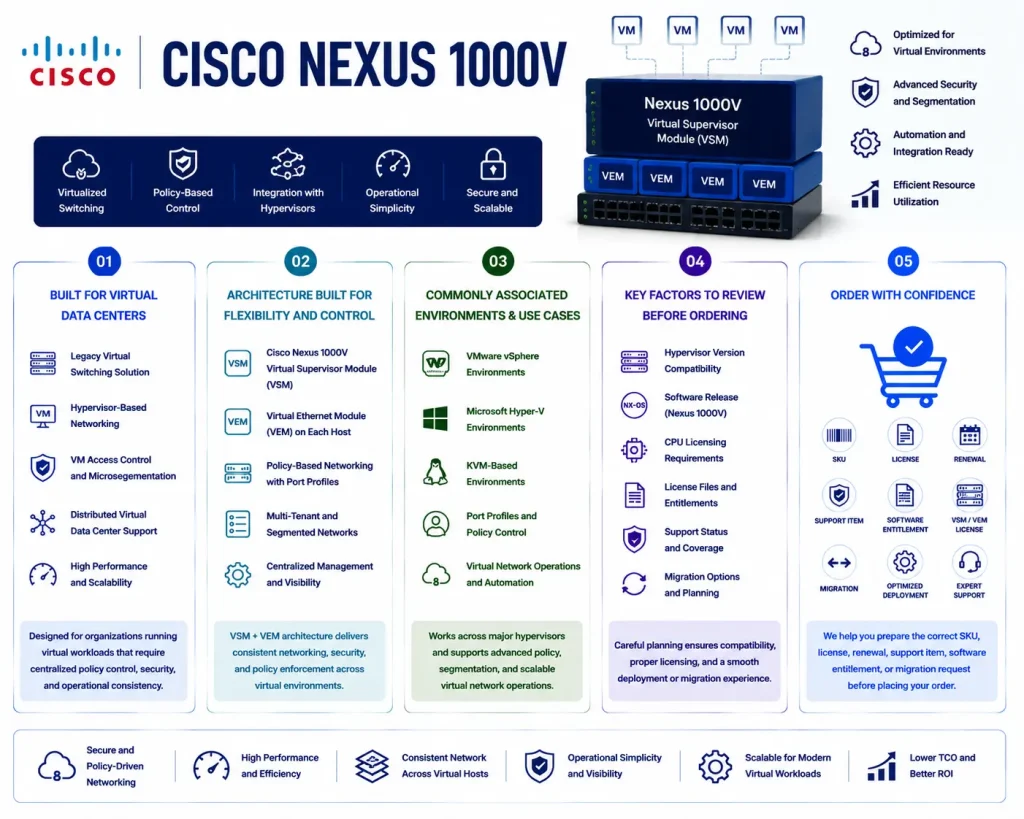
Cisco Nexus 1000V At a glance
What it is : Cisco Nexus 1000V is a virtual distributed switch platform in the Cisco Nexus portfolio.
Product family : Cisco Nexus License
Typical use : Virtual machine networking, distributed virtual switching, hypervisor access networking, VM port-profile control, policy-based virtual access, and legacy virtual data center maintenance.
License or ordering scope : Nexus 1000V software release, hypervisor platform, Virtual Supervisor Module, Virtual Ethernet Module, CPU-based licensing, license file, support renewal, and migration planning.
Who needs it : Data center, virtualization, cloud, and network teams maintaining older Nexus 1000V environments that need the correct Cisco Nexus 1000V part number, license, support item, or migration guidance.
Series Overview
Cisco Nexus 1000V was built to bring Cisco-style network control into virtualized data center environments. Instead of managing only physical switch ports, network teams could define policies for virtual machine interfaces and apply consistent switching behavior across hosts.
In a typical deployment, the Virtual Supervisor Module provides the control and management layer, while Virtual Ethernet Modules run on hypervisor hosts and handle virtual machine traffic. This model allowed network teams to manage virtual access ports with familiar network concepts such as port profiles, VLANs, QoS, security policy, and operational visibility.
Cisco Nexus 1000V is now mostly relevant for legacy environments, license review, software maintenance, support validation, and migration planning. Many customers use this page because they need to identify an existing license, confirm part numbers, review support status, or plan a move toward newer virtual networking, ACI, cloud, or hypervisor-native switching options.
Because the platform is software-based and tied to hypervisor compatibility, ordering should be handled carefully. The hypervisor version, Nexus 1000V release, active licenses, CPU count, support status, and replacement path should all be checked before selecting the final SKU.
Licensing and Part Number Guidance
Choosing the correct part number for Cisco Nexus 1000V depends on the software version, hypervisor platform, host count, CPU count, license type, support coverage, and migration requirement.
Cisco Nexus 1000V licensing may involve license files, per-CPU licensing, multi-hypervisor licensing behavior, support renewal, or software entitlement review depending on the installed version and platform. Some environments may already have basic features enabled, while advanced feature or migration-related requirements should be checked against the actual license file and Cisco-supported workflow.
Buyers should confirm whether the request is for VMware vSphere, Microsoft Hyper-V, KVM, or another supported historical deployment model. This is important because licensing, compatibility, and support expectations may differ by platform and release.
For existing deployments, the current license and software inventory should be reviewed before ordering. This helps avoid wrong license quantities, unsupported release assumptions, expired support coverage, or a part number that no longer fits the real virtualization environment.
Common Use Cases
| Use case | Why it matters |
|---|---|
| Virtual machine access switching | Extends switching and policy control to VM interfaces inside hypervisor environments |
| Port-profile management | Helps apply consistent network settings across virtual machine ports and host clusters |
| Legacy VMware or Hyper-V networking | Supports environments that still depend on Nexus 1000V for virtual switching operations |
| License validation | Helps confirm CPU count, license file, feature use, and support coverage before renewal or migration |
| Support or renewal planning | Helps determine whether an existing Nexus 1000V environment can still be supported or maintained |
| Migration planning | Supports transition from Nexus 1000V toward newer Nexus, ACI, cloud, or hypervisor-native networking models |
Models, Licenses, and Ordering Scope
| Area to check | What to confirm |
|---|---|
| Platform type | VMware vSphere, Microsoft Hyper-V, KVM, or supported historical deployment environment |
| Software release | Cisco Nexus 1000V release, compatibility matrix, upgrade status, and maintenance condition |
| Architecture | Virtual Supervisor Module, Virtual Ethernet Modules, HA pair, host clusters, and deployment layout |
| License type | CPU-based license, multi-hypervisor license, license file, support renewal, or software entitlement |
| Host scope | Number of hypervisor hosts, installed CPUs, VEM instances, and cluster growth requirement |
| Feature scope | Basic switching, port profiles, policy control, security, QoS, monitoring, or advanced virtual networking need |
| Support status | Existing contract, renewal eligibility, retirement status, and migration path |
| Quantity | Number of CPUs, hosts, licenses, support renewals, or migration targets |
| Activation method | License file, Cisco licensing portal workflow, support validation, or Cisco-supported activation path |
| Part number | Correct Cisco Nexus 1000V software, license, support, renewal, or migration-related SKU |
What to Check Before Requesting a Quote
Before requesting a quote for Cisco Nexus 1000V, confirm the hypervisor platform, Nexus 1000V software release, host count, CPU count, license file status, support coverage, and current deployment role. You should also define whether the request is for a new license review, support renewal, license transfer, software entitlement, existing environment maintenance, or migration planning. Each scenario can change the final part number and the correct commercial path. For existing environments, prepare the current inventory first. This should include VSM version, VEM version, hypervisor version, host count, CPU count, license file details, support status, and any migration deadlines.
Activation and Delivery Notes
After the correct Cisco Nexus 1000V part number is selected, activation depends on the software release, license file, hypervisor platform, and Cisco-supported licensing workflow. Some deployments use traditional license files rather than modern subscription-first licensing. If the environment uses a VSM high-availability pair, the license behavior should be checked before delivery so the active and standby control-plane design remains aligned with the installed license. For renewals or migration projects, support and retirement status should be reviewed first. This helps prevent delivery delays and gives the buyer a realistic view of whether to renew, replace, or migrate the existing virtual switching environment.
Cisco Nexus Series pricing depends on your Switch series, license type, deployment model and support requirements.