

Cisco Wireless License provides the software entitlements required to operate, manage, and expand Cisco enterprise wireless networks. It commonly applies to Cisco Catalyst access points connected to Catalyst wireless controllers, with licensing selected according to access-point quantity, software tier, subscription term, and required management or assurance capabilities.
A wireless order should not be based only on the controller model. Each access point joining a Cisco Catalyst 9800 Wireless Controller must have an appropriate subscription entitlement. The correct configuration also depends on whether the network needs standard wireless operation, centralized automation, advanced assurance, location services, or integration with platforms such as Cisco Catalyst Center.
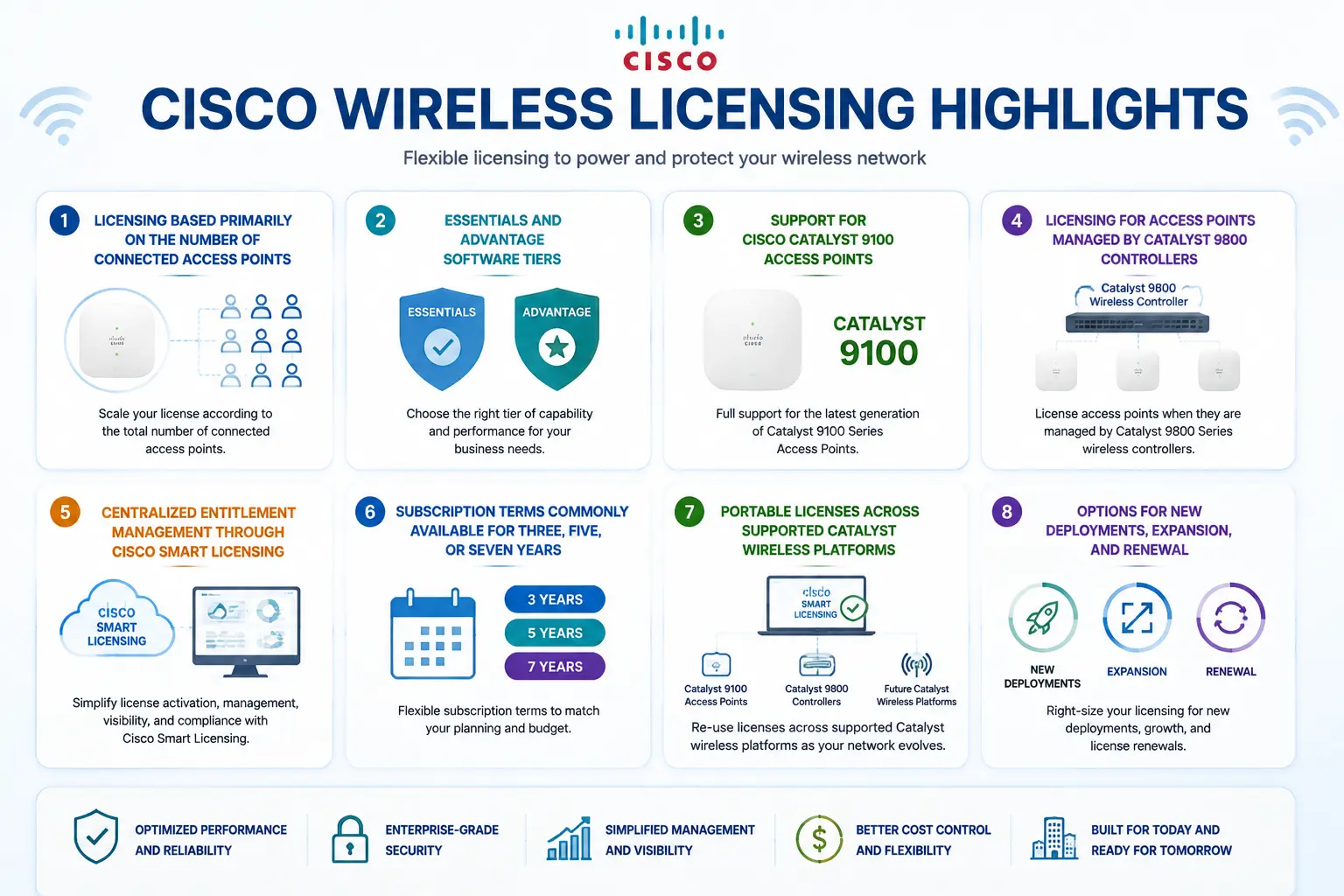
Cisco Wireless Licensing Highlights
- Licensing based primarily on the number of connected access points
- Essentials and Advantage software tiers
- Support for Cisco Catalyst 9100 Access Points
- Licensing for access points managed by Catalyst 9800 controllers
- Centralized entitlement management through Cisco Smart Licensing
- Subscription terms commonly available for three, five, or seven years
- Portable licenses across supported Catalyst wireless platforms
- Options for new deployments, expansion, and renewal
Cisco Wireless License At a Glance
What it covers: Wireless access-point operation, controller entitlement, management, automation, and assurance features
Product family: Cisco Networking
Main products: Cisco Catalyst 9100 and Cisco Catalyst 9800
Primary measurement: Number of managed access points
Main tiers: Cisco DNA Essentials and Cisco DNA Advantage
License management: Cisco Smart Licensing Using Policy
Typical use: Campus, branch, education, healthcare, retail, warehouse, and public wireless networks
Cisco Wireless License Overview
Cisco wireless licensing is generally assigned per access point rather than as one license for the entire controller, following the entitlement structure used across the broader Cisco License ecosystem. When access points connect to a Cisco Catalyst 9800 controller, each connected access point must be covered by a valid Cisco DNA or applicable Cisco wireless subscription to maintain license compliance. The controller itself can boot without an access-point subscription, but licenses are required when managed access points join it.
The selected tier determines the software capabilities available to the wireless environment. Essentials supports core connectivity, management, and operational functions, while Advantage is intended for networks requiring broader automation, assurance, analytics, policy, and advanced service capabilities.
Licenses are deposited into the customer’s Cisco Smart Account and can be tracked through Cisco Smart Software Manager. Existing entitlements should be reviewed before ordering additional access points because remaining subscription terms may be portable across supported Catalyst 9100 models and wireless-controller environments.
Cisco Wireless Product Overview
Cisco Catalyst 9100 Access Points
Cisco Catalyst 9100 is Cisco’s enterprise access-point family for indoor, outdoor, remote-worker, and specialized wireless deployments. The portfolio includes Wi-Fi 6 and Wi-Fi 6E models designed for environments ranging from small branches and hotel rooms to high-density campuses, warehouses, hospitals, and public venues.
When Catalyst 9100 access points are ordered for a Catalyst-controlled deployment, the required wireless software tier and subscription term should be selected with the hardware. Cisco DNA Wireless subscriptions support the Catalyst 9100 family and provide the access-point entitlement needed for centralized configuration, policy, optimization, and related management capabilities.
The correct model still matters. Radio design, antenna type, environmental rating, client density, uplink speed, power availability, regulatory domain, and controller compatibility should be confirmed before access-point quantities and licenses are finalized.
Cisco Catalyst 9800 Wireless Controllers
Cisco Catalyst 9800 Wireless Controllers provide centralized control, policy enforcement, mobility, security, and operational management for supported Cisco access points. The family includes physical appliances, virtual cloud controllers, embedded options, and models designed for different site and client scales.
A Catalyst 9800 controller does not normally require a separate license merely to start. Licensing is consumed according to the access points connected to it. Every managed access point must be covered by the required wireless subscription, and the configured license level should match the purchased Essentials or Advantage entitlement.
Certain controller models may also have platform-specific options. For example, the Catalyst 9800-L supports a high-performance license that increases supported access points, clients, and throughput. This type of controller-capacity option is separate from the subscriptions required for connected access points.
Options and Licensing Models
Cisco Wireless License selection usually involves four decisions:
- Access-point quantity: Each managed access point requires coverage.
- License tier: Essentials or Advantage, based on required functions.
- Subscription term: Selected according to the purchasing agreement and lifecycle plan.
- Management architecture: Controller-only operation or integration with Cisco Catalyst Center and related services.
A buyer deploying standard branch Wi-Fi may only need core wireless management. A large campus using policy automation, advanced assurance, analytics, and deeper troubleshooting may benefit from the Advantage tier. The tier should therefore be selected from actual operational requirements rather than automatically choosing the highest option.
Features and Benefits
Cisco wireless licensing gives organizations a structured way to expand wireless coverage without rebuilding the licensing model for every site. Access-point-based quantities make it easier to align subscriptions with physical deployment growth. The combination of Catalyst 9100 access points and Catalyst 9800 controllers supports centralized configuration, secure access, mobility, radio optimization, and consistent policies across multiple locations. Higher-tier software can add richer assurance and automation, helping teams identify whether poor wireless service is caused by coverage, interference, authentication, the wired network, or an application path.
Compatibility and Requirements
| Area | What to confirm |
|---|---|
| Access points | Exact Catalyst 9100 models and quantities |
| Controller | Catalyst 9800 model, virtual platform, or embedded deployment |
| Software | Compatible access-point and IOS XE releases |
| License tier | Essentials or Advantage |
| Capacity | Access points, clients, throughput, and site growth |
| Management | Controller-only or Catalyst Center integration |
| Account | Cisco Smart Account and correct Virtual Account |
| Infrastructure | PoE, switching, uplinks, VLANs, identity, and RF design |
Cisco publishes a wireless compatibility matrix covering supported access points, controller platforms, and software combinations. The exact release pairing should be checked before deployment or migration.
How Cisco Wireless License Activation Works
Cisco wireless entitlements are delivered electronically to the customer’s Smart Account. The Catalyst 9800 controller uses Smart Licensing Using Policy to record and report license consumption for connected access points.
Administrators configure the applicable Essentials or Advantage level, confirm the Smart Account and Virtual Account, and verify that the number of reported access points matches the purchased entitlement. Connected, offline, or on-premises reporting workflows can be selected according to the organization’s network-access policies.
Pricing Factors and Quote Process
Cisco Wireless License pricing mainly depends on the number of access points, selected tier, subscription term, and whether the request is for a new deployment, expansion, migration, or renewal. Complete the price-quote form using Cisco as the brand and Cisco Wireless License as the product. You may attach an access-point list, controller details, existing license inventory, or technical specification. Tier selection and other ordering options can be clarified during the quote process.
Cisco Wireless pricing depends on your license type, deployment model and support requirements.