

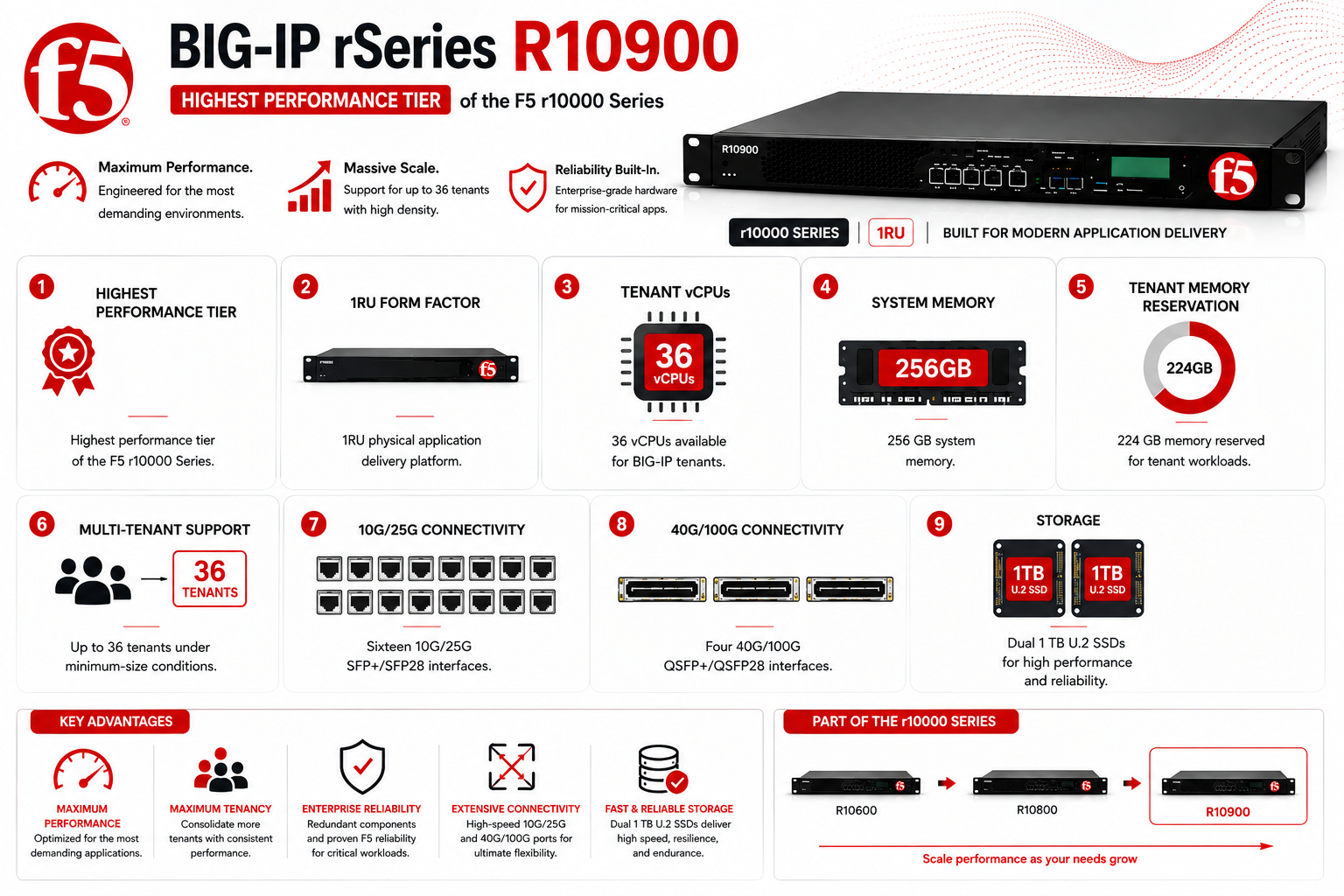
BIG-IP R10900 is the highest performance tier of the F5 r10000 Series, designed for large enterprise application delivery, security, and workload-consolidation environments that need the full compute capacity of the r10000 hardware platform. It combines 36 vCPUs available to BIG-IP tenants, 256 GB of system memory, high-density 25G and 100G connectivity, and redundant internal storage in a compact 1RU appliance.
R10900 uses the same physical platform as R10600 and R10800, but no additional tenant CPU capacity is disabled by licensing. It therefore makes sense where a lower r10000 tier would leave little headroom or where several substantial BIG-IP workloads need to share one appliance.
Series Highlights
- Highest performance tier of the F5 r10000 Series
- 1RU physical application delivery platform
- 36 vCPUs available for BIG-IP tenants
- 256 GB system memory
- 224 GB memory reserved for tenant workloads
- Up to 36 tenants under minimum-size conditions
- Sixteen 10G/25G SFP+/SFP28 interfaces
- Four 40G/100G QSFP+/QSFP28 interfaces
- Dual 1 TB U.2 SSD
Review BIG-IP R10900 Price List and request a quote tailored to your licensing needs.
BIG-IP R10900 At a glance
What it is: Fully enabled F5 r10000 Series application delivery and security appliance
Product family: BIG-IP rSeries License
Platform layer: F5OS
Tenant compute: 36 vCPUs
System memory: 256 GB
Memory reserved for tenants: 224 GB
Maximum tenant count: Up to 36
Storage: Two 1 TB U.2 SSDs
Interfaces: Sixteen 10G/25G plus four 40G/100G ports
Series Overview
The r10000 platform contains a 24-core Intel Xeon processor presented as 48 hyperthreaded logical processing cores. Twelve vCPUs are reserved for F5OS, leaving 36 available for BIG-IP tenant workloads on R10900. Unlike R10600 and R10800, R10900 has no additional CPU resources disabled by the performance license.
Those resources may be concentrated into one large tenant or divided across multiple environments. F5 currently lists a theoretical maximum of 36 tenants, but that figure assumes lightweight minimum-size configurations. Typical production tenants should be sized around modules, traffic, memory, disk, and upgrade requirements rather than around the maximum tenant count alone.
Network capacity is equally strong: sixteen 10G/25G ports and four 40G/100G interfaces provide enough density for high-speed application and data-center designs without moving to a modular chassis.
Licensing and Part Number Guidance
The R10900 model determines the amount of r10000 compute capacity available to tenants. It does not by itself define which BIG-IP License services are licensed. An order may include traffic-management capabilities, DNS, application or API security, access services, network security, or another supported BIG-IP combination. Software entitlement, support, optics, power, and appliance quantity therefore need to be reviewed alongside the hardware model.
R10900 is also the final tier in the r10000 PAYG ladder. R10600 can move to R10800 or R10900, and R10800 can upgrade to R10900 through licensing because all three use the same base hardware. Once R10900 is reached, there is no further r10000 PAYG capacity to unlock.
Common Use Cases
| Use case | Why R10900 can fit |
|---|---|
| Large enterprise ADC | Full r10000 compute capacity |
| Application security | Headroom for inspection-heavy workloads |
| SSL/TLS services | High-capacity encrypted application processing |
| BIG-IP consolidation | Up to 36 tenant vCPUs for separated workloads |
| Data-center edge | Dense 25G and 100G networking |
| DNS and access services | Multiple service roles on one physical platform |
| Large iSeries refresh | Modern rSeries platform for major hardware migrations |
| Capacity-sensitive design | Avoids another PAYG step within r10000 |
Models, Licenses, and Ordering Scope
| Area | What to confirm |
|---|---|
| Platform | BIG-IP R10900 |
| BIG-IP services | LTM, DNS, Advanced WAF, AFM, APM, or required combination |
| Compute | vCPU requirement per tenant |
| Tenant design | Number, image type, memory, CPU, and application role |
| Interfaces | 10G, 25G, 40G, or 100G |
| Availability | Standalone or two-appliance HA |
| Capacity | Whether r10000 still leaves enough future headroom |
| Storage | Dual 1 TB U.2 SSDs |
| Power | AC, DC, or HVDC configuration |
| Optics | SFP+, SFP28, QSFP+, or QSFP28 |
| Support | F5 support level and term |
| Part numbers | Hardware, software, optics, power, support, and accessories |
What to Check Before Requesting a Quote
Start with the expected workload rather than automatically choosing R10900 because it is the largest r10000 model. Map peak traffic, SSL/TLS demand, connection volume, security inspection, BIG-IP modules, and network-interface requirements. Tenant design deserves particular attention. F5 supports several tenant image types with different minimum CPU, memory, and disk requirements. A 36-tenant theoretical maximum is therefore not the same as a realistic 36-workload production deployment.
Also check growth beyond the current project. R10900 has no remaining r10000 PAYG step. If most of the 36 tenant vCPUs, 224 GB tenant-memory pool, or interface capacity will already be committed, the newer r12000 Series should be evaluated before the order is finalized. F5’s current r12000 hardware increases system memory to 512 GB and provides higher tenant-compute tiers.
Activation and Delivery Notes
R10900 deployment begins at the F5OS platform layer. The platform license, physical interfaces, VLANs, and shared settings are configured there before BIG-IP tenants are deployed. Tenants inherit the system license and selected platform capabilities; F5 advises against replacing or deleting the platform license from inside an individual tenant.
CPU and memory are then allocated to each tenant according to its workload. F5 recommends at least two vCPUs for a typical BIG-IP tenant; single-vCPU configurations are intended for lightweight LTM or DNS use. For HA, corresponding BIG-IP tenants should run on separate rSeries appliances. F5 does not provide an HA relationship between the two F5OS platform layers themselves.
F5 pricing depends on your product edition, license type, deployment model, traffic needs, term, and support requirements.