

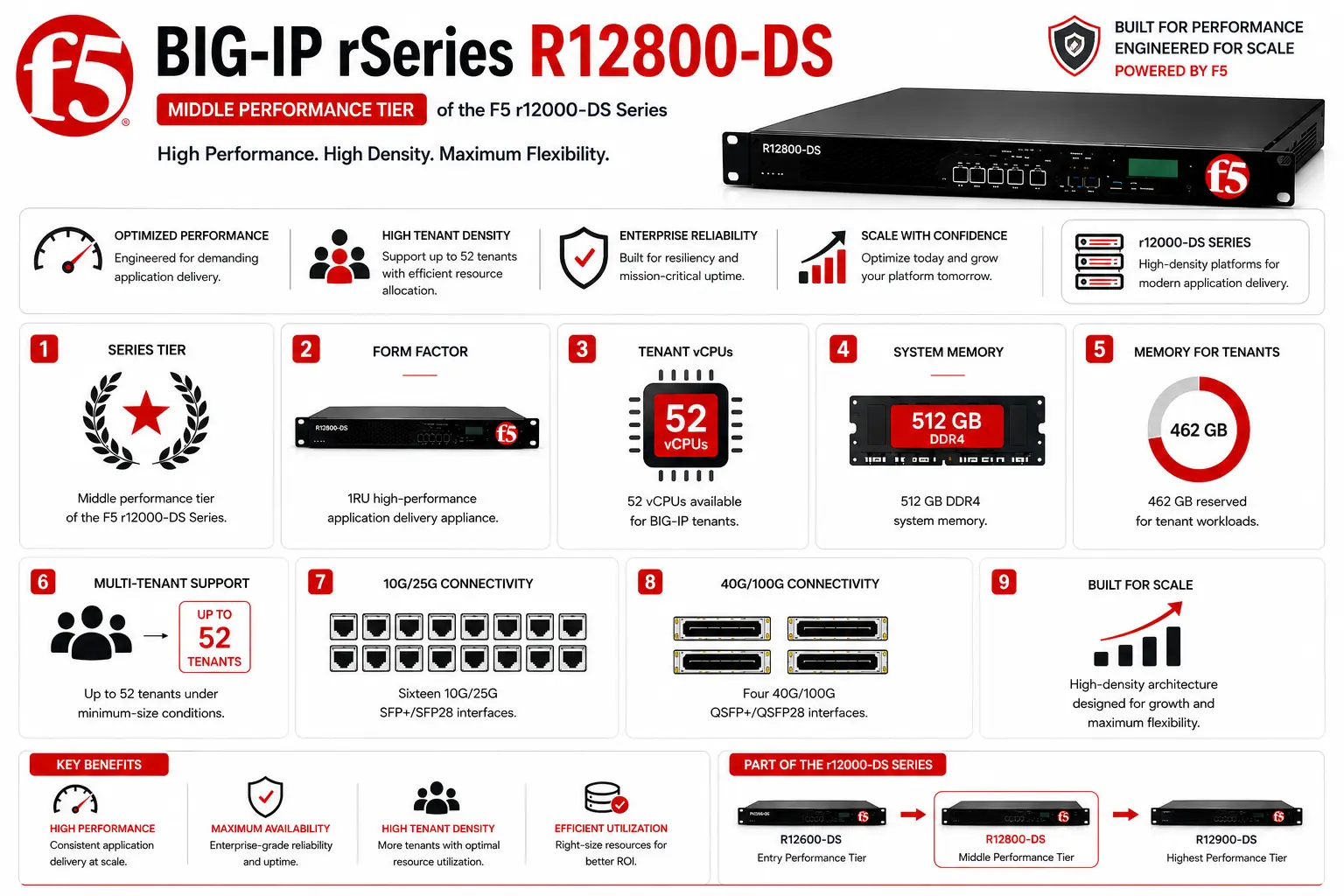
BIG-IP R12800-DS is the middle performance tier of F5’s r12000-DS Series, built for large application delivery and security environments where encrypted traffic, tenant consolidation, and high-speed network connectivity drive platform sizing. It provides more compute capacity than R12600-DS while retaining the same 1RU hardware architecture, 512 GB memory, redundant storage, and dense 25G/100G connectivity.
The R12800-DS makes 52 vCPUs available to BIG-IP tenants and is particularly suited to organizations processing large volumes of TLS traffic or consolidating several substantial BIG-IP workloads onto one appliance. Because R12600-DS, R12800-DS, and R12900-DS share the same physical platform, an R12800-DS can later move to the fully enabled R12900-DS tier through a Pay-as-you-Grow license change.
Series Highlights
- Middle performance tier of the F5 r12000-DS Series
- 1RU high-performance application delivery appliance
- 52 vCPUs available for BIG-IP tenants
- 512 GB DDR4 system memory
- 462 GB reserved for tenant workloads
- Up to 52 tenants under minimum-size conditions
- Sixteen 10G/25G SFP+/SFP28 interfaces
- Four 40G/100G QSFP+/QSFP28 interfaces
BIG-IP R12800-DS At a glance
What it is: High-scale F5 application delivery platform optimized for demanding SSL/TLS workloads
Product family: BIG-IP rSeries License
Series: r12000-DS
Platform layer: F5OS
Tenant compute: 52 vCPUs
System memory: 512 GB
Memory reserved for tenants: 462 GB
Maximum tenant count: Up to 52
Storage: Dual 2 TB U.2/U.3 SSDs in RAID1
Series Overview
The r12000-DS hardware exposes 72 logical vCPUs. Twelve are reserved for F5OS, while eight are disabled at the R12800-DS licensing tier. This leaves 52 vCPUs available to BIG-IP tenants. Those resources can be concentrated into a large application-delivery instance or divided among several isolated workloads.
Current F5OS specifications allocate 462 GB of the system’s 512 GB memory to tenants. F5 technically supports as many as 52 minimum-size tenants, although a real production design usually uses fewer and larger tenants to provide predictable CPU and memory resources.
The performance profile is where R12800-DS stands out. F5 publishes 195 Gbps L4 and L7 throughput, up to 8.5 million L7 requests per second, 335,000 RSA 2K SSL transactions per second, 240,000 ECDHE-ECDSA P-256 transactions per second, and 100 Gbps bulk encryption under its test conditions.
Licensing and Part Number Guidance
The R12800-DS model determines the amount of compute available on the r12000-DS hardware. The final order must still include the BIG-IP services required by the environment. A deployment may use LTM for application delivery, Advanced WAF for web and API protection, DNS, AFM, APM, or several services together. SSL-heavy security workloads can require substantially more compute than straightforward LTM traffic, so software selection and appliance sizing should be reviewed together.
R12800-DS also has one remaining PAYG step. A license upgrade can unlock the eight vCPUs currently disabled and convert the platform to R12900-DS capacity without replacing the appliance. If most of the available 52 vCPUs will already be allocated at deployment, comparing R12900-DS pricing before purchase may be more economical.
Common Use Cases
| Use case | Why R12800-DS can fit |
|---|---|
| Large TLS termination | 100 Gbps bulk encryption and high SSL TPS |
| Enterprise ADC | 195 Gbps L4/L7 throughput |
| Application security | Compute headroom for inspection-heavy services |
| BIG-IP consolidation | 52 tenant vCPUs and large memory pool |
| Data-center edge | Dense 25G and 100G connectivity |
| High-volume APIs | TLS processing combined with application security |
| Large platform refresh | r12000-scale replacement for older high-end ADCs |
| Growth deployment | One remaining PAYG step to R12900-DS |
Models, Licenses, and Ordering Scope
| Area | What to confirm |
|---|---|
| Platform | BIG-IP R12800-DS |
| BIG-IP services | LTM, Advanced WAF, DNS, AFM, APM, or required combination |
| SSL/TLS workload | Transactions, encryption throughput, certificates, and ciphers |
| Tenant design | Number, vCPU, memory, image type, and role |
| Interfaces | 10G, 25G, 40G, or 100G |
| Availability | Standalone or paired HA systems |
| PAYG | Remain R12800-DS or plan R12900-DS |
| Storage | Dual 2 TB RAID1 SSDs |
| Power | AC or optional dual DC configuration |
| Optics | SFP+, SFP28, QSFP+, or QSFP28 |
| Support | Required coverage and term |
| Part numbers | Appliance, BIG-IP entitlement, PAYG, optics, power, and support |
What to Check Before Requesting a Quote
Start with encrypted application traffic. Record peak throughput, SSL transactions per second, bulk TLS traffic, concurrent connections, required BIG-IP modules, and network-interface speeds. Tenant planning should follow the actual application architecture. Although R12800-DS can technically support 52 single-vCPU tenants, F5 notes that single-vCPU configurations are intended for very light LTM or DNS workloads and are generally not recommended for normal production use.
For a consolidated design, estimate each tenant separately. A small DNS instance does not consume resources like a large Advanced WAF tenant processing substantial encrypted traffic. Also consider the remaining growth path. R12800-DS is only eight vCPUs below the fully enabled R12900-DS tier. If that difference is likely to be needed soon, request both configurations for comparison.
Activation and Delivery Notes
Initial setup takes place at the F5OS platform layer. The administrator activates the platform license, prepares physical interfaces and VLANs, imports the required tenant image, and allocates vCPU and memory before deploying BIG-IP. Tenants inherit system-level capabilities such as licensing and VLAN access. F5 specifically advises administrators not to install or remove the appliance license from inside an individual tenant.
For high availability, corresponding BIG-IP tenants should run on separate rSeries systems with identical resources. F5 supports Device Service Clustering between the tenants; there is no substitute for the second physical system when connection mirroring and appliance resilience are required. Before delivery, confirm BIG-IP licensing, optics, power supplies, tenant allocation, support coverage, HA quantity, and any planned R12900-DS PAYG upgrade.
F5 pricing depends on your product edition, license type, deployment model, traffic needs, term, and support requirements.