

VIPRION 2200 is an F5 modular application delivery platform designed for organizations that require scalable BIG-IP services within a chassis-based architecture. The platform uses modular blades rather than operating as a conventional fixed appliance, allowing processing capacity and application services to be designed around the organization’s traffic and availability requirements.
The platform can support BIG-IP capabilities such as Local Traffic Management, application security, access control, and other services supported by the applicable hardware and software release. For organizations evaluating a VIPRION 2200 License, the chassis, blade configuration, BIG-IP version, required modules, throughput, and licensing model should be considered together rather than treating the license as an isolated software item.
Quick Benefits
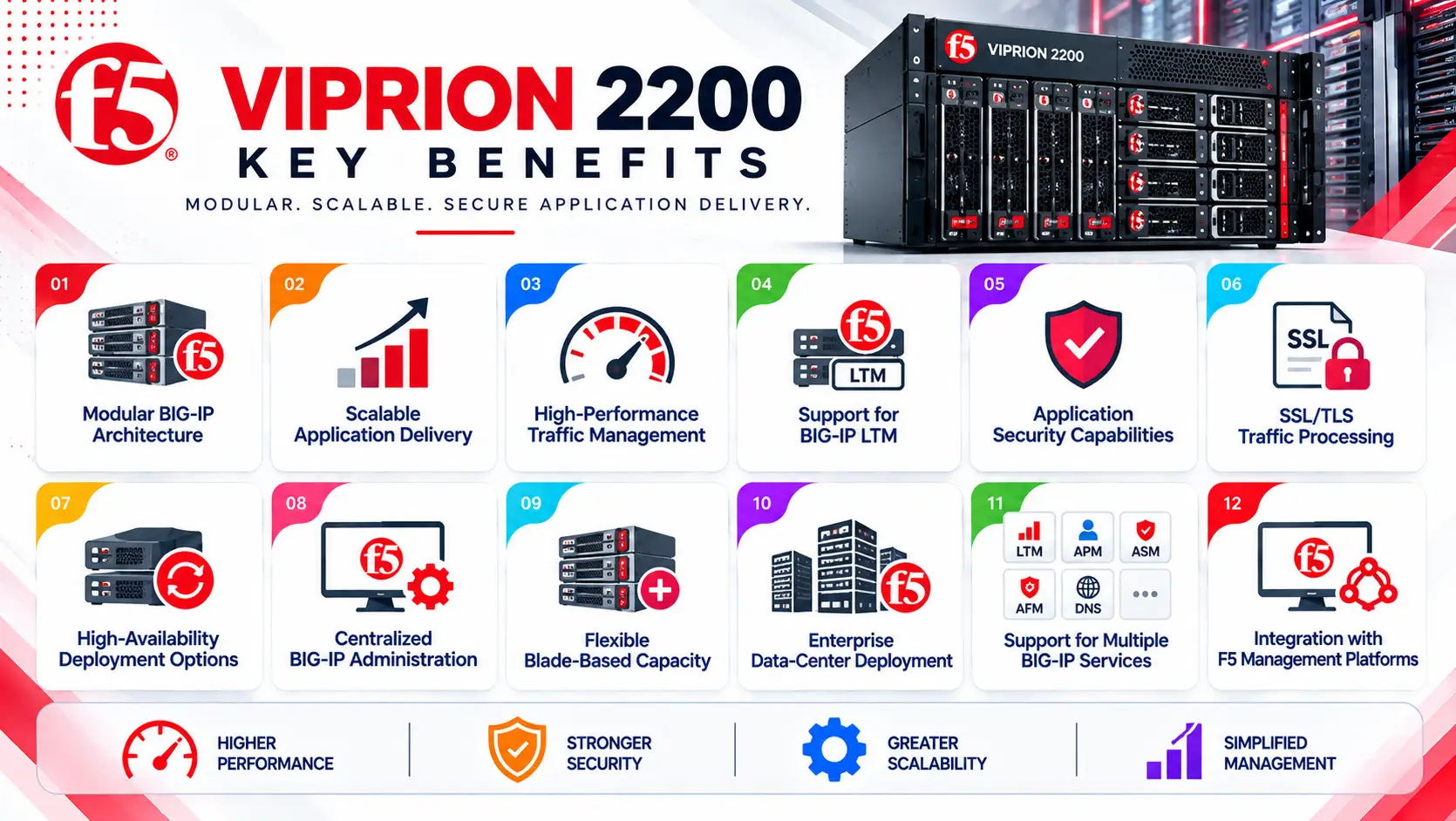
- Modular BIG-IP architecture
- Scalable application delivery
- High-performance traffic management
- Support for BIG-IP LTM
- Application security capabilities
- SSL/TLS traffic processing
- High-availability deployment options
- Centralized BIG-IP administration
- Flexible blade-based capacity
- Enterprise data-center deployment
- Support for multiple BIG-IP services
- Integration with F5 management platforms
VIPRION 2200 At a Glance
| Item | Details |
|---|---|
| Product name | F5 VIPRION 2200 |
| Vendor | F5 |
| Product type | Modular application delivery platform |
| Platform family | VIPRION |
| Software | F5 BIG-IP / TMOS |
| Architecture | Chassis with processing blades |
| Primary purpose | Application delivery, traffic management, and security |
| Main service | BIG-IP Local Traffic Management |
| Security services | Supported BIG-IP security modules |
| Deployment | Enterprise data center |
| Management | BIG-IP management and supported F5 centralized management |
| Licensing | BIG-IP software and service entitlements |
| Scalability | Blade-based modular capacity |
| Typical use | High-volume and mission-critical application environments |
| Ordering criteria | Chassis, blades, software version, modules, capacity, support, and term |
Product Overview
The VIPRION architecture is different from a conventional standalone BIG-IP appliance.
A VIPRION chassis provides the physical platform, while processing blades provide the compute resources used by BIG-IP. This allows organizations to design the platform around application traffic and service requirements.
A typical architecture consists of:
VIPRION Chassis
→ Provides the physical platform
Processing Blades
→ Provide processing resources
BIG-IP / TMOS
→ Provides the software foundation
Licensed Modules
→ Add application delivery and security functionality
Application Services
→ Load balancing, traffic management, access control, and security policies
This separation between hardware capacity and software functionality is important when planning both deployment and licensing.
Core Technical Flow
A typical VIPRION 2200 application-delivery workflow can be represented as:
Client Request
→ Traffic reaches the VIPRION virtual server
Traffic Classification
→ BIG-IP identifies the destination service and applicable policy
Security Processing
→ Security and access policies are evaluated where licensed and configured
Load Balancing
→ LTM selects an appropriate backend resource
Application Delivery
→ Traffic is forwarded to the selected server
Response Processing
→ BIG-IP processes the response before returning it to the client
This architecture allows application delivery and security functions to operate on the same BIG-IP platform.
Options and Licensing Models
| Option | Description | Typical Requirement |
|---|---|---|
| BIG-IP Base | Core BIG-IP software entitlement | Required for BIG-IP operation |
| LTM | Local traffic management and load balancing | Application delivery |
| Advanced WAF | Web application security | Public-facing and critical applications |
| AFM | Network firewall capabilities | Network and data-center security |
| APM | Identity-aware application access | Remote and controlled application access |
| BIG-IP DNS | DNS and global application traffic management | Multi-site applications |
| SSL Orchestrator | Encrypted traffic visibility and service chaining | SSL/TLS inspection architectures |
| Subscription | Time-based BIG-IP service entitlement | New deployments and subscription-based environments |
| Perpetual | Applicable long-term software entitlement | Existing eligible licensing environments |
| Support | Technical support and software maintenance | Production deployments |
The availability of each module should be verified against the specific VIPRION 2200 hardware and BIG-IP release before ordering.
Features and Benefits
Modular Application Delivery
The primary architectural advantage of VIPRION is its modular design.
Instead of treating processing capacity as a permanently fixed appliance specification, organizations can use supported blades to build the required processing configuration.
This is particularly relevant to environments where application traffic and SSL processing requirements can increase over time.
BIG-IP Local Traffic Management
LTM provides the application-delivery functionality commonly associated with VIPRION deployments.
It can manage traffic using:
- Load-balancing algorithms
- Health monitors
- Persistence
- Virtual servers
- Pools
- Profiles
- Traffic policies
- iRules
This enables the platform to distribute client requests across application servers while maintaining application availability.
Application Security
Where the required BIG-IP security modules are licensed, VIPRION can provide additional protection for applications.
Advanced WAF can inspect application traffic and help protect against attacks such as:
- SQL injection
- Cross-site scripting
- Malicious HTTP requests
- Automated application attacks
- Application-layer abuse
Compatibility and Requirements
Before selecting a VIPRION 2200 License, evaluate the complete deployment rather than only the chassis.
Important considerations include:
- VIPRION chassis configuration
- Supported blade configuration
- BIG-IP/TMOS version
- Application throughput
- SSL/TLS throughput
- Concurrent connections
- New connections per second
- Number of applications
- Number of virtual servers
- LTM requirements
- WAF requirements
- Firewall requirements
- APM requirements
- DNS requirements
- High-availability architecture
How Activation Works
The licensing process generally follows the BIG-IP activation model.
Hardware Preparation
→ Install and configure the VIPRION chassis and supported blades
BIG-IP Installation
→ Install the supported BIG-IP/TMOS software
Base Activation
→ Activate BIG-IP using the applicable registration key
Module Licensing
→ Apply licenses for required BIG-IP services
Resource Provisioning
→ Allocate the required resources to licensed services
Configuration
→ Configure VLANs, self IPs, virtual servers, pools, policies, and other BIG-IP objects
Validation
→ Verify license status and test application traffic
Pricing and Quote Process
Pricing for VIPRION 2200 License depends on the selected BIG-IP services, hardware configuration, licensing model, support, and subscription term.
Before requesting a quotation, prepare:
- VIPRION chassis details
- Blade quantity and configuration
- BIG-IP version
- Required throughput
- SSL/TLS traffic volume
- Concurrent connections
- Application count
- LTM requirements
- WAF requirements
- AFM requirements
- APM requirements
- DNS requirements
The licensing scope should be calculated according to the actual application architecture. A VIPRION deployment used primarily for LTM may require a substantially different software configuration from one combining LTM, Advanced WAF, AFM, APM, and DNS.