

Cisco Smart License refers to Cisco’s modern licensing model for managing software entitlements, product activation, license usage, and subscription visibility through Cisco Smart Account, Virtual Account, and Cisco Smart Software Manager. Unlike traditional PAK-based licensing, Cisco Smart License is designed to centralize license ownership and usage management, making it easier for organizations to activate Cisco products, track entitlements, manage renewals, and control licenses across different Cisco platforms.
Key Benefits
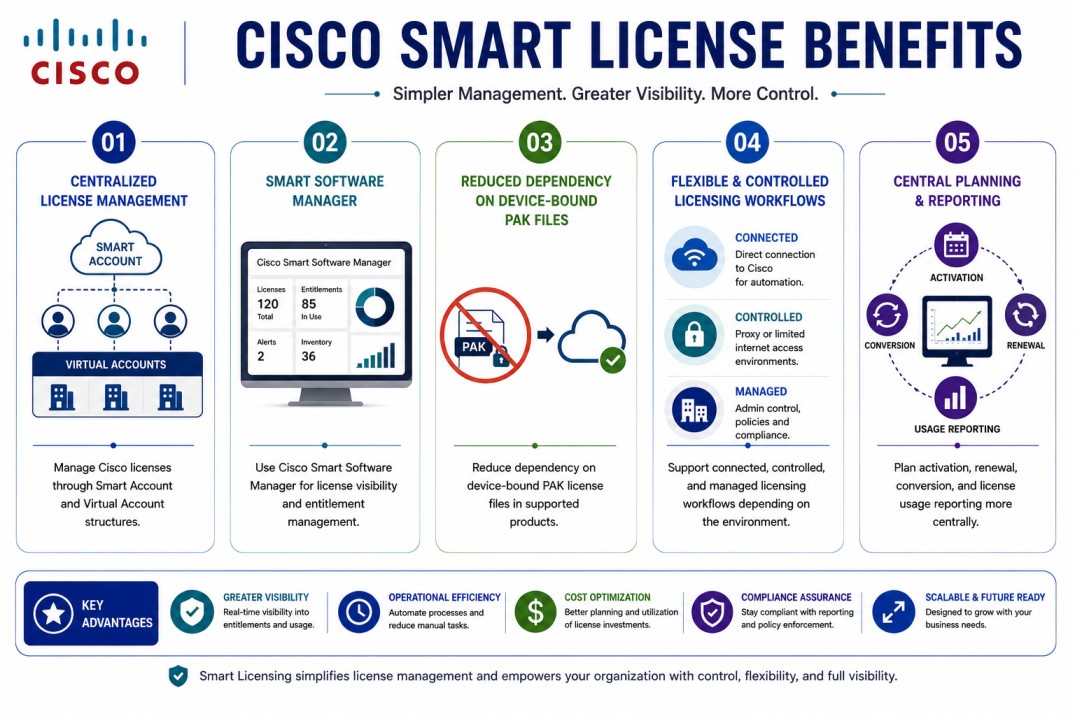
- Manage Cisco licenses through Smart Account and Virtual Account structures
- Use Cisco Smart Software Manager for license visibility and entitlement management
- Reduce dependency on device-bound PAK license files in supported products
- Support connected, controlled, and managed licensing workflows depending on the environment
- Plan activation, renewal, conversion, and license usage reporting more centrally
Cisco Smart License At a glance
What it does : Cisco Smart License helps organizations manage Cisco software licenses, product entitlements, feature access, subscription usage, and renewals from a centralized licensing environment.
License category : Cisco License Model
Main licensing tools : Cisco Smart Account, Virtual Account, Cisco Smart Software Manager, Cisco Software Central, and supported product registration or reporting workflows.
License behavior : Cisco Smart License is generally account-based and entitlement-based, rather than only tied to a single device license file like many Classic licenses.
Where it applies : Cisco networking, security, collaboration, data center, wireless, routing, switching, firewall, SD-WAN, ACI, UC, and software-based products where Smart Licensing is supported.
Who needs it : Organizations that need centralized license visibility, product activation, license assignment, renewal tracking, usage management, or migration from Classic licensing to Smart Licensing.
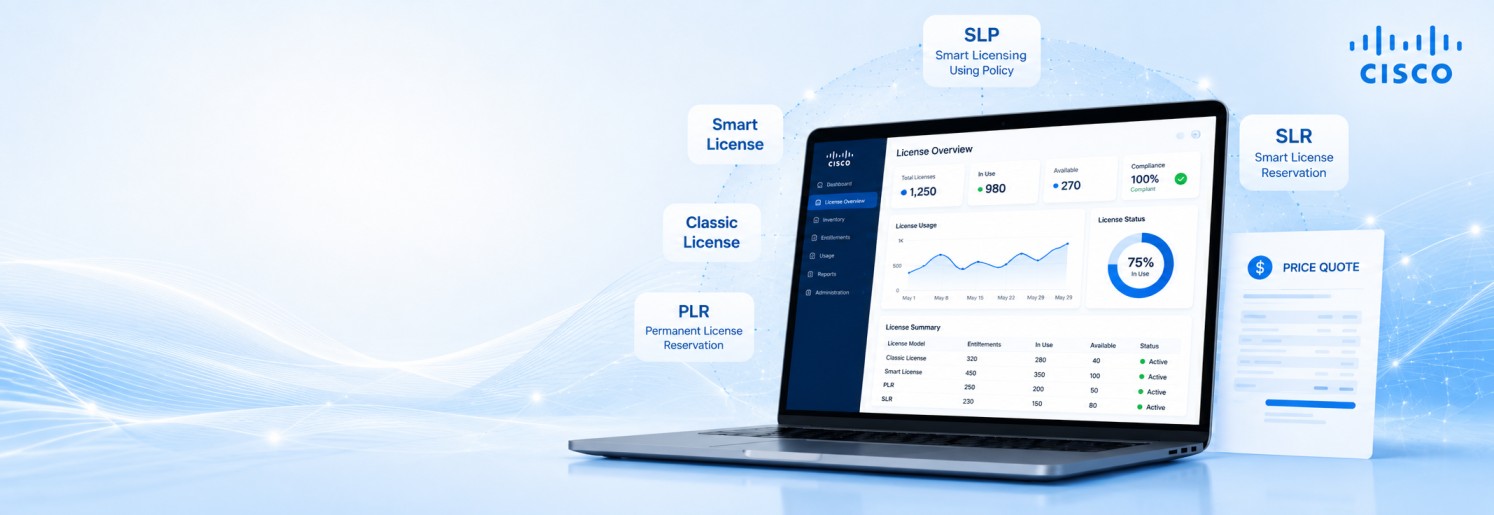
License Model Overview
Cisco Smart License is Cisco’s account-based licensing model for managing software entitlement and product activation more centrally. Instead of handling every license as a separate PAK file tied to one device, Smart Licensing allows organizations to manage entitlements through Cisco Smart Account and Virtual Account structures.
A Smart Account works as the main licensing container for the organization. It helps keep purchased licenses, product instances, subscriptions, and license agreements organized under one account. Virtual Accounts can then be used to separate licenses by department, project, customer, region, product family, or internal business unit.
Cisco Smart Software Manager is the main portal used to view and manage Smart Licenses. Through this portal, administrators can check available entitlements, assigned licenses, product instances, usage status, alerts, and renewal-related information.
Cisco Smart License is useful because many modern Cisco products are no longer managed only through traditional license files. Depending on the product and software version, the device or platform may register to Cisco licensing tools, report usage, or follow a supported Smart Licensing workflow. Across the wider Cisco License portfolio, the Smart License model is especially valuable for organizations managing multiple Cisco products because it centralizes visibility into purchased entitlements, current usage, renewals, and licensing issues.
How Cisco Smart License Works
Cisco Smart License works by connecting Cisco product entitlement to a Smart Account instead of treating every license as an isolated device file. The process usually starts when a Cisco license-enabled product or subscription is purchased and assigned to a Smart Account. The customer or administrator then manages the license inside Cisco Smart Software Manager or another supported Cisco licensing workflow. In many Smart Licensing deployments, a Cisco device or software product registers with Cisco licensing tools through a token or supported registration method. Once the product is registered, license usage can be associated with the correct Smart Account and Virtual Account.
Administrators can then monitor whether the product is authorized, whether enough license entitlement exists, and whether any usage or compliance issue needs attention. This helps reduce confusion when licenses are spread across many devices, sites, or product families. For restricted environments, some customers may use local or controlled licensing methods such as Cisco Smart Software Manager On-Prem. In supported environments, PLR License or SLR License activation options may also be considered where direct connectivity or standard registration is not suitable.
Cisco Smart License Usage, Reporting, and Billing Models
In Cisco Smart Licensing environments, prepaid and postpaid usage depends on the Cisco product, license type, and buying program. Prepaid licensing is the more common model, where the customer purchases the license entitlement before use and then the product reports usage through Cisco Smart Licensing or Smart Licensing Using Policy. Postpaid licensing is mainly associated with Cisco MSLA, where supported product instances consume licenses first and report actual usage for billing and reconciliation. In SLP environments, postpaid usage is handled through Utility Mode. The product generates RUM reports and sends them to Cisco Smart Software Manager (CSSM), Cisco Smart Licensing Utility (CSLU), or Smart Software Manager On-Prem (SSM On-Prem), depending on the deployment topology. CSSM then provides the required RUM acknowledgement, and in postpaid workflows this acknowledgement is an important part of license reporting. Because not every Cisco license supports postpaid usage, the product, subscription ID, Smart Account, and license type should be confirmed before deployment.
Where This License Model Is Used
Cisco Smart License is used across many modern Cisco product families. It can apply to routing, switching, security, wireless, collaboration, data center, SD-WAN, ACI, firewall, UC, and software-based platforms where Smart Licensing is supported. Common examples include Cisco Catalyst switches, Cisco routers, Cisco Secure Firewall, Cisco ISE, Cisco SD-WAN, Cisco ACI, Cisco APIC, Cisco Nexus Dashboard, Cisco Unified Communications products, and other Cisco software or subscription-based solutions.
The exact workflow may differ by product. Some platforms use classic Smart Licensing registration, some use Smart Licensing Using Policy, and some may support local or offline workflows depending on software version and customer environment. This is why Cisco Smart License planning should always start with the exact product name, model, software version, required feature, and connectivity condition. A firewall, router, collaboration server, and data center controller may all use Smart Licensing, but their activation steps may not be identical.
Cisco Smart Activation Workflow
The Cisco Smart License activation process usually follows a structured workflow.
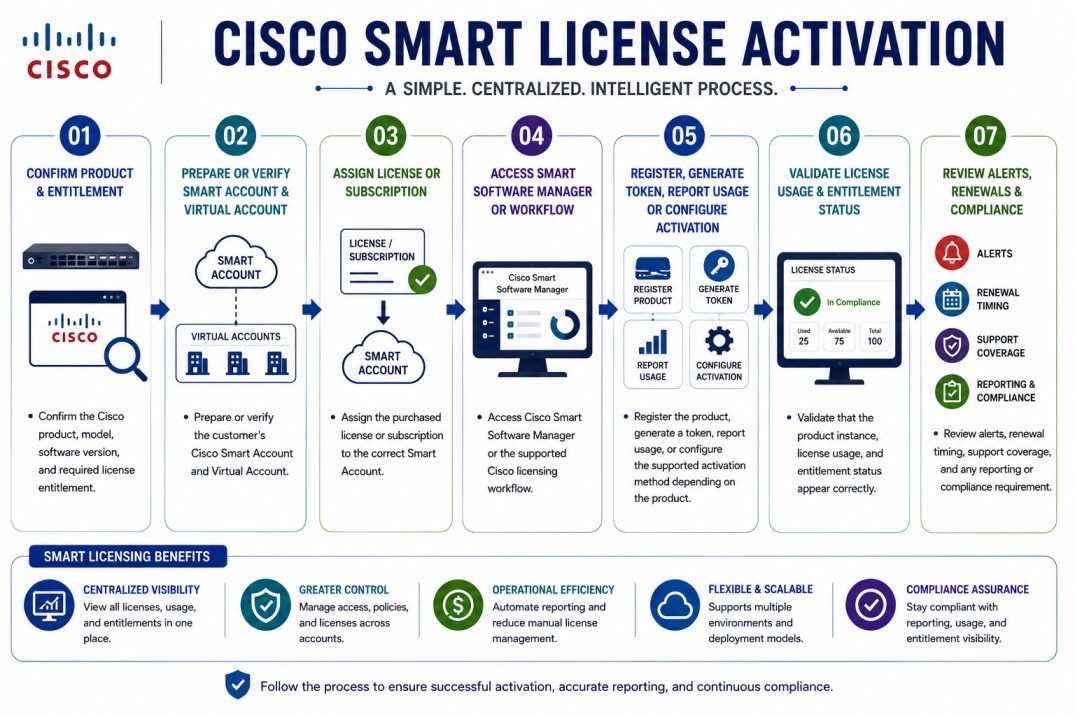
The exact workflow depends on the Cisco product. Some products require registration, some use usage reporting, and some may use Smart Licensing Using Policy instead of the older Smart Licensing behavior.
Features & Benefits
Cisco Smart License helps organizations manage Cisco licensing with better visibility and control. This is useful when a company has multiple Cisco products, different locations, several administrators, or a mix of hardware and software subscriptions. One major benefit is centralized license management. Instead of tracking licenses device by device, administrators can view ownership and usage through Smart Account and Cisco Smart Software Manager.
Another benefit is cleaner organization. Virtual Accounts allow companies to separate licenses by project, department, site, customer, or business unit. This makes it easier to manage large Cisco environments without mixing all licenses into one flat inventory. Cisco Smart License can also help with renewal planning. Since entitlements and product instances are visible in a central system, administrators can better understand which licenses are active, which products are consuming licenses, and which renewals may need attention.
It also supports migration from older licensing models. In some cases, Classic licenses can be converted or managed through Cisco licensing tools, helping organizations move from traditional PAK-based licensing toward a more centralized licensing model. Overall, Cisco Smart License helps reduce license tracking issues, simplify entitlement management, improve visibility, and support long-term Cisco product operations.
System Requirements
Common environments
- Cisco Catalyst switches and routers
- Cisco firewall and security products
- Cisco SD-WAN environments
- Cisco data center products such as ACI, APIC, Nexus, and Nexus Dashboard
- Cisco collaboration and UC platforms
- Cisco wireless and access network products
- Organizations migrating from Classic License to Smart Licensing
- Customers that need centralized license visibility across multiple Cisco products
Technical requirements
- Cisco Smart Account
- Correct Virtual Account structure
- Cisco product name, model, and software version
- Required feature, subscription, or license entitlement
- Access to Cisco Software Central or Cisco Smart Software Manager
- Supported registration, reporting, or activation method
- Connectivity model: direct, proxy, on-prem, restricted, offline, or air-gapped
- Support contract, subscription term, and renewal requirement
Pricing factors + quote process
Pricing for Cisco Smart License depends on the Cisco product, license type, subscription term, feature level, quantity, support coverage, and activation requirement.
A Smart License for a router feature may be priced differently from a firewall subscription, SD-WAN license, UC license, data center license, security service, or collaboration product subscription.
The main pricing factors usually include product family, license SKU, software tier, number of devices or users, subscription duration, support level, Smart Account readiness, and whether the request involves renewal, migration, conversion, or new activation.
During the quote process, the Cisco product and license requirement are reviewed first. Then the Smart Account status, Virtual Account structure, activation method, software version, support coverage, and renewal timing are mapped into the correct quote.
After you request a quote
- We review your Cisco product, model, and software version
- Identify whether Cisco Smart License is the correct licensing model
- Check Smart Account, Virtual Account, activation, renewal, or migration requirements
- Provide pricing, delivery details, and activation guidance
Cisco Smart pricing depends on your license type, deployment model and support requirements.